Smart contract code on monitor with solidity syntax highlighted
1344×768 · AVIF · CC BY 4.0
Smart contracts are self-executing programs on blockchains like Ethereum, written in Solidity, a high-level language with syntax similar to JavaScript.
About this subject
Smart contracts revolutionized how digital agreements are established and executed. They are programs that run exactly as programmed without any possibility of censorship, fraud, or third-party interference. The Solidity language was created specifically for the Ethereum platform, launched in 2015, and has since become the primary language for developing smart contracts on Ethereum Virtual Machine (EVM) compatible blockchains.
Solidity's syntax is influenced by C++, Python, and JavaScript, making it accessible to programmers familiar with these languages. A typical smart contract includes state variables, functions, modifiers, and events. Security is critical: programming errors can lead to significant financial losses, as seen in the 2016 DAO attack, which resulted in an Ethereum hard fork.
Beyond Ethereum, Solidity is used on blockchains like Binance Smart Chain, Polygon, and Avalanche. The language evolves constantly; version 0.8.0 introduced default overflow checks. Tools like Remix IDE, Truffle, and Hardhat aid in development and testing, while standards like ERC-20 and ERC-721 define interfaces for fungible and non-fungible tokens, respectively.
Smart contract adoption has expanded into decentralized finance (DeFi), non-fungible tokens (NFTs), supply chains, and decentralized governance. Despite challenges like scalability and transaction costs (gas fees), the technology evolves with layer-2 solutions and new blockchains. Once deployed, smart contract code is immutable, requiring rigorous auditing before deployment.
Frequently Asked Questions
What is Solidity and what is it used for?
Solidity is a high-level contract-oriented programming language designed for developing smart contracts on the Ethereum platform and other EVM-compatible blockchains.
What are the main security risks in smart contracts?
Main risks include reentrancy, integer overflow, unauthorized access, and logic errors. Rigorous audits and testing are essential to mitigate vulnerabilities.
How are smart contracts executed?
They are executed by the Ethereum Virtual Machine (EVM) when a transaction is sent to the contract's address. Each operation consumes gas, and the result is recorded on the blockchain.
Direct URL
https://pub-c7d6a6ea828543ac903a74a341ccb2e1.r2.dev/imagens/smart-contract-code-on-monitor-with-solidity-syntax-highlighted-closeup-macro-shot-golden-hour-late-afternoon.avifHow to credit
Include a visible link back to UtilizAí. Copy one of the snippets below:
<a href="https://xn--utiliza-eza.com/en/midia/imagens/smart-contract-code-on-monitor-with-solidity-syntax-highlighted-closeup-macro-shot-golden-hour-late-afternoon">Smart contract code on monitor with solidity syntax highlighted</a> by <a href="https://xn--utiliza-eza.com">UtilizAí</a>, licensed under <a href="https://creativecommons.org/licenses/by/4.0/">CC BY 4.0</a>.
[Smart contract code on monitor with solidity syntax highlighted](https://xn--utiliza-eza.com/en/midia/imagens/smart-contract-code-on-monitor-with-solidity-syntax-highlighted-closeup-macro-shot-golden-hour-late-afternoon) by [UtilizAí](https://xn--utiliza-eza.com), CC BY 4.0
License: CC-BY-4.0
Tags
Related images
 Smart contract code on monitor with solidity syntax highlighted
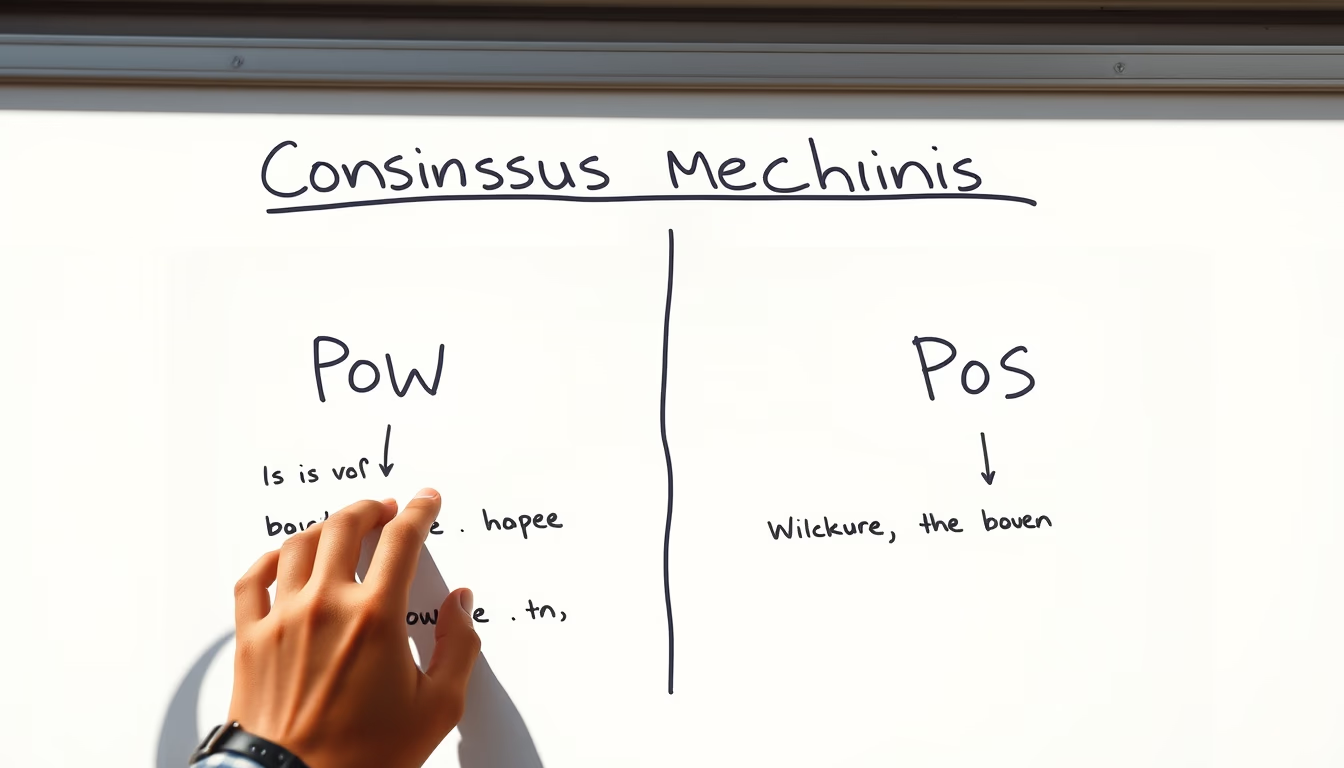 Consensus mechanism diagram on whiteboard showing PoW vs PoS
 Distributed ledger multiple servers in data center
 Hash function visualization cryptographic equations on glass screen
 Hash function visualization cryptographic equations on glass screen
 Hash function visualization cryptographic equations on glass screen