Salar de uyuni reflection
1344×768 · AVIF · CC BY 4.0
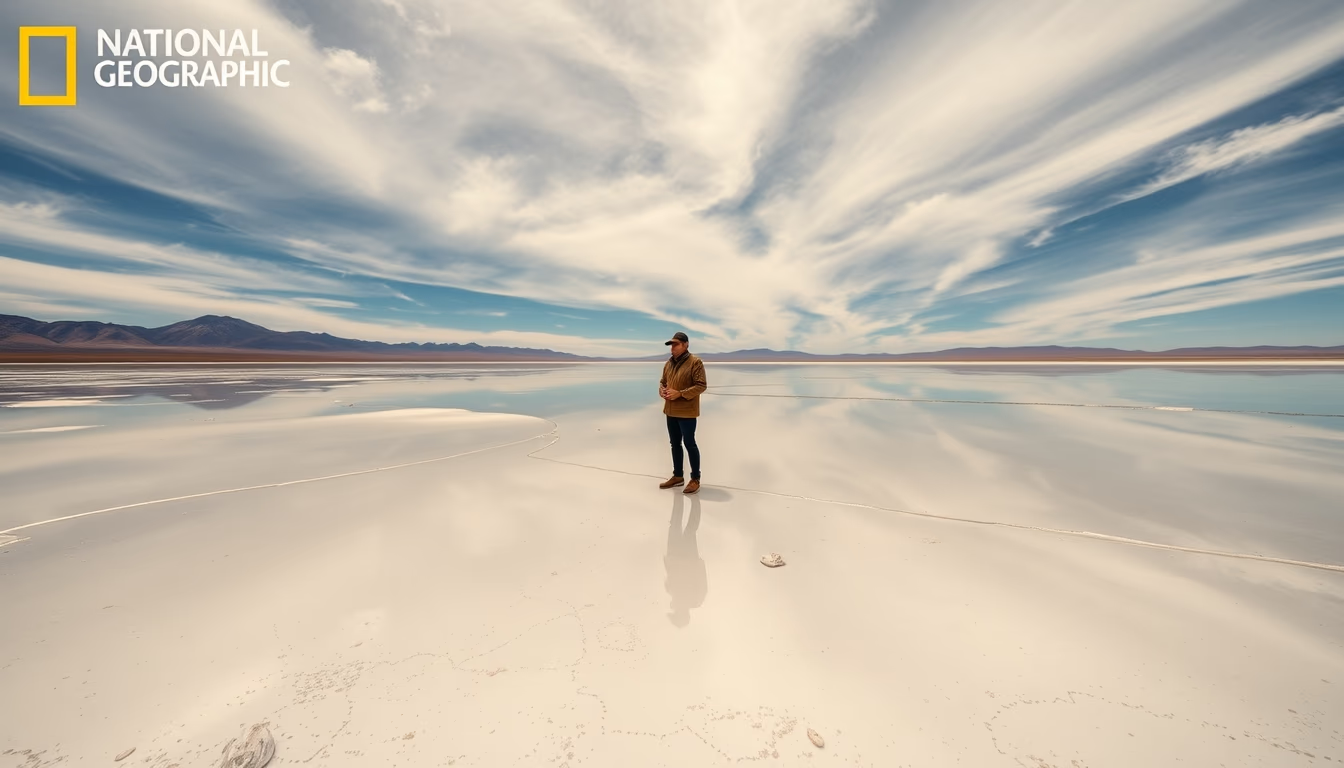
Salar de Uyuni in Bolivia is the world's largest salt flat, famous for its mirror effect during the rainy season, creating a reflected sky on the ground.
About this subject
Salar de Uyuni is located in southwestern Bolivia, in the Antonio Quijarro Province, Potosí Department, at an elevation of approximately 3,656 meters. Spanning over 10,000 km², it is the largest salt flat on Earth, formed from the evaporation of prehistoric lakes such as Lake Minchin, which dried up about 40,000 years ago. Its salt crust, which can reach up to 10 meters in thickness, covers a brine layer rich in lithium, potassium, and boron, making the region one of the world's largest lithium reserves.
During the rainy season, from December to April, a thin layer of water covers the flat surface, transforming it into a giant natural mirror. This phenomenon attracts photographers and tourists worldwide, as the reflection of the cloudy or starry sky creates a surreal landscape where the horizon disappears. Incahuasi Island, a rocky outcrop covered in giant cacti, emerges from the salt flat and offers a panoramic view of this white sea.
Culturally, Salar de Uyuni is sacred to the Aymara people, who call it "Tunupa" after an Andean deity. Salt extraction is a traditional activity, and local communities produce handicrafts such as vases and sculptures carved from salt. The site also serves as a base for expeditions to the Atacama Desert and southwestern Bolivia, including colorful lagoons and geysers.
Scientifically, the salt flat is used for calibrating satellite altimeters due to its extreme flatness. The elevation variation across its entire extent is less than 1 meter, making it the flattest place on Earth. Additionally, the subsurface brine contains about 70% of the world's lithium reserves, a key element for electric vehicle batteries, sparking debates about economic exploitation and environmental preservation.
Frequently Asked Questions
Why does Salar de Uyuni reflect the sky like a mirror?
During the rainy season, a thin layer of water covers the perfectly flat surface, creating a specular reflection. The extreme flatness, with elevation variation less than 1 meter, allows the water to form a giant natural mirror.
What is the importance of Salar de Uyuni for the tech industry?
The salt flat holds one of the world's largest lithium reserves, a key element for batteries in smartphones, laptops, and electric cars. About 70% of global lithium is estimated to lie beneath its salt crust.
Is it safe to visit Salar de Uyuni?
Yes, but precautions are needed. During the dry season, the surface is hard and safe for vehicles. In the rain, the water layer can hide holes, so experienced guides are recommended. The altitude requires acclimatization to avoid altitude sickness.
Direct URL
https://pub-c7d6a6ea828543ac903a74a341ccb2e1.r2.dev/imagens/salar-de-uyuni-reflection-national-geographic-style-p0.avifHow to credit
Include a visible link back to UtilizAí. Copy one of the snippets below:
<a href="https://xn--utiliza-eza.com/en/midia/imagens/salar-de-uyuni-reflection-national-geographic-style-p0">Salar de uyuni reflection</a> by <a href="https://xn--utiliza-eza.com">UtilizAí</a>, licensed under <a href="https://creativecommons.org/licenses/by/4.0/">CC BY 4.0</a>.
[Salar de uyuni reflection](https://xn--utiliza-eza.com/en/midia/imagens/salar-de-uyuni-reflection-national-geographic-style-p0) by [UtilizAí](https://xn--utiliza-eza.com), CC BY 4.0
License: CC-BY-4.0