Salar de uyuni reflection
1344×768 · AVIF · CC BY 4.0
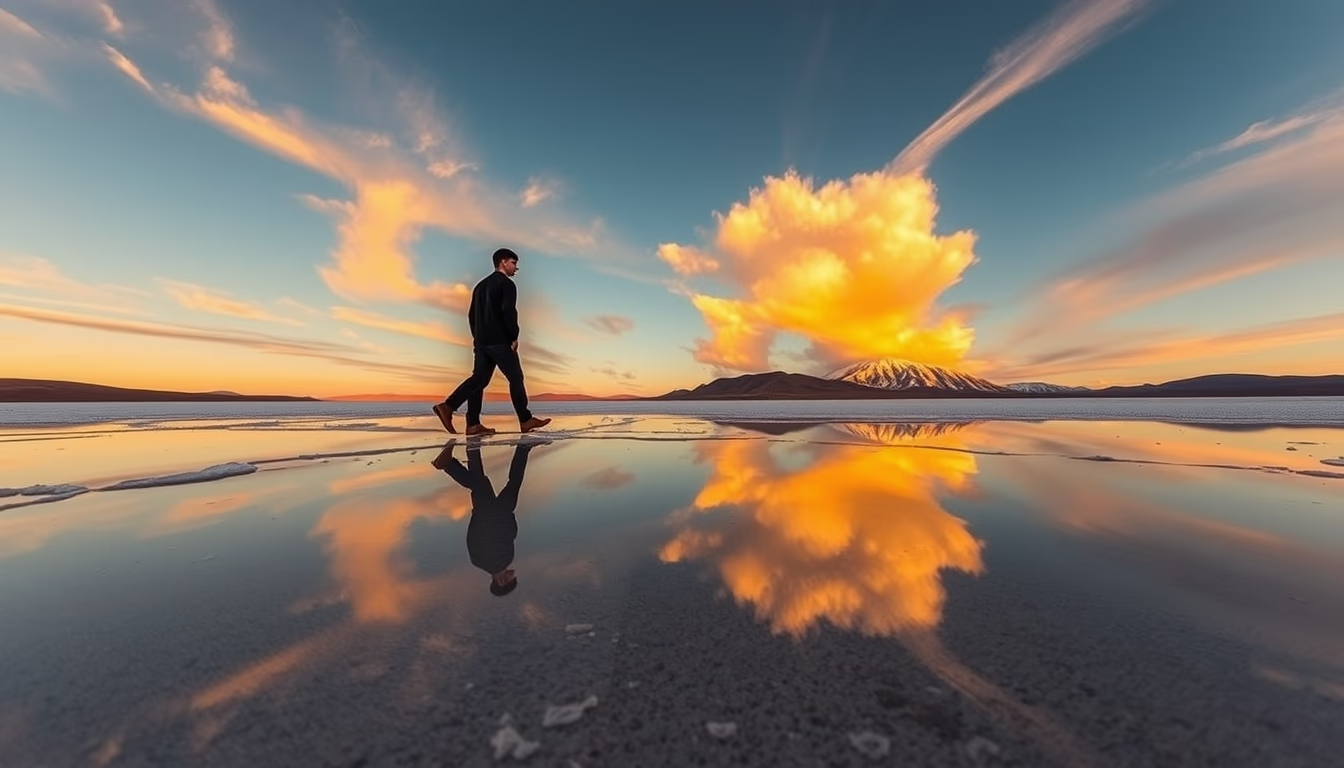
Salar de Uyuni in Bolivia is the world's largest salt flat, famous for its mirror effect during the rainy season.
About this subject
Salar de Uyuni is located in southwestern Bolivia, in the Potosí department, covering an area of over 10,000 km². It formed from the evaporation of prehistoric lakes thousands of years ago, leaving a salt crust that can be tens of meters thick. During the rainy season from January to March, a thin layer of water covers the surface, creating a perfect reflection of the sky, a phenomenon that attracts photographers and tourists worldwide.
Geologically, the salt flat is one of the flattest surfaces on Earth, with an altitude variation of less than one meter across its entire expanse. This feature makes it an ideal site for satellite calibration and remote sensing studies. Moreover, Salar de Uyuni holds about 70% of the world's known lithium reserves, a critical resource for battery production, giving it strategic global importance.
Culturally, the salt flat is surrounded by unique landscapes, such as Isla Incahuasi, a fossilized coral island covered by giant cacti up to 12 meters tall. The region also hosts Andean flamingos that feed on crustaceans in nearby lagoons. During the dry season, the ground forms characteristic hexagonal patterns from salt crystallization.
Visiting Salar de Uyuni combines science, nature, and adventure. Tours depart from the town of Uyuni and include stops at the Train Cemetery, Laguna Colorada, and Laguna Verde. The mirror effect is most intense at the peak of the rainy season, but the salt flat offers stunning scenery throughout the year.
Frequently Asked Questions
What causes the mirror effect at Salar de Uyuni?
The mirror effect happens when a thin layer of water covers the salt crust during the rainy season, creating a nearly perfect reflection of the sky and clouds.
What is the altitude of Salar de Uyuni?
Salar de Uyuni lies at about 3,656 meters above sea level on the Bolivian Altiplano.
Is Salar de Uyuni dangerous to visit?
It is generally safe, but guided tours are recommended due to extreme weather, the risk of getting lost in the white expanse, and the need to navigate the salt surface.
Direct URL
https://pub-c7d6a6ea828543ac903a74a341ccb2e1.r2.dev/imagens/salar-de-uyuni-reflection-cinematic-wide-shot-p11.avifHow to credit
Include a visible link back to UtilizAí. Copy one of the snippets below:
<a href="https://xn--utiliza-eza.com/en/midia/imagens/salar-de-uyuni-reflection-cinematic-wide-shot-p11">Salar de uyuni reflection</a> by <a href="https://xn--utiliza-eza.com">UtilizAí</a>, licensed under <a href="https://creativecommons.org/licenses/by/4.0/">CC BY 4.0</a>.
[Salar de uyuni reflection](https://xn--utiliza-eza.com/en/midia/imagens/salar-de-uyuni-reflection-cinematic-wide-shot-p11) by [UtilizAí](https://xn--utiliza-eza.com), CC BY 4.0
License: CC-BY-4.0