Pixel art retro game
1344×768 · AVIF · CC BY 4.0
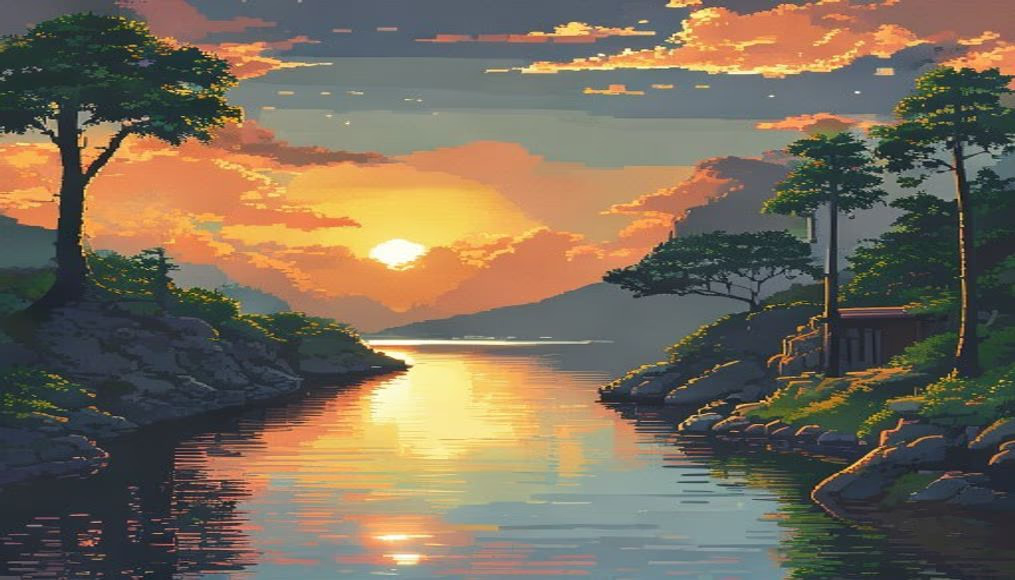
Pixel art in retro games: the art that defined an era of 8-bit and 16-bit consoles and still inspires developers today.
About this subject
Pixel art emerged as a technical necessity in early home video games, such as the Atari 2600 and the Nintendo Entertainment System (NES). With very low resolutions, typically 256x240 pixels, and palettes limited to 256 colors, artists had to create expressive characters, scenarios, and animations with every pixel counting. This constraint gave rise to a unique visual style that defined generations.
Key figures like Yoichi Kotabe (animator for Super Mario Bros. and Metroid) and Masami Hirata (Castlevania) developed techniques such as dithering, manual anti-aliasing, and thick sprite outlines to convey depth. Games like The Legend of Zelda (1986), Mega Man 2 (1988), and Chrono Trigger (1995) are prime examples of how pixel art could deliver atmosphere, emotion, and entire worlds with just a few pixels.
With the rise of 3D graphics, pixel art was abandoned by the mainstream industry but found new life in indie games starting in the 2000s. Titles such as Cave Story (2004), Super Meat Boy (2010), and Stardew Valley (2016) proved the style is still commercially viable and artistically relevant. Today, pixel art is celebrated in exhibitions, chiptune music, and online communities that keep the retro aesthetic alive.
Interestingly, pixel art has also influenced other fields, like typography (bitmap fonts) and contemporary digital art. Artists like eBoy create gigantic pixel art mosaics with millions of pixels, demonstrating that technical limitations have transformed into a distinctive artistic language.
Frequently Asked Questions
Why did old games use pixel art?
Due to hardware limitations of 1980s and 1990s consoles and computers, which had little memory and processing power. Pixel art was the most efficient way to display colorful graphics with minimal resources.
How did artists create characters with so few pixels?
They used techniques like black outlines to define shapes, dithering to simulate gradients, and contrasting colors to highlight details. Each pixel was placed manually, often on 8x8 or 16x16 grids.
Is pixel art still used in modern games?
Yes, especially in indie games seeking a retro aesthetic or nostalgia. Successful examples include Stardew Valley, Celeste, and Shovel Knight. Pixel art is also used in mobile games and projects with low production budgets.
Direct URL
https://pub-c7d6a6ea828543ac903a74a341ccb2e1.r2.dev/imagens/pixel-art-retro-game-travel-photography-v10.avifHow to credit
Include a visible link back to UtilizAí. Copy one of the snippets below:
<a href="https://xn--utiliza-eza.com/en/midia/imagens/pixel-art-retro-game-travel-photography-v10">Pixel art retro game</a> by <a href="https://xn--utiliza-eza.com">UtilizAí</a>, licensed under <a href="https://creativecommons.org/licenses/by/4.0/">CC BY 4.0</a>.
[Pixel art retro game](https://xn--utiliza-eza.com/en/midia/imagens/pixel-art-retro-game-travel-photography-v10) by [UtilizAí](https://xn--utiliza-eza.com), CC BY 4.0
License: CC-BY-4.0