Indian devanagari sanskrit
1344×768 · AVIF · CC BY 4.0
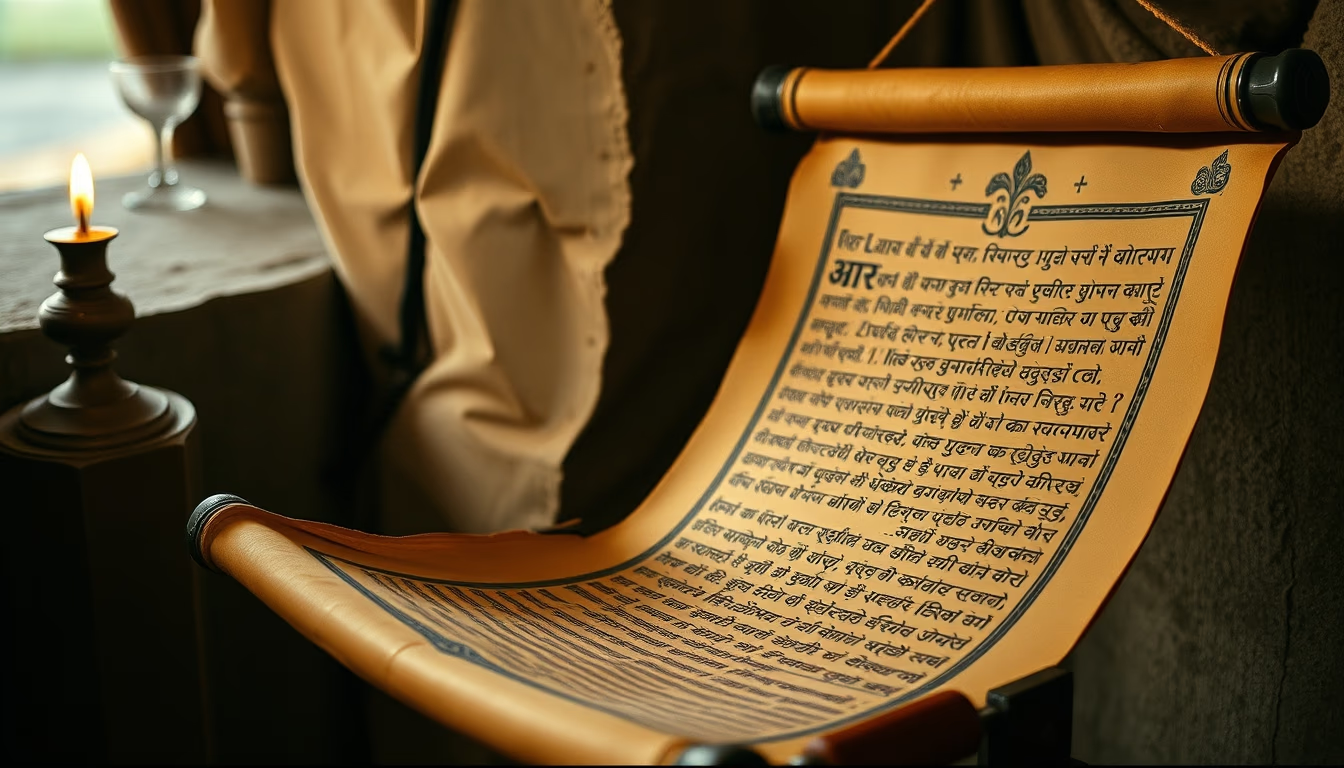
Devanagari script, used for Sanskrit and several Indian languages, is one of the oldest writing systems in continuous use, originating in the 7th century.
About this subject
Devanagari is an abugida script that evolved from the Brahmi script around the 7th century CE. It is used to write Sanskrit, Hindi, Marathi, Konkani, Nepali, and several other languages of India and Nepal. The name 'Devanagari' means 'script of the city of gods,' reflecting its association with sacred Hindu texts such as the Vedas and Upanishads.
A distinctive feature of Devanagari is the continuous horizontal line running along the top of the characters, which connects letters within a word. It is a syllabic system where each consonant carries an inherent vowel (short a), which can be modified by diacritical marks. The script is phonetic and highly regular, enabling precise pronunciation of texts.
Historically, Sanskrit served as the lingua franca of ancient India, used in philosophy, science, literature, and religion. Major works like the Mahabharata, Ramayana, and Ayurvedic texts were composed in Sanskrit and preserved in Devanagari manuscripts. Today, Sanskrit is studied as a classical and liturgical language, with revivalist efforts in some communities.
From a calligraphic perspective, Devanagari boasts a rich tradition of styles, ranging from formal, angular scripts to cursive and decorative forms. Devanagari calligraphy is practiced in religious and artistic contexts, with techniques varying between brush, pen, and traditional tools. Unicode has allocated the block U+0900, U+097F for digital representation, ensuring the script's preservation in the modern era.
Frequently Asked Questions
What is the Devanagari script?
Devanagari is an abugida script used for Sanskrit, Hindi, and other Indian languages. It originated around the 7th century CE and is characterized by a horizontal line at the top of letters.
Which languages use Devanagari?
Devanagari is used for Sanskrit, Hindi, Marathi, Konkani, Nepali, and several other languages of India and Nepal. It is the fourth most widely used script globally, with over 600 million speakers.
What is the importance of Sanskrit in Indian culture?
Sanskrit is the classical language of India, the basis of religious texts (Vedas, Upanishads), philosophy, and literature (Mahabharata, Ramayana). It has influenced many modern Indian languages and is studied as a liturgical and academic language.
Direct URL
https://pub-c7d6a6ea828543ac903a74a341ccb2e1.r2.dev/imagens/indian-devanagari-sanskrit-film-grain-authentic-fresh12.avifHow to credit
Include a visible link back to UtilizAí. Copy one of the snippets below:
<a href="https://xn--utiliza-eza.com/en/midia/imagens/indian-devanagari-sanskrit-film-grain-authentic-fresh12">Indian devanagari sanskrit</a> by <a href="https://xn--utiliza-eza.com">UtilizAí</a>, licensed under <a href="https://creativecommons.org/licenses/by/4.0/">CC BY 4.0</a>.
[Indian devanagari sanskrit](https://xn--utiliza-eza.com/en/midia/imagens/indian-devanagari-sanskrit-film-grain-authentic-fresh12) by [UtilizAí](https://xn--utiliza-eza.com), CC BY 4.0
License: CC-BY-4.0