Icebreaker arctic ship
1344×768 · AVIF · CC BY 4.0
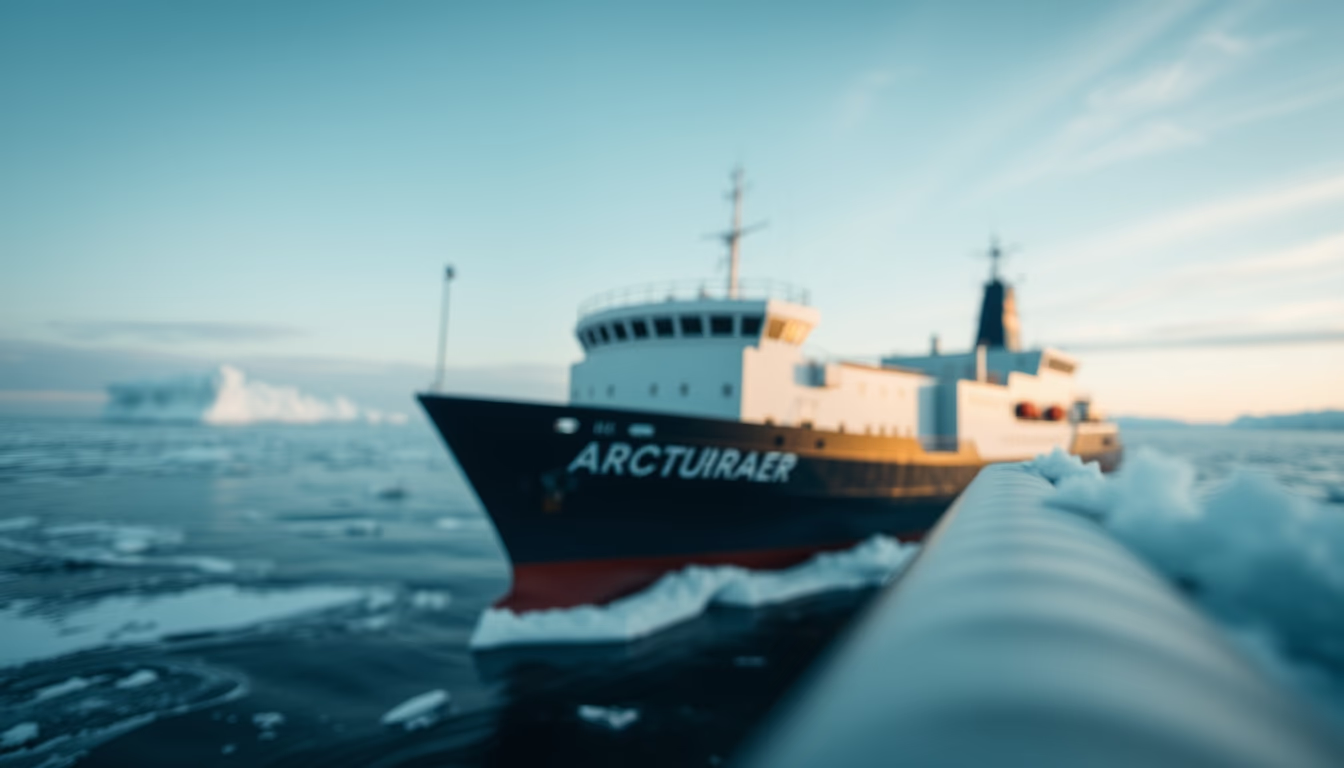
An icebreaker ship designed to navigate through ice-covered waters, crucial for Arctic and Antarctic maritime routes.
About this subject
Icebreakers are specialized ships designed to navigate through ice-covered waters, creating and maintaining channels for other vessels. They operate primarily in polar regions like the Arctic Ocean, where sea ice can reach thicknesses of several meters. Their hulls are reinforced with high-strength steel and feature curved shapes to ride over ice and break it under the vessel's weight.
Russia, the largest Arctic nation, operates the world's most powerful fleet of nuclear icebreakers, including the 50 Let Pobedy (50 Years of Victory), capable of breaking ice up to 2.8 meters thick. These ships are powered by nuclear reactors, providing long endurance in extreme conditions. Other countries like Canada, the United States, and Norway operate diesel or hybrid icebreakers for resupplying remote communities, scientific research, and sovereignty patrols.
Historically, Arctic exploration relied on these vessels. In 1899, the Russian icebreaker Yermak became the first to reach the North Pole. Today, melting ice due to climate change has opened new commercial routes like the Northern Sea Route, increasing demand for modern icebreakers. However, operations require crews trained for subzero temperatures, ice navigation, and potential encounters with polar bears.
Icebreakers also play a critical role in science, supporting climate, oceanographic, and marine biology expeditions. For example, the German Polarstern is a research icebreaker conducting annual Arctic missions, gathering data on polar ecosystems. Without these ships, safe access to polar regions would be nearly impossible, limiting trade, research, and national security.
Frequently Asked Questions
What is the difference between a nuclear and a diesel icebreaker?
Nuclear icebreakers use atomic reactors for power, offering long endurance and high strength for thick ice. Diesel icebreakers are more common and flexible but require frequent refueling and have lower icebreaking capacity.
How many icebreakers does Russia have?
Russia operates the largest fleet, about 40 icebreakers, including nuclear ones. In 2024, it launched new vessels like Arktika to modernize its Arctic capability.
How do icebreakers support scientific research?
They transport scientists and equipment to polar regions for studying climate, sea ice, ocean currents, and wildlife. Many have onboard laboratories, like the Polarstern, which conducts annual Arctic expeditions.
Direct URL
https://pub-c7d6a6ea828543ac903a74a341ccb2e1.r2.dev/imagens/icebreaker-arctic-ship-macro-closeup-p8.avifHow to credit
Include a visible link back to UtilizAí. Copy one of the snippets below:
<a href="https://xn--utiliza-eza.com/en/midia/imagens/icebreaker-arctic-ship-macro-closeup-p8">Icebreaker arctic ship</a> by <a href="https://xn--utiliza-eza.com">UtilizAí</a>, licensed under <a href="https://creativecommons.org/licenses/by/4.0/">CC BY 4.0</a>.
[Icebreaker arctic ship](https://xn--utiliza-eza.com/en/midia/imagens/icebreaker-arctic-ship-macro-closeup-p8) by [UtilizAí](https://xn--utiliza-eza.com), CC BY 4.0
License: CC-BY-4.0