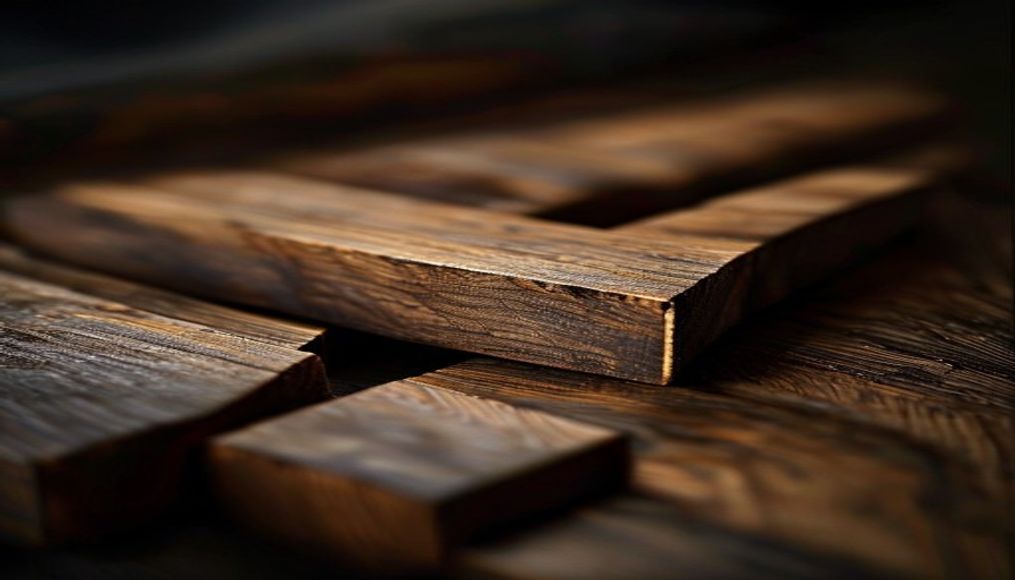
Finger joint clean
1344×768 · AVIF · CC BY 4.0
The finger joint, also known as a box joint, is a woodworking technique that joins pieces of wood with complementary rectangular cutouts, providing strength and a clean aesthetic.
About this subject
The finger joint, also known as a box joint, is a woodworking technique used to join two pieces of wood at a right angle. It consists of a series of rectangular cutouts in each piece that fit perfectly together. Unlike a butt joint, which relies only on glue and nails, the finger joint provides a large gluing surface area, resulting in an extremely strong bond. It is commonly used in drawers, boxes, furniture, and even wooden structures.
The origin of the finger joint dates back to early woodworking, but it gained popularity with the advent of power tools such as routers and table saws, which allow precise and repetitive cuts. Variations include the blind finger joint (where the fingers are not visible on the outside) and the through finger joint (where the fingers are visible). The finger joint is often confused with the dovetail joint, but the latter has trapezoidal shapes and is more complex to execute.
In modern woodworking, the finger joint is valued for its minimalist aesthetic and functionality. It eliminates the need for screws or nails, and its clean, symmetrical appearance is appreciated in contemporary designs. Moreover, it is very efficient for woods like plywood and MDF, as it maximizes the glue contact area. A curious fact: the finger joint is also called "box joint" because of its frequent use in building boxes.
To cut a finger joint, a woodworker can use a dedicated jig attached to a router or table saw, or cut manually with a dovetail saw and chisel. Precision is key: too-loose fingers weaken the joint, while too-tight fingers may split the wood. The depth of the cuts is usually equal to the thickness of the wood, ensuring the pieces are flush after assembly.
Frequently Asked Questions
What is the difference between a finger joint and a dovetail joint?
A finger joint has rectangular cuts, while a dovetail joint has trapezoidal shapes. The dovetail offers better resistance to pulling forces but is more difficult to execute. The finger joint is simpler and faster to make.
What tools are needed to make a finger joint?
Common tools include a router with a finger joint jig, a table saw with a similar jig, or hand tools like a dovetail saw and chisel. Using a jig ensures precise and repeatable cuts.
Is a finger joint strong enough for furniture?
Yes, it is very strong due to the large gluing surface area. It is ideal for drawers, boxes, and structures that do not endure heavy lateral stress. For maximum strength, use good quality wood glue and well-fitted wood.
Direct URL
https://pub-c7d6a6ea828543ac903a74a341ccb2e1.r2.dev/imagens/finger-joint-clean-minimalist-composition-p2.avifHow to credit
Include a visible link back to UtilizAí. Copy one of the snippets below:
<a href="https://xn--utiliza-eza.com/en/midia/imagens/finger-joint-clean-minimalist-composition-p2">Finger joint clean</a> by <a href="https://xn--utiliza-eza.com">UtilizAí</a>, licensed under <a href="https://creativecommons.org/licenses/by/4.0/">CC BY 4.0</a>.
[Finger joint clean](https://xn--utiliza-eza.com/en/midia/imagens/finger-joint-clean-minimalist-composition-p2) by [UtilizAí](https://xn--utiliza-eza.com), CC BY 4.0
License: CC-BY-4.0