Catamaran tropical
1344×768 · AVIF · CC BY 4.0
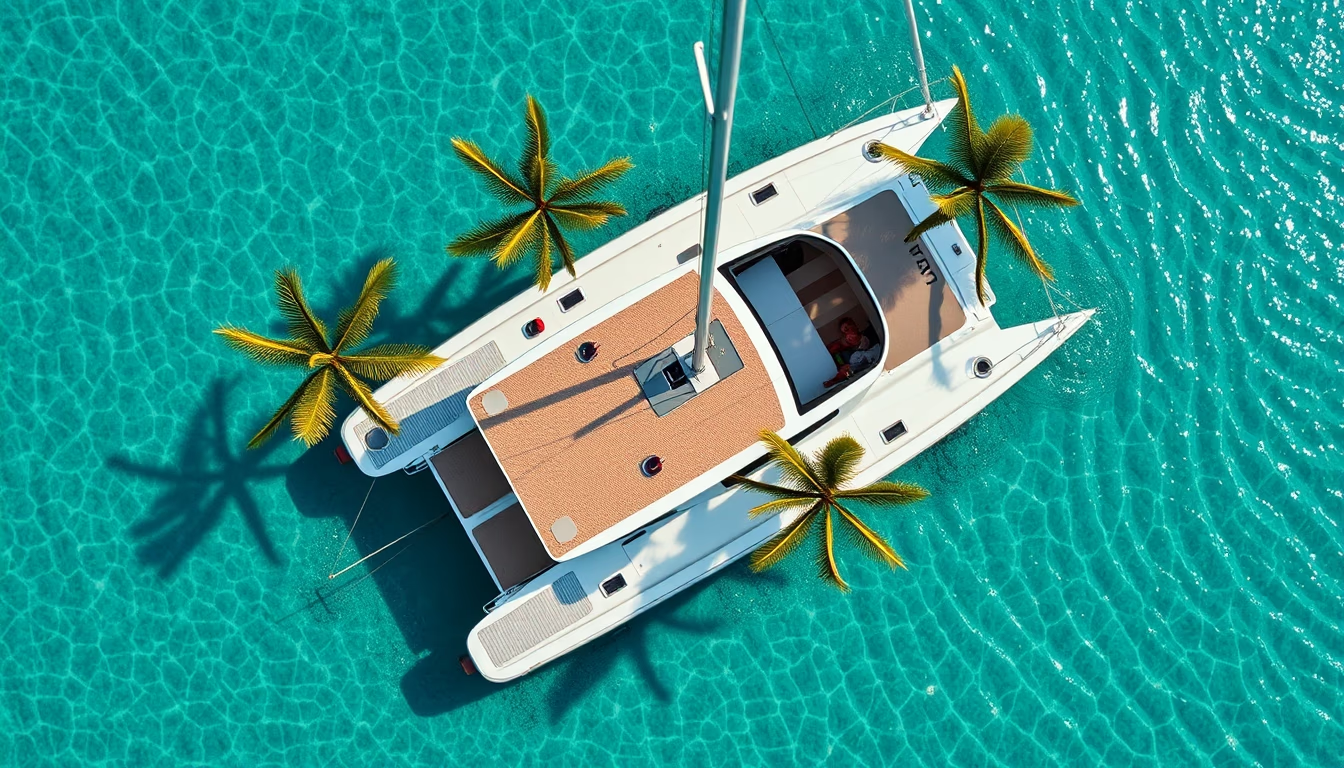
Tropical catamarans combine stability, space and efficiency for warm-water navigation, popular in island tourism.
About this subject
The catamaran, with its twin hulls, is particularly suited for tropical environments due to its stability, shallow draft, and spacious deck area. In regions like the Caribbean, northeastern Brazil, and Southeast Asia, catamarans are widely used for tourist excursions, luxury charters, and inter-island transportation. Their ability to navigate shallow waters makes them ideal for coral reefs and protected bays.
The dual-hull design offers advantages over traditional monohulls: lower resistance to motion, greater living space, and absence of severe rolling, reducing seasickness in passengers. Modern models such as the Lagoon 42 and Fountaine Pajot Saona 47 incorporate self-tacking sails, outboard engines, and solar panels, making sailing more sustainable and comfortable. Many of these boats are built with lightweight composites like fiberglass and carbon fiber, which resist salt corrosion and tropical heat.
In Brazilian tourism, destinations like Fernando de Noronha, Abrolhos, and the coast of Alagoas offer catamaran tours with stops for snorkeling and marine life observation. The capacity to carry 20 to 50 passengers allows operators to run daily excursions at competitive costs. Additionally, catamarans are often used in ocean sailing competitions, such as the Rio-Fernando de Noronha regatta, where their speed in moderate winds outperforms monohull sailboats.
Curiously, the term 'catamaran' comes from the Tamil 'kattumaram', meaning 'tied logs', referring to the ancient rafts of southern India and Sri Lanka. This indigenous technology was adapted by Europeans in the 20th century to create modern recreational vessels. Today, the largest catamarans, such as the 'Hodgdon Yachts 86', exceed 25 meters in length and offer air-conditioned suites, desks, and even helipads.
Frequently Asked Questions
What is the difference between a catamaran and a monohull?
A catamaran has two parallel hulls, providing greater lateral stability, less rolling, and more interior space compared to a monohull of the same length. A monohull has a single hull, more prone to heeling, but with better upwind performance in strong winds.
Are catamarans suitable for shallow waters?
Yes, due to their shallow draft (the submerged part of the hulls), catamarans can navigate in depths of 1 to 2 meters, ideal for reefs, lagoons, and shallow coastal areas.
How much does a medium-sized tourist catamaran cost in Brazil?
A new catamaran of 12 to 15 meters (40 to 50 feet) for tourist excursions typically costs between R$ 2 million and R$ 5 million, depending on the manufacturer, finishings, and onboard equipment.
Direct URL
https://pub-c7d6a6ea828543ac903a74a341ccb2e1.r2.dev/imagens/catamaran-tropical-isometric-flat-lay-p12.avifHow to credit
Include a visible link back to UtilizAí. Copy one of the snippets below:
<a href="https://xn--utiliza-eza.com/en/midia/imagens/catamaran-tropical-isometric-flat-lay-p12">Catamaran tropical</a> by <a href="https://xn--utiliza-eza.com">UtilizAí</a>, licensed under <a href="https://creativecommons.org/licenses/by/4.0/">CC BY 4.0</a>.
[Catamaran tropical](https://xn--utiliza-eza.com/en/midia/imagens/catamaran-tropical-isometric-flat-lay-p12) by [UtilizAí](https://xn--utiliza-eza.com), CC BY 4.0
License: CC-BY-4.0