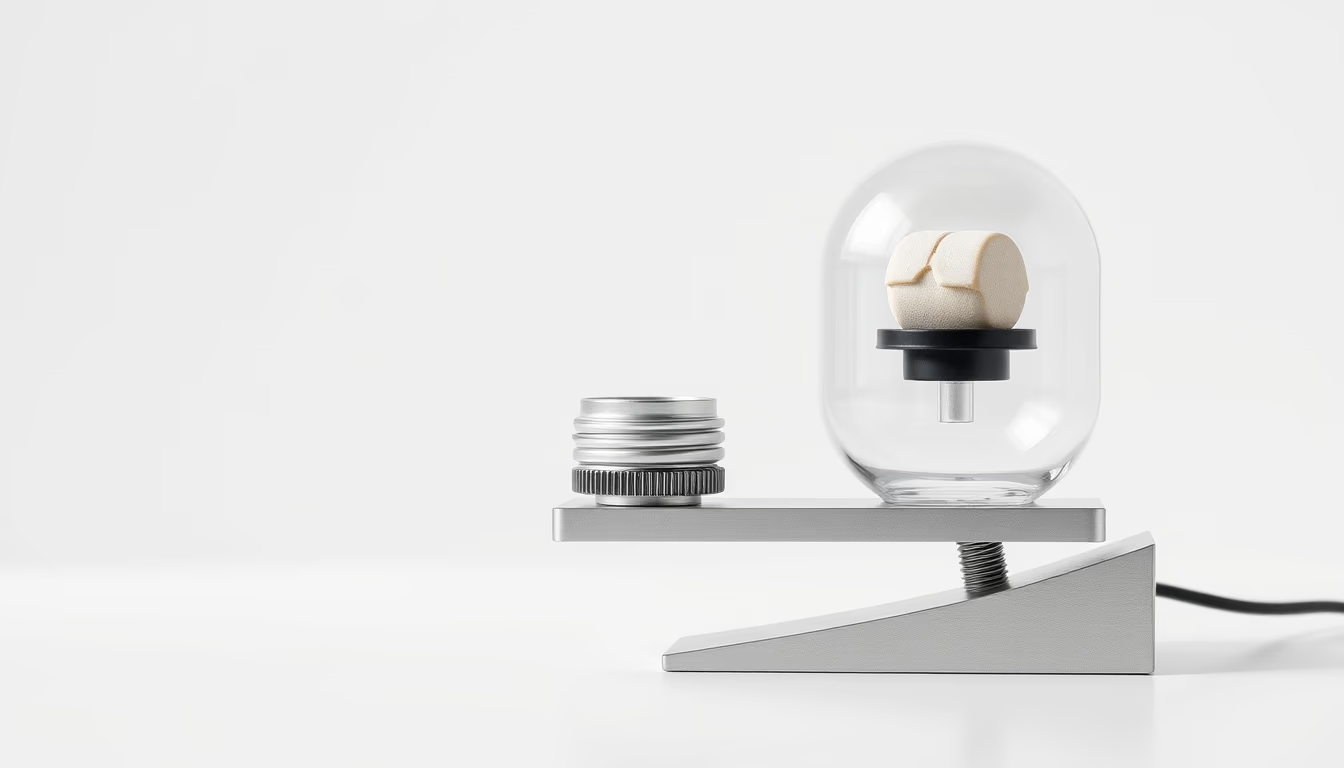
Analytical balance closeup
1344×768 · AVIF · CC BY 4.0

Discover how an analytical balance works, an essential laboratory instrument for mass measurements with precision up to 0.0001 g.
About this subject
An analytical balance is a high-precision mass measuring instrument, typically with a resolution of 0.1 mg (0.0001 g) and a maximum capacity between 100 g and 200 g. Its operating principle relies on electromagnetic force compensation: an electromagnetic force counterbalances the weight of the sample, measured by a load cell or similar mechanism. Unlike semi-analytical balances, which have a precision of 0.001 g, the analytical balance requires controlled environmental conditions, such as absence of drafts, stable temperature, and a level surface, hence its protective glass chamber.
These instruments are essential in chemistry, pharmaceutical, and quality control laboratories, where small mass variations can compromise experimental results or formulations. Periodic calibration is mandatory, typically performed with certified standard weights following standards like ISO 17025. Many modern models feature automatic internal calibration, adjusting to temperature changes.
A technical curiosity is that the analytical balance uses a stabilization algorithm to ensure reliable readings, ignoring momentary vibrations. The extreme precision requires the operator to close the chamber doors and wait a few seconds until the value stabilizes. It is also recommended to use tweezers or spatulas to handle samples, avoiding direct hand contact.
The evolution of analytical balances includes digital interfaces, computer connectivity, and data management software, facilitating recording and traceability of measurements. Some models allow measurements below 0.1 mg, called microbalances, used in nanotechnology and materials research. Understanding these details helps appreciate the importance of the analytical balance in modern science.
Frequently Asked Questions
What is the difference between an analytical balance and a semi-analytical balance?
An analytical balance has a precision of 0.1 mg (0.0001 g), while a semi-analytical balance has a precision of 0.001 g (1 mg). The analytical balance requires a more controlled environment and has a glass chamber to avoid drafts.
How is an analytical balance calibrated?
Calibration uses certified standard weights, either internal or external. Modern models have automatic calibration that compensates for temperature variations. It should be performed periodically according to laboratory standards.
Why does an analytical balance need a glass chamber?
The glass chamber protects the sample from drafts and temperature variations, which can affect measurement precision at the 0.1 mg scale. It also prevents contamination and ensures stability.
Direct URL
https://pub-c7d6a6ea828543ac903a74a341ccb2e1.r2.dev/imagens/analytical-balance-closeup-tilt-shift-miniature-fresh8.avifHow to credit
Include a visible link back to UtilizAí. Copy one of the snippets below:
<a href="https://xn--utiliza-eza.com/en/midia/imagens/analytical-balance-closeup-tilt-shift-miniature-fresh8">Analytical balance closeup</a> by <a href="https://xn--utiliza-eza.com">UtilizAí</a>, licensed under <a href="https://creativecommons.org/licenses/by/4.0/">CC BY 4.0</a>.
[Analytical balance closeup](https://xn--utiliza-eza.com/en/midia/imagens/analytical-balance-closeup-tilt-shift-miniature-fresh8) by [UtilizAí](https://xn--utiliza-eza.com), CC BY 4.0
License: CC-BY-4.0