Woodturning chisel detail
1344×768 · JPG · CC BY 4.0
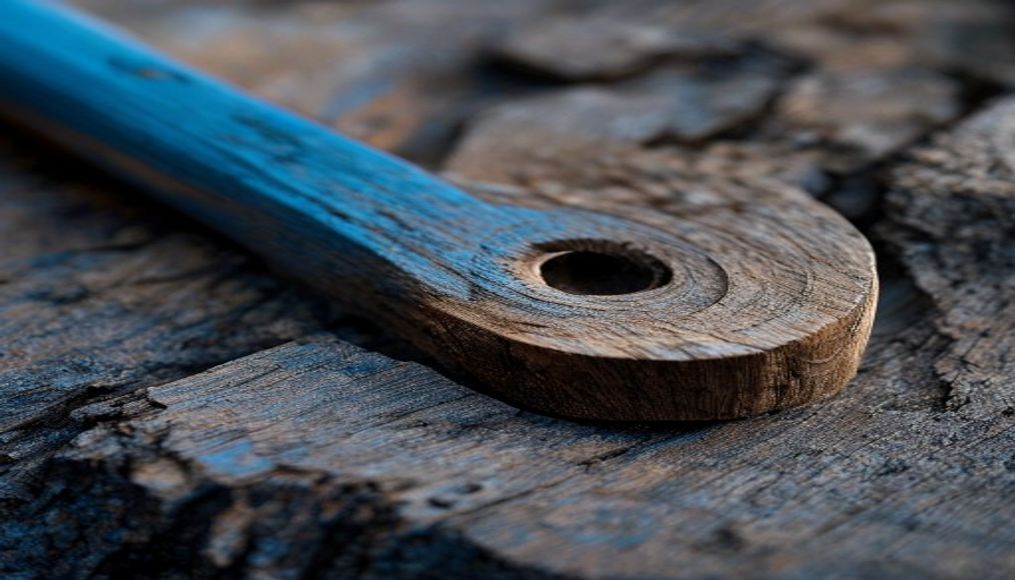
Detail of a woodturning chisel, an essential tool for shaping turned wooden pieces.
About this subject
A woodturning chisel is a cutting tool specifically designed for use on wood lathes. Unlike standard bench chisels, these tools have long handles that allow secure support against the tool rest and blades with specific geometries for cuts on rotating workpieces. The main types include gouges (with curved cross-sections), skew chisels (with angled straight edges), roughing gouges, and parting tools. Each serves a distinct purpose: gouges shape concave curves, skews smooth surfaces and create fine details, while parting tools cut pieces off the lathe.
Manufacturing of these tools evolved from carbon steel to high-speed steel (HSS), which retains edge sharpness longer and withstands frictional heat. Sharpening is done on water stones or grinders, requiring precise angles, typically between 25 and 45 degrees depending on the cut. A well-honed blade reduces wood tear-out and yields a smooth finish. Brands like Sorby, Ashley Iles, and Robert Sorby are global references, though many artisans prefer custom-forged chisels.
Historically, woodturning dates back to ancient Egypt, using bow lathes. The Industrial Revolution standardized chisels and lathes, popularizing the craft. In Brazil, turning is strong in producing furniture legs, tool handles, and decorative objects. Wood species vary: pine for beginners, ipe for durable pieces, and bubinga for ornamental items. Choosing the right chisel directly affects the final quality of the workpiece.
Frequently Asked Questions
What is the difference between a chisel and a gouge in woodturning?
A chisel (skew chisel) has a straight blade with an angled bevel, used for straight cuts and smoothing. A gouge has a curved, U-shaped blade, ideal for hollowing concave shapes and creating rounded contours.
How to sharpen a woodturning chisel?
Use a water stone or wet grinder. Maintain the original bevel angle (typically 30 to 40 degrees) and move the blade consistently. Finish with a fine-grit stone to polish the edge. Avoid overheating the steel.
What are the main types of woodturning chisels?
The main types are: roughing gouge, spindle gouge, skew chisel, square end scraper, and parting tool. Each has a specific function in turning operations.
Direct URL
https://pub-c7d6a6ea828543ac903a74a341ccb2e1.r2.dev/imagens/woodturning-chisel-detail-aerial-drone-shot-p4.jpgHow to credit
Include a visible link back to UtilizAí. Copy one of the snippets below:
<a href="https://xn--utiliza-eza.com/en/midia/imagens/woodturning-chisel-detail-aerial-drone-shot-p4">Woodturning chisel detail</a> by <a href="https://xn--utiliza-eza.com">UtilizAí</a>, licensed under <a href="https://creativecommons.org/licenses/by/4.0/">CC BY 4.0</a>.
[Woodturning chisel detail](https://xn--utiliza-eza.com/en/midia/imagens/woodturning-chisel-detail-aerial-drone-shot-p4) by [UtilizAí](https://xn--utiliza-eza.com), CC BY 4.0
License: CC-BY-4.0