Salmon farm offshore
1344×768 · AVIF · CC BY 4.0
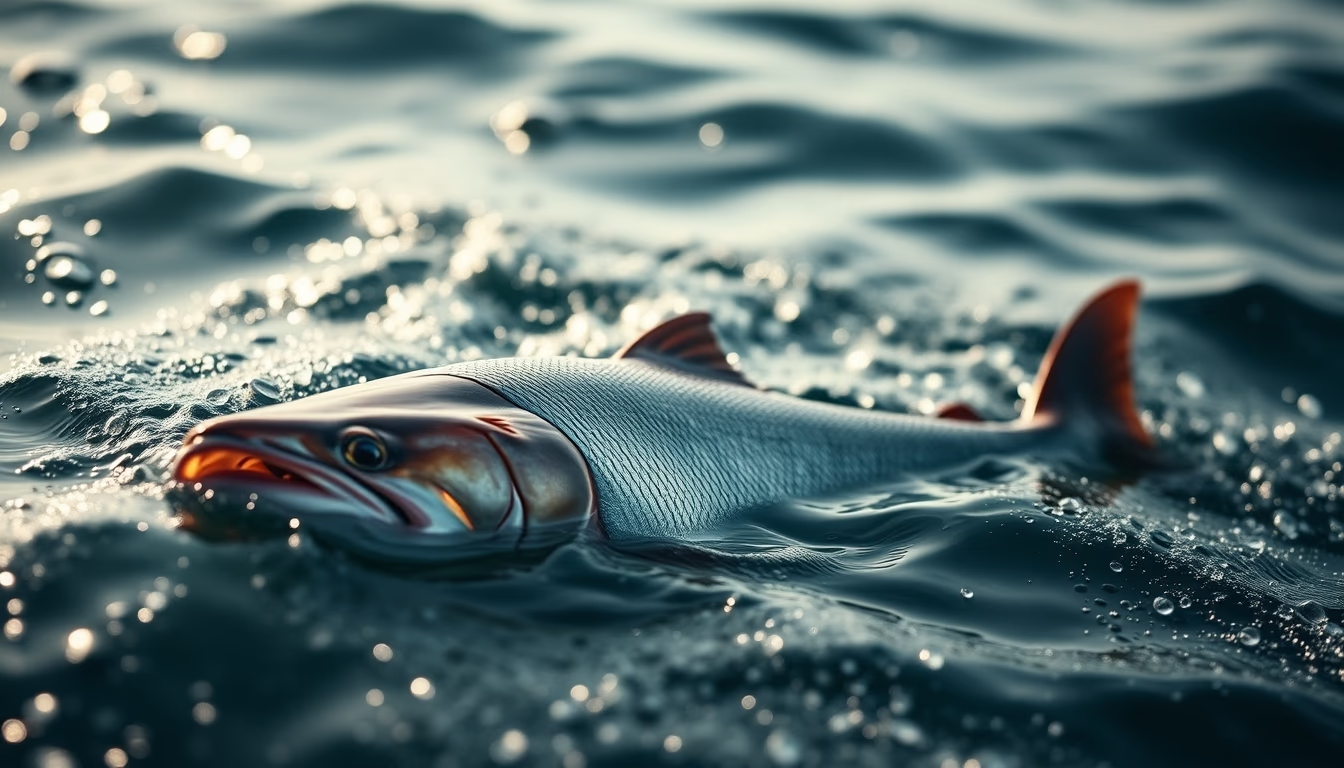
Offshore salmon farming is the cultivation of salmon in submerged structures in the open ocean, a practice that promises to relieve environmental pressure from coastal farms and meet growing global demand for the fish.
About this subject
Offshore salmon farming represents an evolution in aquaculture, moving salmon production to deeper, exposed waters. Unlike traditional coastal farms, these facilities are anchored in the open ocean, where stronger currents help disperse organic waste and reduce concentrations of parasites like sea lice. Norwegian companies such as SalMar lead with projects like Ocean Farm 1, a 68‑meter-diameter spherical structure capable of producing up to 1.5 million salmon per cycle. Other countries, including Chile, Canada, and Scotland, are also investing in similar technologies, adapted to local wind and wave conditions.
Operating these farms involves significant technical challenges. Structures must withstand storms, strong currents, and saltwater corrosion. Automated feeding systems and remote monitoring using cameras and sensors are essential, as human access is limited. Additionally, genetic selection of salmon strains more resistant to ocean stress has been a research focus. Energy for these operations often comes from renewable sources such as wind turbines or solar panels installed on the platforms.
From an environmental perspective, offshore salmon farming can mitigate common issues of coastal aquaculture, such as eutrophication and disease transmission to wild populations. However, it raises new questions, like the acoustic impact of structures and the risk of large‑scale escapes during storms. Studies indicate that fish welfare may be superior due to cleaner currents and lower population density. Certification by bodies such as the Aquaculture Stewardship Council (ASC) is beginning to include specific criteria for offshore operations.
Economically, the upfront cost is high, but the prospect of higher productivity per water volume and lower disease incidence may compensate. The global salmon market, worth billions of dollars annually, sees offshore technology as a scalable alternative to meet demand growing at about 5% per year. Countries with extensive, exposed coastlines, like Norway and Chile, are at the forefront, while regions like Brazil are still exploring potential for native species in similar systems.
Frequently Asked Questions
What is offshore salmon farming?
It is the cultivation of salmon in submerged or floating structures located in the open ocean, away from the coast, where conditions are more challenging but offer better waste dispersion and lower parasite loads.
Which countries are leading offshore salmon farming?
Norway, Chile, Canada, and Scotland are the main investors. Norway, with projects like SalMar's Ocean Farm 1, is considered a pioneer, while Chile adapts technologies for its calmer southern waters.
What are the main environmental challenges of offshore salmon farming?
Challenges include storm‑related escape risks, acoustic impact of structures, and the need for renewable energy. On the positive side, it reduces coastal eutrophication and disease transmission to wild populations.
Direct URL
https://pub-c7d6a6ea828543ac903a74a341ccb2e1.r2.dev/imagens/salmon-farm-offshore-magazine-editorial-fresh7.avifHow to credit
Include a visible link back to UtilizAí. Copy one of the snippets below:
<a href="https://xn--utiliza-eza.com/en/midia/imagens/salmon-farm-offshore-magazine-editorial-fresh7">Salmon farm offshore</a> by <a href="https://xn--utiliza-eza.com">UtilizAí</a>, licensed under <a href="https://creativecommons.org/licenses/by/4.0/">CC BY 4.0</a>.
[Salmon farm offshore](https://xn--utiliza-eza.com/en/midia/imagens/salmon-farm-offshore-magazine-editorial-fresh7) by [UtilizAí](https://xn--utiliza-eza.com), CC BY 4.0
License: CC-BY-4.0