Salar de uyuni reflection
1344×768 · AVIF · CC BY 4.0
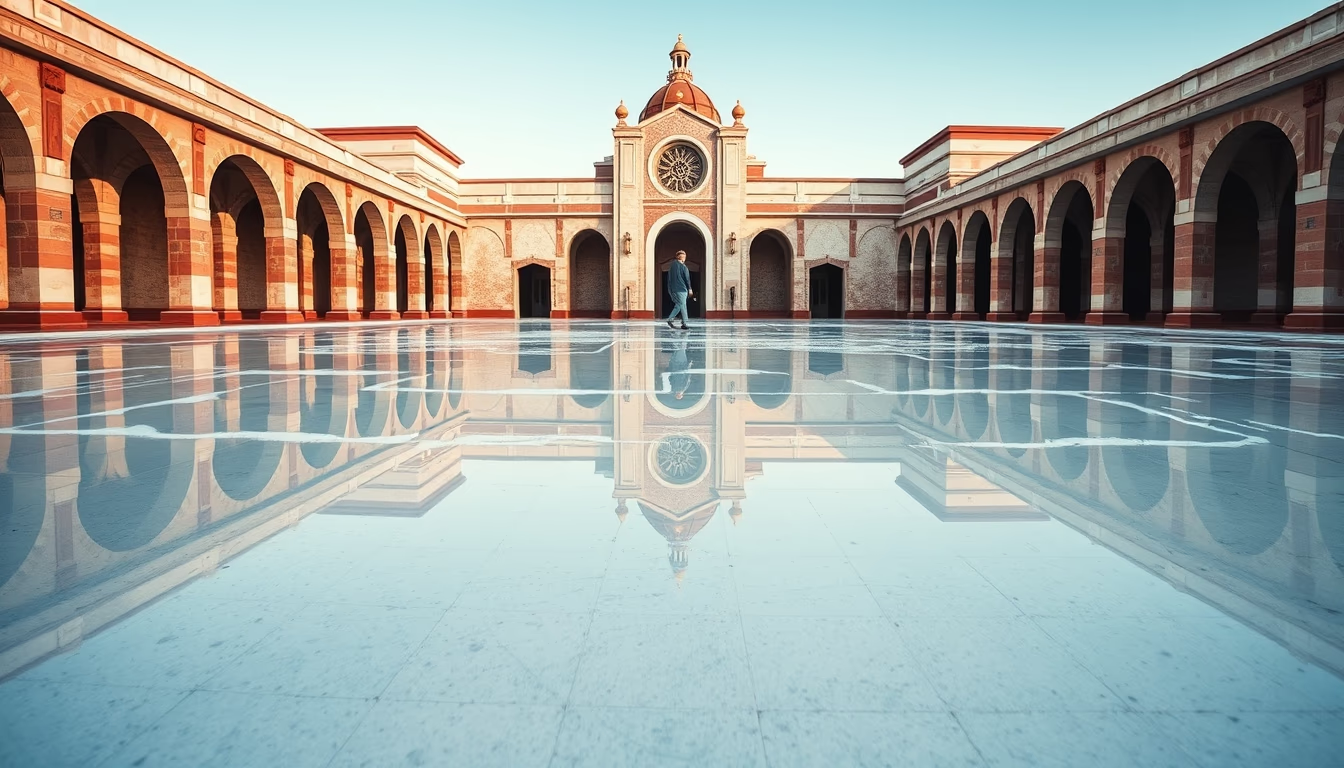
Salar de Uyuni, in Bolivia, is the world's largest salt flat, famous for its natural mirror that perfectly reflects the sky during the rainy season.
About this subject
Salar de Uyuni is located in southwestern Bolivia, in the Daniel Campos Province of Potosí Department, at an altitude of about 3,656 meters above sea level. Covering an area of approximately 10,582 square kilometers, it is the largest salt flat on Earth, formed from the evaporation of prehistoric lakes such as Lake Minchin, which covered much of the Andean altiplano around 40,000 years ago. The salt crust can reach thicknesses of up to 10 meters in the center, and its flat, uniform surface results from millennia of sedimentation and evaporation.
Beyond its scenic beauty, Salar de Uyuni holds enormous economic and scientific importance. It is estimated to contain about 10 billion tons of salt, as well as the world's largest lithium reserve, with roughly 21 million tons of the mineral, crucial for batteries in electronic devices and electric vehicles. However, lithium extraction has sparked environmental and social debates about its impact on the fragile altiplano ecosystem. During the rainy season (December to April), a thin layer of water covers the salt, creating the famous mirror effect that attracts tourists and photographers from around the globe.
Culturally, the region is rich in Andean traditions. Near the salt flat, the Train Cemetery in the town of Uyuni displays abandoned steam locomotives from the 19th century, when the area was a major railway hub for mineral transport. The salt flat also hosts indigenous rituals, such as offerings to Pachamama (Mother Earth), and features islands covered in giant cacti, like Isla Incahuasi, some over a thousand years old. The combination of geology, history, and mysticism makes Salar de Uyuni one of the most unique destinations in the world.
Frequently Asked Questions
What is the best time to visit Salar de Uyuni to see the mirror effect?
The best time is during the rainy season, from December to April, when a thin layer of water covers the salt and creates the perfect reflection of the sky. January and February usually offer the best mirrors, but access to some areas may be limited.
Why is Salar de Uyuni important for lithium?
The salt flat holds the world's largest lithium reserve, with about 21 million tons. Lithium is essential for producing rechargeable batteries used in cell phones, laptops, and electric vehicles, making the region strategic for the global energy transition.
Is it true that Salar de Uyuni is used to calibrate satellites?
Yes. Due to its extremely flat surface and high reflectivity, Salar de Uyuni is used as a calibration point for remote sensing satellites, helping to adjust instruments for measuring altitude and reflectance.
Direct URL
https://pub-c7d6a6ea828543ac903a74a341ccb2e1.r2.dev/imagens/salar-de-uyuni-reflection-architectural-photography-p2.avifHow to credit
Include a visible link back to UtilizAí. Copy one of the snippets below:
<a href="https://xn--utiliza-eza.com/en/midia/imagens/salar-de-uyuni-reflection-architectural-photography-p2">Salar de uyuni reflection</a> by <a href="https://xn--utiliza-eza.com">UtilizAí</a>, licensed under <a href="https://creativecommons.org/licenses/by/4.0/">CC BY 4.0</a>.
[Salar de uyuni reflection](https://xn--utiliza-eza.com/en/midia/imagens/salar-de-uyuni-reflection-architectural-photography-p2) by [UtilizAí](https://xn--utiliza-eza.com), CC BY 4.0
License: CC-BY-4.0