Maglev train tokyo
1344×768 · AVIF · CC BY 4.0
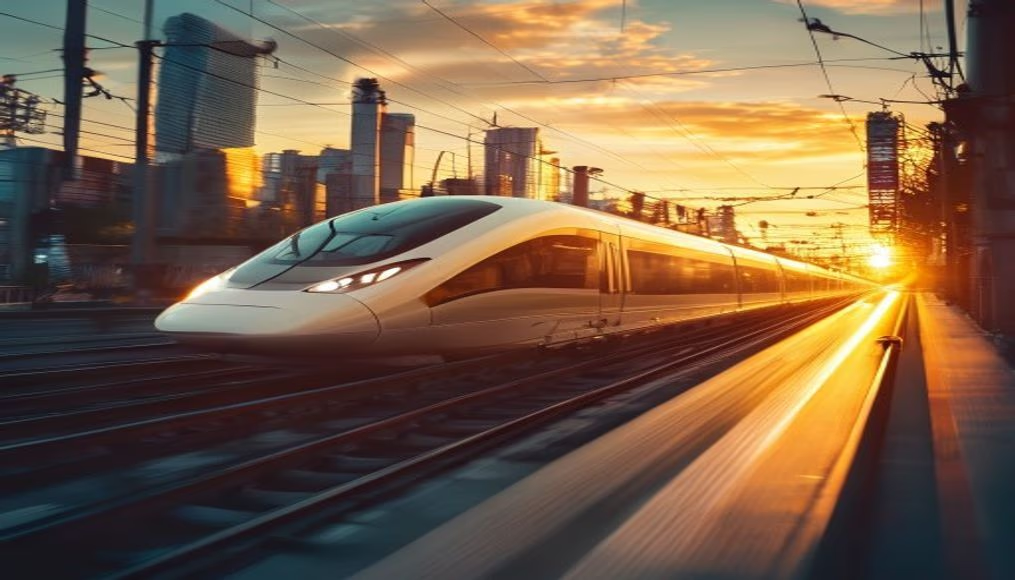
The Japanese maglev train, operating on the Chuo Shinkansen line, uses magnetic levitation to achieve record speeds of up to 603 km/h, connecting Tokyo to Nagoya from 2027.
About this subject
The Japanese maglev train represents the pinnacle of high-speed rail technology. Developed by the Central Japan Railway Company (JR Central), the train uses superconducting magnetic levitation (SCMaglev), where superconducting magnets in the track and vehicle generate repulsive and attractive forces that suspend the train about 10 centimeters above the ground, eliminating friction and enabling extreme speeds.
The most ambitious project is the Chuo Shinkansen line, which will connect Tokyo to Nagoya in just 40 minutes (compared to 95 minutes for the current shinkansen), with a planned extension to Osaka. The world speed record for a train carrying passengers was set on April 21, 2015, when a maglev reached 603 km/h on the Yamanashi test track. This milestone demonstrates the technical viability of the system, which operates quietly and with low energy consumption at high speeds.
Construction of the first phase between Tokyo and Nagoya began in 2014, with an expected opening in 2027. However, the project faces significant geological challenges, such as tunneling through mountainous regions and the need to mitigate environmental impacts. The total estimated cost exceeds 9 trillion yen (about 60 billion dollars), making it one of the largest infrastructure investments in Japan.
Beyond speed, the maglev offers advantages such as superior safety (efficient emergency braking system) and operation in adverse weather conditions, as the train does not rely on physical contact with the rails. Japanese technology is also attracting international interest, with potential exports to countries like the United States (proposed maglev between Washington and Baltimore) and India.
Frequently Asked Questions
What is the top speed of the Japanese maglev train?
The record speed is 603 km/h, achieved during testing in 2015. In commercial service, the train is expected to reach about 505 km/h.
When will the Tokyo-Nagoya maglev line start operating?
The Chuo Shinkansen line is scheduled to begin service in 2027, connecting Tokyo to Nagoya in approximately 40 minutes.
How does magnetic levitation work in Japanese maglev trains?
The system uses superconducting magnets cooled by liquid helium to generate intense magnetic fields. The track contains coils that induce repulsive and attractive forces, levitating and propelling the train without physical contact.
Direct URL
https://pub-c7d6a6ea828543ac903a74a341ccb2e1.r2.dev/imagens/maglev-train-tokyo-cinematic-wide-shot-p1.avifHow to credit
Include a visible link back to UtilizAí. Copy one of the snippets below:
<a href="https://xn--utiliza-eza.com/en/midia/imagens/maglev-train-tokyo-cinematic-wide-shot-p1">Maglev train tokyo</a> by <a href="https://xn--utiliza-eza.com">UtilizAí</a>, licensed under <a href="https://creativecommons.org/licenses/by/4.0/">CC BY 4.0</a>.
[Maglev train tokyo](https://xn--utiliza-eza.com/en/midia/imagens/maglev-train-tokyo-cinematic-wide-shot-p1) by [UtilizAí](https://xn--utiliza-eza.com), CC BY 4.0
License: CC-BY-4.0