Train signal semaphore
1344×768 · JPG · CC BY 4.0
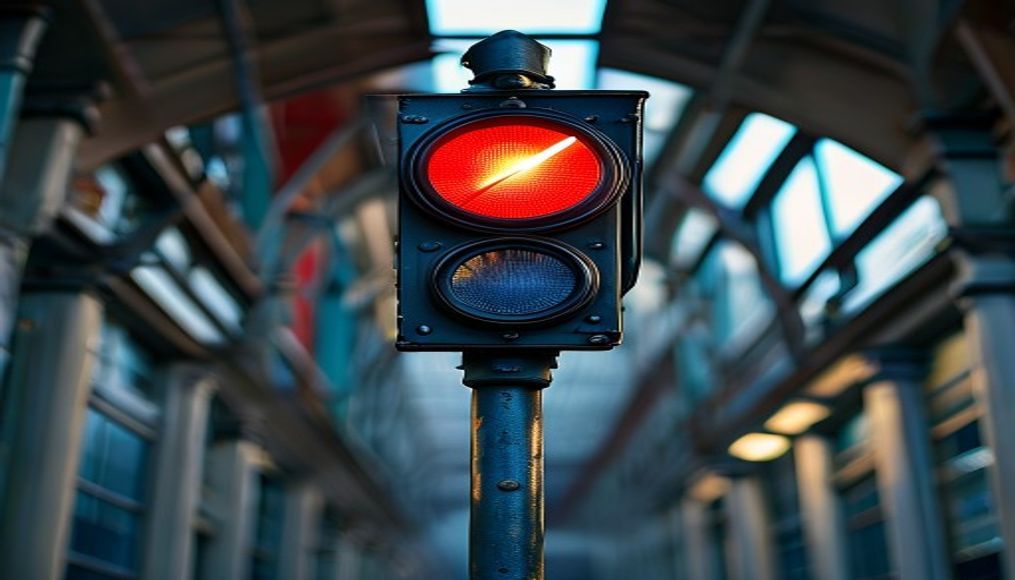
The railway semaphore signal is a mechanical signaling system used to control train traffic since the 19th century.
About this subject
The railway semaphore signal is a mechanical signaling device consisting of a mast with one or more movable arms that indicate stop or proceed to train drivers. Invented by Joseph James Stevens in 1841 and first adopted by British railways, this system replaced manual signals and flags, enhancing operational safety and reliability. The basic principle is straightforward: a horizontal arm means absolute stop, while an arm lowered (lower quadrant) or raised (upper quadrant) indicates clear to proceed. Each arm represents a signal aspect; multiple arms can convey more complex instructions, such as permission to take a diverging route or indication of the next signal.
The distinction between lower and upper quadrants relates to fail-safe design: in lower quadrant signals, a broken cable would cause the arm to fall to the stop position by gravity, an intrinsically safe feature. Upper quadrant signals were developed later and became standard in many countries due to more compact assembly and better visibility. Night versions used colored lanterns, red for stop, green for clear, that moved with the arm. Throughout much of the 20th century, semaphore signals were the primary means of railway signaling worldwide, including Brazil, where they equipped lines of the Central do Brasil, Paulista, and Sorocabana railways.
With technological advances, mechanical semaphores were gradually replaced by electric light signals and centralized traffic control systems, starting in the 1930s in the United States and later elsewhere. Today, many are preserved on heritage railways and in museums, such as the Estrada de Ferro Campos do Jordão and the Immigration Museum in São Paulo. Beyond historical significance, semaphore signals are admired for their industrial aesthetics and precise mechanical operation, often featured in architectural railway photography. The term "semaphore" derives from Greek "sema" (signal) and "phoros" (bearer), later extended to traffic lights.
Frequently Asked Questions
What is the difference between a railway semaphore signal and a modern light signal?
A semaphore signal is mechanical, with a movable arm indicating stop (horizontal) or proceed (inclined). Modern light signals use colored lights (red, yellow, green) and are electrically controlled, allowing greater flexibility and integration with automated systems.
How does a train driver know whether to proceed at a semaphore signal at night?
Night semaphores have lanterns attached to the arm: when the arm is in the stop position, the lantern shows a red light; when inclined for proceed, it shows a green light. Thus, the driver sees the color regardless of the arm position.
Are semaphore signals still in use in Brazil?
Yes, on some heritage and tourist railways, such as the Estrada de Ferro Campos do Jordão (SP) and the Corcovado Train (RJ), where they are preserved as part of the heritage. On commercial lines, they have been almost entirely replaced by light or electronic signals.
Direct URL
https://pub-c7d6a6ea828543ac903a74a341ccb2e1.r2.dev/imagens/train-signal-semaphore-architectural-photography-p4.jpgHow to credit
Include a visible link back to UtilizAí. Copy one of the snippets below:
<a href="https://xn--utiliza-eza.com/en/midia/imagens/train-signal-semaphore-architectural-photography-p4">Train signal semaphore</a> by <a href="https://xn--utiliza-eza.com">UtilizAí</a>, licensed under <a href="https://creativecommons.org/licenses/by/4.0/">CC BY 4.0</a>.
[Train signal semaphore](https://xn--utiliza-eza.com/en/midia/imagens/train-signal-semaphore-architectural-photography-p4) by [UtilizAí](https://xn--utiliza-eza.com), CC BY 4.0
License: CC-BY-4.0