Indian devanagari sanskrit
1344×768 · AVIF · CC BY 4.0
Devanagari is one of the oldest and most precise writing systems in the world, used for Sanskrit and several modern Indian languages.
About this subject
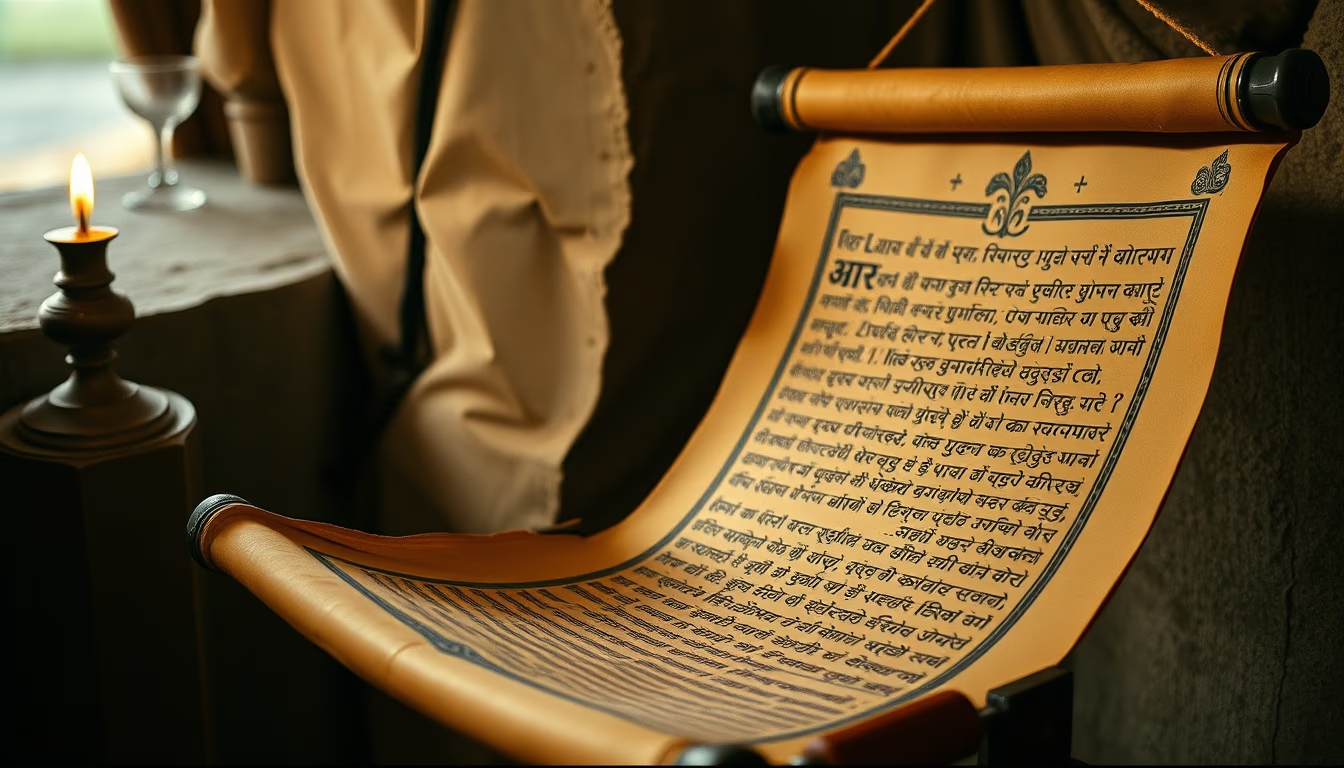
Devanagari (देवनागरी) is an abugida writing system that evolved from the Gupta script between the 7th and 9th centuries CE. It is the official script for Sanskrit, Hindi, Marathi, and Nepali, among other Indian languages. The name devanagari means 'script of the city of gods', reflecting its historical use in religious and philosophical texts. Today, it is the fourth most widely used script in the world, with over 600 million speakers.
The most distinctive feature of devanagari is the continuous horizontal line (shirorekha) that connects the letters at the top. Each syllable is represented by a glyph that combines a consonant with an inherent vowel (short a), which can be modified by diacritics. Unlike the Latin alphabet, devanagari is phonetically precise: each character has a single, unchangeable sound. This makes it ideal for preserving the pronunciation of Vedic Sanskrit, which relied on correct intonation.
For Sanskrit, devanagari is almost inseparable. Although Sanskrit was historically written in other scripts (such as Grantha in South India), devanagari became the academic and editorial standard from the 19th century onward. Foundational texts like the Vedas, Upanishads, and Bhagavad Gita are commonly published in devanagari. The script's phonetic precision allows scholars to transcribe mantras and hymns without ambiguity.
Devanagari also played a crucial role in digital encoding. It was among the first scripts to be supported in Unicode (block U+0900 to U+097F), enabling its preservation and dissemination on the internet. Today, devanagari is taught in schools across India and in Sanskrit courses worldwide, keeping alive a written tradition that dates back over a thousand years.
Frequently Asked Questions
What does devanagari mean and what is its origin?
Devanagari means 'script of the city of gods'. It originated from the Gupta script between the 7th and 9th centuries CE and is used for Sanskrit, Hindi, Marathi, and Nepali.
Why is devanagari considered a phonetically precise system?
Because each character represents a single, unchangeable sound with no silent letters or ambiguous combinations, unlike the Latin alphabet.
Is devanagari used only in India?
No, besides India, it is used in Nepal and by the Indian diaspora. It is also the standard script for academic Sanskrit worldwide.
Direct URL
https://pub-c7d6a6ea828543ac903a74a341ccb2e1.r2.dev/imagens/indian-devanagari-sanskrit-magazine-editorial-fresh7.avifHow to credit
Include a visible link back to UtilizAí. Copy one of the snippets below:
<a href="https://xn--utiliza-eza.com/en/midia/imagens/indian-devanagari-sanskrit-magazine-editorial-fresh7">Indian devanagari sanskrit</a> by <a href="https://xn--utiliza-eza.com">UtilizAí</a>, licensed under <a href="https://creativecommons.org/licenses/by/4.0/">CC BY 4.0</a>.
[Indian devanagari sanskrit](https://xn--utiliza-eza.com/en/midia/imagens/indian-devanagari-sanskrit-magazine-editorial-fresh7) by [UtilizAí](https://xn--utiliza-eza.com), CC BY 4.0
License: CC-BY-4.0