Icebreaker arctic ship
1344×768 · AVIF · CC BY 4.0
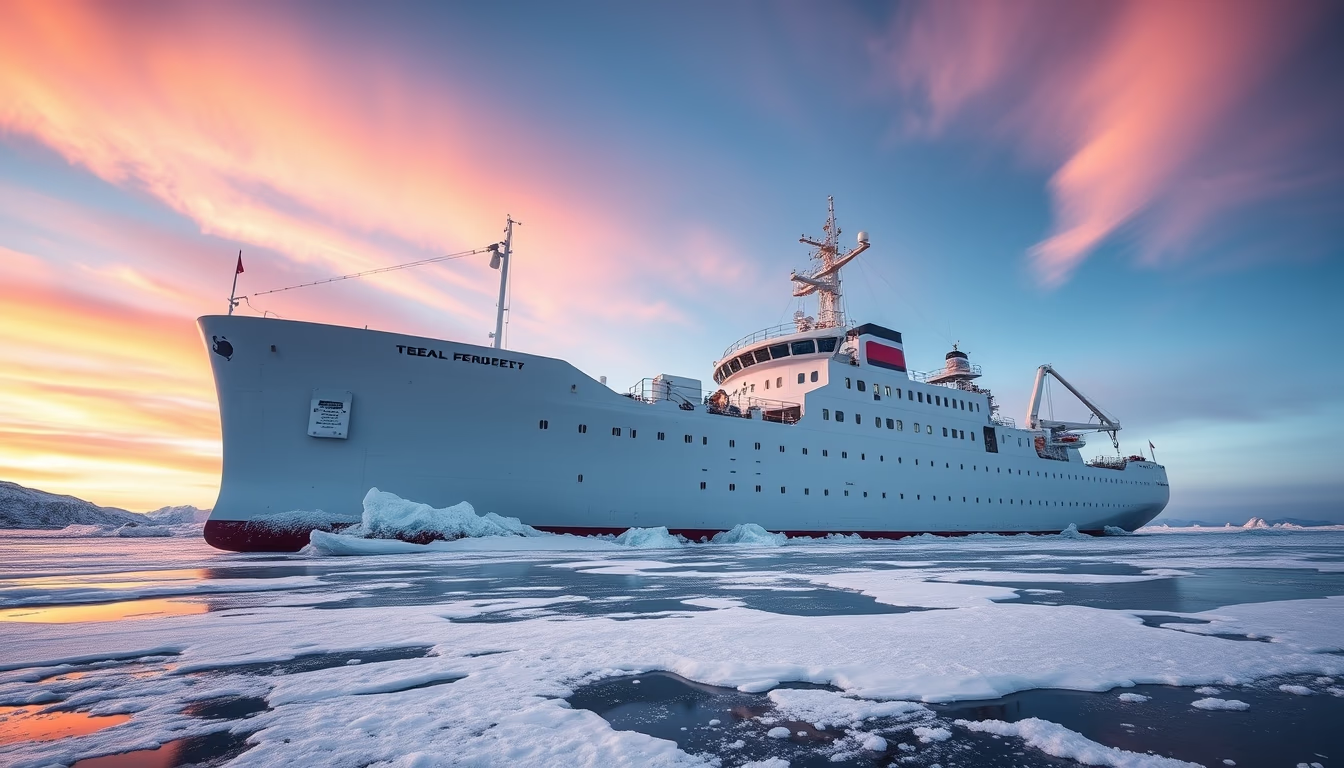
Icebreakers are ships designed to navigate ice-covered waters, crucial for Arctic exploration and logistics.
About this subject
Icebreakers are specialized vessels with reinforced hulls and powerful engines, capable of forcing their way through frozen seas. In the Arctic, these ships play a vital role in maintaining navigation routes such as the Northern Sea Route, linking Europe to Asia across the top of the world. Russia operates the largest icebreaker fleet globally, including nuclear-powered ships like '50 Let Pobedy', one of the largest ever built. These vessels can break ice up to three meters thick, enabling cargo ships and research vessels to transit previously inaccessible regions.
Beyond commercial transport, icebreakers are essential for scientific expeditions in the Arctic, studying climate change, marine ecosystems, and polar geology. They also support search and rescue operations in extreme conditions. Demand for icebreakers has increased with the melting of sea ice, opening new maritime routes while raising environmental concerns about the impact of heavy shipping on the fragile Arctic ecosystem.
Interestingly, not all icebreakers are the same. There are different classes: shallow-draft icebreakers for port operations and deep-sea ones capable of tackling thick Arctic Ocean ice. Technology has evolved from steam-powered icebreakers in the 19th century to modern nuclear-powered vessels with dynamic positioning systems. Countries like Canada, the United States, Norway, and Finland also maintain significant fleets, though smaller than Russia's.
The future of icebreakers includes more sustainable designs, such as LNG or battery propulsion. China's 'Xuelong 2' exemplifies modern bidirectional navigation capability. Smaller automated icebreakers are also being developed for specific tasks. Nevertheless, the Arctic remains one of the most challenging environments for navigation, and icebreakers are key to unlocking its secrets and economic potential.
Frequently Asked Questions
How does an icebreaker break ice?
Icebreakers use the weight of the hull and powerful engines to ride up onto the ice and break it with gravity. The spoon-shaped bow design facilitates this, while protected propellers and ballast systems aid maneuverability.
What is the largest icebreaker in the world?
Currently, the largest icebreaker is the Russian nuclear ship '50 Let Pobedy' (50 Years of Victory), measuring 160 meters in length and 25 meters in width. It can break ice up to 3 meters thick.
Why are icebreakers important for the Arctic?
They enable navigation in frozen waters, vital for trade, scientific research, and rescue operations. As ice melts, routes like the Northeast Passage become more viable, increasing the relevance of icebreakers.
Direct URL
https://pub-c7d6a6ea828543ac903a74a341ccb2e1.r2.dev/imagens/icebreaker-arctic-ship-long-exposure-p0.avifHow to credit
Include a visible link back to UtilizAí. Copy one of the snippets below:
<a href="https://xn--utiliza-eza.com/en/midia/imagens/icebreaker-arctic-ship-long-exposure-p0">Icebreaker arctic ship</a> by <a href="https://xn--utiliza-eza.com">UtilizAí</a>, licensed under <a href="https://creativecommons.org/licenses/by/4.0/">CC BY 4.0</a>.
[Icebreaker arctic ship](https://xn--utiliza-eza.com/en/midia/imagens/icebreaker-arctic-ship-long-exposure-p0) by [UtilizAí](https://xn--utiliza-eza.com), CC BY 4.0
License: CC-BY-4.0