Icebreaker arctic ship
1344×768 · AVIF · CC BY 4.0
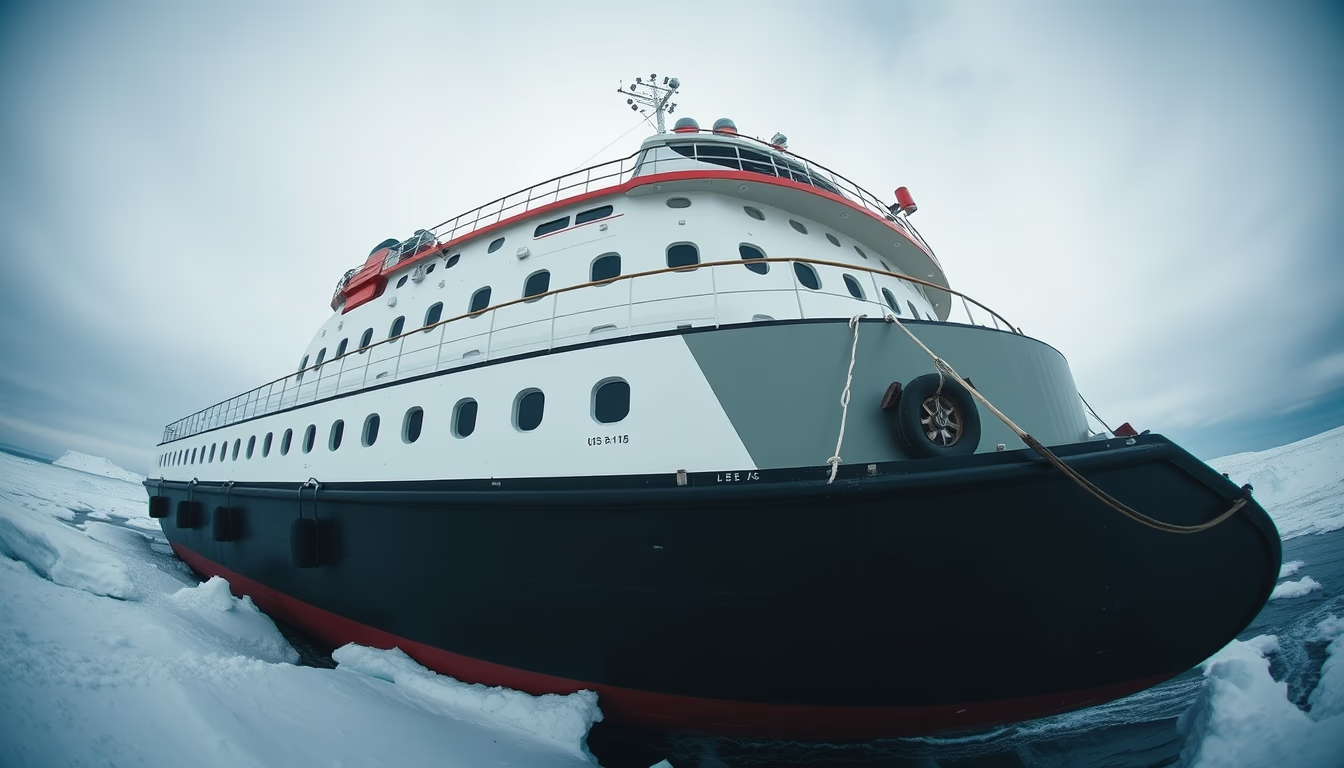
Icebreakers are ships designed to navigate through ice-covered waters, essential for polar routes and scientific research in the Arctic.
About this subject
Icebreakers are specialized vessels with reinforced hulls and inclined bows, capable of breaking through sea ice. The first modern icebreaker was the Russian 'Pilot', built in 1864 at Kronstadt harbor. Since then, these ships have evolved to include nuclear propulsion, like the Arktika class, which operate along the Northern Sea Route.
The working principle is straightforward: the ship rides up onto the ice, breaking it with the hull's weight. The spoon-shaped bow allows ice to slide upward and fracture. Powerful propulsion systems, such as variable-pitch propellers and diesel-electric engines, provide enough force to penetrate ice several meters thick. Nuclear icebreakers can operate for years without refueling.
The geopolitical importance of icebreakers grows with the melting of Arctic ice, opening new trade routes and areas for oil and gas exploration. Russia has the largest fleet of nuclear icebreakers, used to maintain navigation along the Northern Sea Route, which shortens voyages between Europe and Asia. These vessels are also crucial for scientific research, supplying polar stations, and conducting rescues in remote areas.
Interesting facts include the 'Sevmorput', a nuclear-powered cargo ship that also functions as an icebreaker, and the fact that the largest non-nuclear icebreaker is the Canadian 'CCGS Louis S. St-Laurent'. With climate change, the demand for icebreakers is expected to rise, driving projects like China's 'Xue Long 2' and Finland's 'Polaris'.
Frequently Asked Questions
How does an icebreaker navigate through ice?
It uses a robust hull and a sloping bow that allows the ice to break under the ship's weight. Powerful propulsion systems provide the force to move over ice sheets.
What is the largest icebreaker in the world?
The Russian 'Arktika' (Project 22220) is one of the largest nuclear icebreakers, measuring 173 meters in length and capable of breaking ice up to 2.8 meters thick.
Are icebreakers only used in the Arctic?
No. They also operate in Antarctica, the Baltic Sea, the Great Lakes, and other regions where seasonal ice blocks ports and waterways.
Direct URL
https://pub-c7d6a6ea828543ac903a74a341ccb2e1.r2.dev/imagens/icebreaker-arctic-ship-fish-eye-wide-angle-p2.avifHow to credit
Include a visible link back to UtilizAí. Copy one of the snippets below:
<a href="https://xn--utiliza-eza.com/en/midia/imagens/icebreaker-arctic-ship-fish-eye-wide-angle-p2">Icebreaker arctic ship</a> by <a href="https://xn--utiliza-eza.com">UtilizAí</a>, licensed under <a href="https://creativecommons.org/licenses/by/4.0/">CC BY 4.0</a>.
[Icebreaker arctic ship](https://xn--utiliza-eza.com/en/midia/imagens/icebreaker-arctic-ship-fish-eye-wide-angle-p2) by [UtilizAí](https://xn--utiliza-eza.com), CC BY 4.0
License: CC-BY-4.0