Icebreaker arctic ship
1344×768 · AVIF · CC BY 4.0
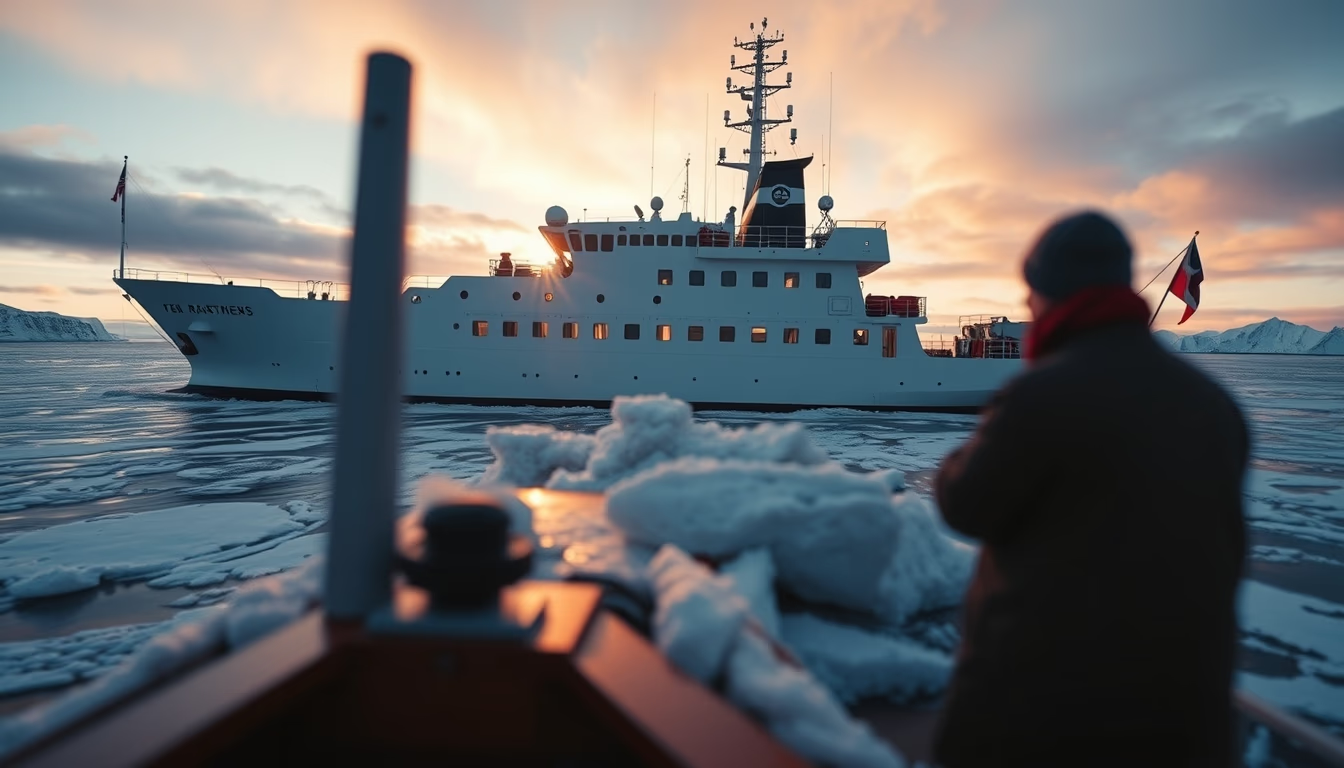
Icebreakers are specialized ships for navigating frozen seas, vital for exploration and trade in the Arctic.
About this subject
Icebreakers are ships specifically designed with reinforced hulls and powerful engines to break through sea ice. They operate primarily in polar regions, such as the Arctic and Antarctica, where ice can reach thicknesses of several meters. Their main function is to open navigable channels for commercial convoys, research vessels, and scientific stations. They are also used in search and rescue missions, resupply of remote outposts, and maritime border patrols.
There are different types of icebreakers, classified by their ice-breaking capability. Light icebreakers operate in thin ice up to 1 meter, while heavy ones, like the Russian "Arktika," can break ice over 2 meters thick. The Russian nuclear-powered icebreaker "Arktika" is one of the most powerful in the world, using nuclear reactors for continuous energy. Other notable examples include the US Coast Guard's "Polar Star" and China's "Aurora." Propulsion technology ranges from diesel-electric to nuclear, with the latter allowing prolonged operation without refueling.
The importance of icebreakers is growing with the melting of Arctic ice and the opening of new maritime routes, such as the Northeast Passage. They enable cargo transport between Europe and Asia in less time than the Suez Canal route. However, operating these ships faces challenges like extreme weather, equipment malfunctions due to low temperatures, and the need for highly trained crews. Environmental safety is also a concern, with risks of fuel or oil spills in fragile ecosystems.
Interestingly, Brazil does not have icebreakers but uses the oceanographic support ship "Almirante Maximiano" for Antarctic research. Most icebreakers are concentrated in countries with Arctic interests: Russia, Canada, USA, Norway, Denmark (Greenland), and Finland. Building new icebreakers is a strategic investment, and Russia plans to expand its nuclear fleet to dominate Arctic navigation. Technology continues to evolve, with projects for autonomous and hybrid icebreakers powered by liquefied natural gas.
Frequently Asked Questions
How does an icebreaker work to break ice?
The icebreaker uses its weight and hull shape to ride up onto the ice and break it. The reinforced hull and inclined bow allow the ship to slide over the ice layer, crushing it with downward force.
What are the largest icebreakers in the world?
The largest are from the Russian Arktika class, such as 'Arktika' (nuclear) and 'Sibir'. The 'Arktika' is 173 meters long and can break ice up to 2.8 meters thick.
Why are icebreakers important for the Arctic?
They keep maritime routes open year-round, facilitating trade, resource transport, and research stations. They also perform rescue operations and environmental protection.
Direct URL
https://pub-c7d6a6ea828543ac903a74a341ccb2e1.r2.dev/imagens/icebreaker-arctic-ship-cinematic-wide-shot-p5.avifHow to credit
Include a visible link back to UtilizAí. Copy one of the snippets below:
<a href="https://xn--utiliza-eza.com/en/midia/imagens/icebreaker-arctic-ship-cinematic-wide-shot-p5">Icebreaker arctic ship</a> by <a href="https://xn--utiliza-eza.com">UtilizAí</a>, licensed under <a href="https://creativecommons.org/licenses/by/4.0/">CC BY 4.0</a>.
[Icebreaker arctic ship](https://xn--utiliza-eza.com/en/midia/imagens/icebreaker-arctic-ship-cinematic-wide-shot-p5) by [UtilizAí](https://xn--utiliza-eza.com), CC BY 4.0
License: CC-BY-4.0