Hangul korean ancient
1344×768 · AVIF · CC BY 4.0
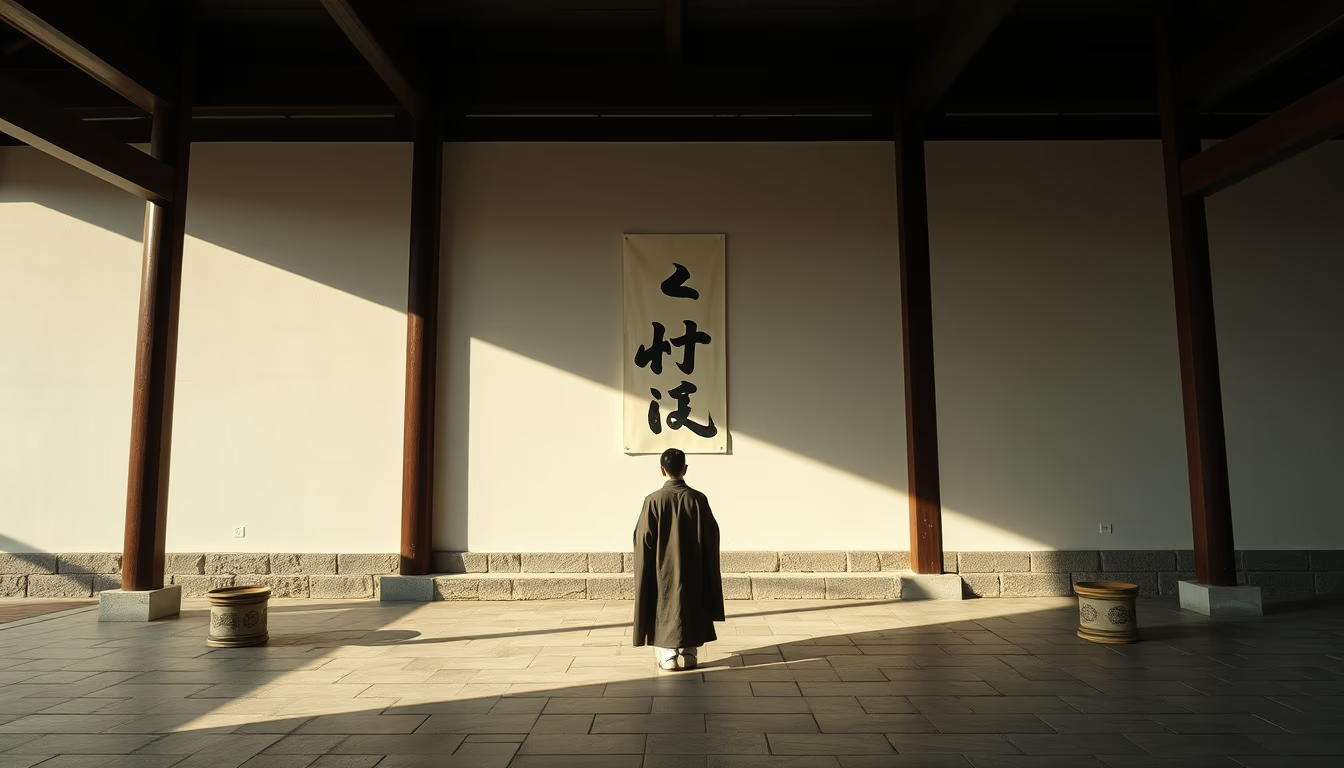
Hangul is the Korean alphabet created in the 15th century by King Sejong, a scientifically designed writing system to promote literacy.
About this subject
Hangul is the native writing system of Korea, developed under King Sejong the Great in 1443 and promulgated in 1446 through the document "Hunminjeongeum" (The Correct Sounds for the Instruction of the People). Unlike other East Asian scripts such as Chinese characters, Hangul was deliberately designed to be easy to learn, aiming to increase literacy among common people. Its phonetic design is remarkable: consonant shapes represent the position of the vocal organs (tongue, lips, throat) when producing the sound, while vowels are formed by combinations of strokes symbolizing heaven, earth, and humans. The original alphabet had 28 letters, now reduced to 24 (14 consonants and 10 vowels), which are grouped into syllabic blocks.
Before Hangul's creation, Korea predominantly used Chinese characters (hanja), which were complex and limited to the literate elite. This hindered written communication for most of the population. The introduction of Hangul represented a social revolution, enabling peasants, women, and lower classes to write and read. The Hunminjeongeum was inscribed on UNESCO's Memory of the World Register in 1997, recognizing its historical and cultural value. Today, Hangul is celebrated annually on Hangul Day (October 9) in South Korea, and is used in both South and North Korea with minor orthographic variations.
The aesthetic beauty of Hangul is also appreciated globally, especially in minimalist compositions that highlight the purity of its geometric lines. Artists and designers frequently use Hangul characters in modern calligraphy works, combining tradition and simplicity. The straight and curved strokes of the alphabet lend themselves well to abstract arrangements, evoking balance and harmony. As part of Korean cultural heritage, Hangul is not just a means of communication but a symbol of identity and national pride, having been a crucial factor in reducing illiteracy on the Korean peninsula.
Frequently Asked Questions
When and by whom was Hangul created?
Hangul was created in 1443 by King Sejong the Great of the Joseon dynasty and officially promulgated in 1446. Its purpose was to provide an accessible writing system for all Koreans, regardless of social class.
What is the difference between Hangul and hanja?
Hanja are Chinese characters used in Korea before Hangul, while Hangul is a native phonetic alphabet. Hanja is more complex and was restricted to the elite; Hangul was designed to be simple and easy to learn, promoting mass literacy.
Is Hangul used only in South Korea?
No, Hangul is the official writing system in both South Korea and North Korea, though there are minor orthographic differences between the two countries. It is also used by the Korean diaspora worldwide.
Direct URL
https://pub-c7d6a6ea828543ac903a74a341ccb2e1.r2.dev/imagens/hangul-korean-ancient-minimalist-composition-fresh5.avifHow to credit
Include a visible link back to UtilizAí. Copy one of the snippets below:
<a href="https://xn--utiliza-eza.com/en/midia/imagens/hangul-korean-ancient-minimalist-composition-fresh5">Hangul korean ancient</a> by <a href="https://xn--utiliza-eza.com">UtilizAí</a>, licensed under <a href="https://creativecommons.org/licenses/by/4.0/">CC BY 4.0</a>.
[Hangul korean ancient](https://xn--utiliza-eza.com/en/midia/imagens/hangul-korean-ancient-minimalist-composition-fresh5) by [UtilizAí](https://xn--utiliza-eza.com), CC BY 4.0
License: CC-BY-4.0