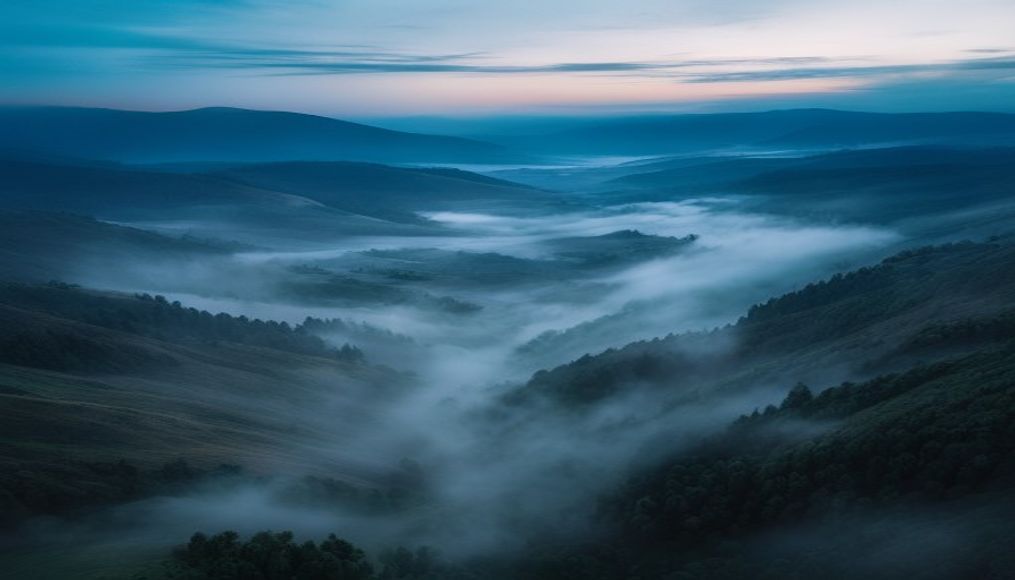
Fog rolling valley
1344×768 · AVIF · CC BY 4.0
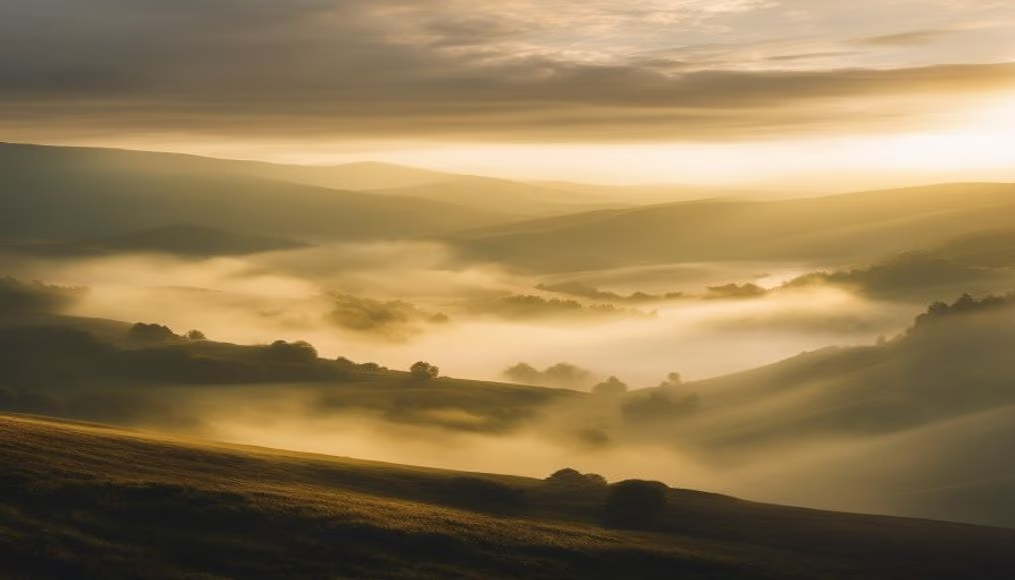
Fog rolling over valleys is a common atmospheric phenomenon in mountainous regions, creating ephemeral landscapes of fleeting beauty.
About this subject
Fog rolling over valleys is a meteorological phenomenon known as advection fog or valley fog. It occurs when warm, moist air moves over a cooler surface, such as a mountain slope or valley floor, causing moisture to condense into tiny suspended water droplets. This process is common in mountainous regions worldwide, including the Serra do Mar in Brazil, the European Alps, and the Appalachian Mountains. In Brazil, it is especially frequent in the south and southeast during autumn and winter, when temperature differences between air and ground are more pronounced.
Fog formation depends on factors such as relative humidity, temperature, wind, and topography. In narrow valleys, fog can accumulate and persist for hours, creating a sea of clouds visible from above. This natural spectacle attracts photographers and tourists, being one of the most iconic scenes in national parks like Itatiaia National Park and Chapada Diamantina. Culturally, fog is associated with mystery and introspection, appearing in literature and film as symbolism for transition or uncertainty.
Interestingly, valley fog can benefit agriculture by maintaining soil moisture and reducing evaporation. However, it also causes visibility issues on roads and at airports, requiring specialized navigation systems. Ecologically, fog is a vital water source for high-altitude ecosystems, where plants absorb moisture directly from droplets in a process called horizontal precipitation. This phenomenon is crucial for cloud forests, such as those atop the Serra do Mar, which harbor unique biodiversity adapted to this microclimate.
Frequently Asked Questions
What causes fog to roll over valleys?
Valley fog forms when warm, moist air moves over cooler surfaces like valley floors, causing water vapor to condense into tiny droplets. Topography helps trap the moist air, enhancing the effect.
In which regions of Brazil is valley fog most common?
It is most common in the South and Southeast, especially the Serra do Mar, Serra da Mantiqueira, and Chapada Diamantina, during autumn and winter when temperature contrasts are greatest.
Does valley fog have any ecological benefits?
Yes, in high-altitude ecosystems, fog provides essential moisture for plants through horizontal precipitation. Cloud forests rely on this phenomenon, supporting unique biodiversity adapted to the microclimate.
Direct URL
https://pub-c7d6a6ea828543ac903a74a341ccb2e1.r2.dev/imagens/fog-rolling-valley-cinematic-wide-shot-p2.avifHow to credit
Include a visible link back to UtilizAí. Copy one of the snippets below:
<a href="https://xn--utiliza-eza.com/en/midia/imagens/fog-rolling-valley-cinematic-wide-shot-p2">Fog rolling valley</a> by <a href="https://xn--utiliza-eza.com">UtilizAí</a>, licensed under <a href="https://creativecommons.org/licenses/by/4.0/">CC BY 4.0</a>.
[Fog rolling valley](https://xn--utiliza-eza.com/en/midia/imagens/fog-rolling-valley-cinematic-wide-shot-p2) by [UtilizAí](https://xn--utiliza-eza.com), CC BY 4.0
License: CC-BY-4.0