Distributed ledger multiple servers in data center
1344×768 · AVIF · CC BY 4.0

Distributed ledgers are replicated record systems across multiple servers in a data center, ensuring transparency and security without a central authority.
About this subject
A distributed ledger is a consensus-based shared database that synchronizes data across multiple servers in a data center. Unlike traditional databases, it does not rely on a single central authority for validation but instead uses a distributed consensus mechanism. This architecture is fundamental to blockchains like Bitcoin and Ethereum, where each node maintains a complete copy of the transaction history. Replication across multiple servers enhances resilience against failures and cyberattacks, as there is no single point of vulnerability.
In modern data centers, implementing distributed ledgers requires robust hardware, low-latency networks, and protocols such as PBFT (Practical Byzantine Fault Tolerance) or Raft. Companies like IBM and Microsoft offer solutions based on Hyperledger Fabric and Azure Blockchain Service, enabling organizations to create permissioned networks for financial, supply chain, and digital identity applications. The use of multiple geographically distributed servers also improves availability and reduces the risk of data loss.
Despite the benefits, distributed ledgers face challenges in scalability and energy consumption. Public networks like Bitcoin consume energy equivalent to entire countries, while corporate solutions opt for more efficient consensus algorithms such as Proof of Authority (PoA) or Delegated Proof of Stake (DPoS). Specialized data centers are increasingly adopting optimized hardware, such as GPUs and ASICs, to process transactions at high speed. Brazil, with its growing fintech market, has seen adoption of distributed ledgers in banks and exchanges, such as the use of DLT in the instant payment system Pix.
Frequently Asked Questions
What is a distributed ledger?
A distributed ledger is a replicated database synchronized across multiple servers without a central authority, using consensus to validate transactions. It is the foundation of technologies like blockchain.
What are the advantages of using multiple servers in a data center for a distributed ledger?
Replication across multiple servers increases security, availability, and resilience, eliminating single points of failure. It also enables greater scalability and attack tolerance.
How does Brazil use distributed ledgers?
Brazil adopts distributed ledgers in financial systems like Pix, as well as in supply chains and digital identity initiatives, with notable use of DLT by banks and fintechs.
Direct URL
https://pub-c7d6a6ea828543ac903a74a341ccb2e1.r2.dev/imagens/distributed-ledger-multiple-servers-in-data-center-symmetric-composition-overcast-soft-daylight.avifHow to credit
Include a visible link back to UtilizAí. Copy one of the snippets below:
<a href="https://xn--utiliza-eza.com/en/midia/imagens/distributed-ledger-multiple-servers-in-data-center-symmetric-composition-overcast-soft-daylight">Distributed ledger multiple servers in data center</a> by <a href="https://xn--utiliza-eza.com">UtilizAí</a>, licensed under <a href="https://creativecommons.org/licenses/by/4.0/">CC BY 4.0</a>.
[Distributed ledger multiple servers in data center](https://xn--utiliza-eza.com/en/midia/imagens/distributed-ledger-multiple-servers-in-data-center-symmetric-composition-overcast-soft-daylight) by [UtilizAí](https://xn--utiliza-eza.com), CC BY 4.0
License: CC-BY-4.0
Tags
Related images
 Smart contract code on monitor with solidity syntax highlighted
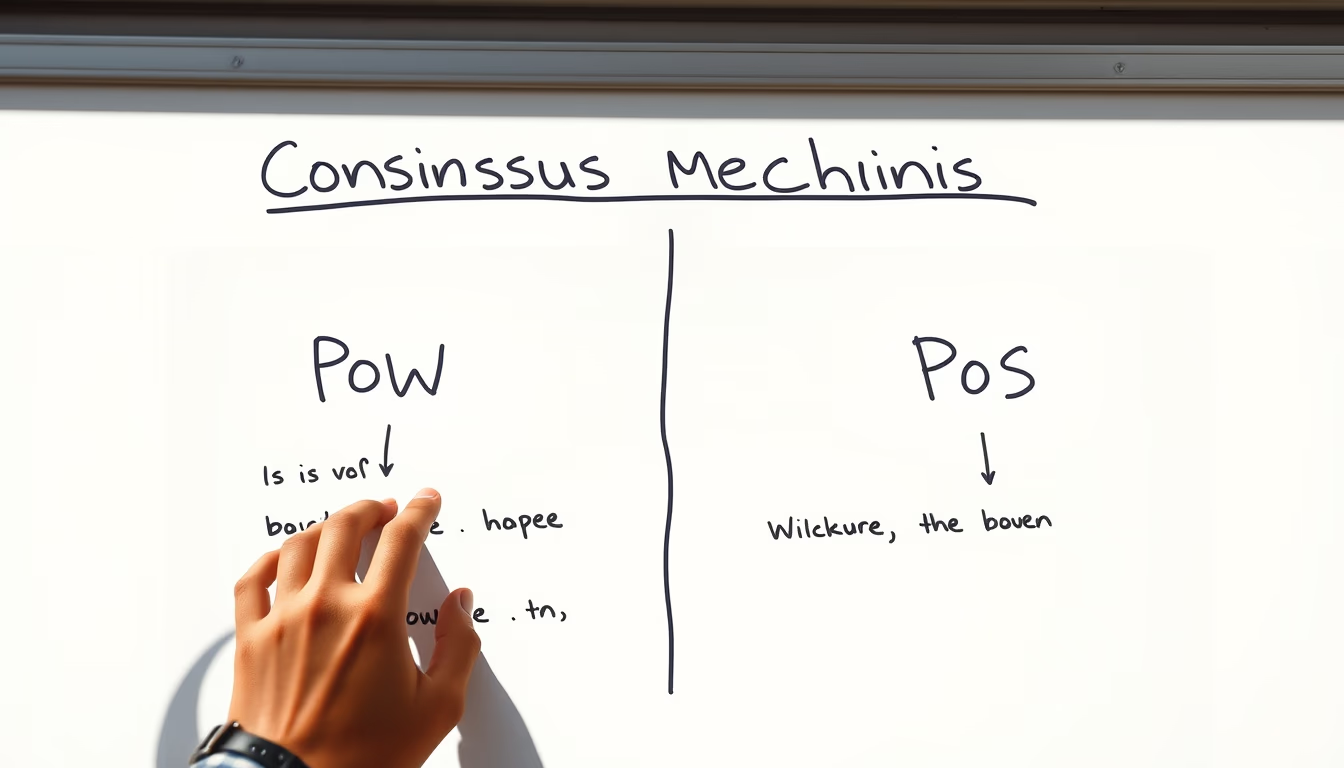 Consensus mechanism diagram on whiteboard showing PoW vs PoS
 Distributed ledger multiple servers in data center
 Hash function visualization cryptographic equations on glass screen
 Hash function visualization cryptographic equations on glass screen
 Hash function visualization cryptographic equations on glass screen