Distributed ledger multiple servers in data center
1344×768 · AVIF · CC BY 4.0

Understand how a distributed ledger operates across multiple servers in a data center, ensuring security and transparency in digital transactions.
About this subject
A distributed ledger is a shared and synchronized database across multiple participants, each maintaining an identical copy of the record. Unlike centralized systems where a single server controls the data, the distributed ledger operates on a network of servers, often housed in geographically dispersed data centers. This architecture eliminates single points of failure and increases resilience against cyberattacks.
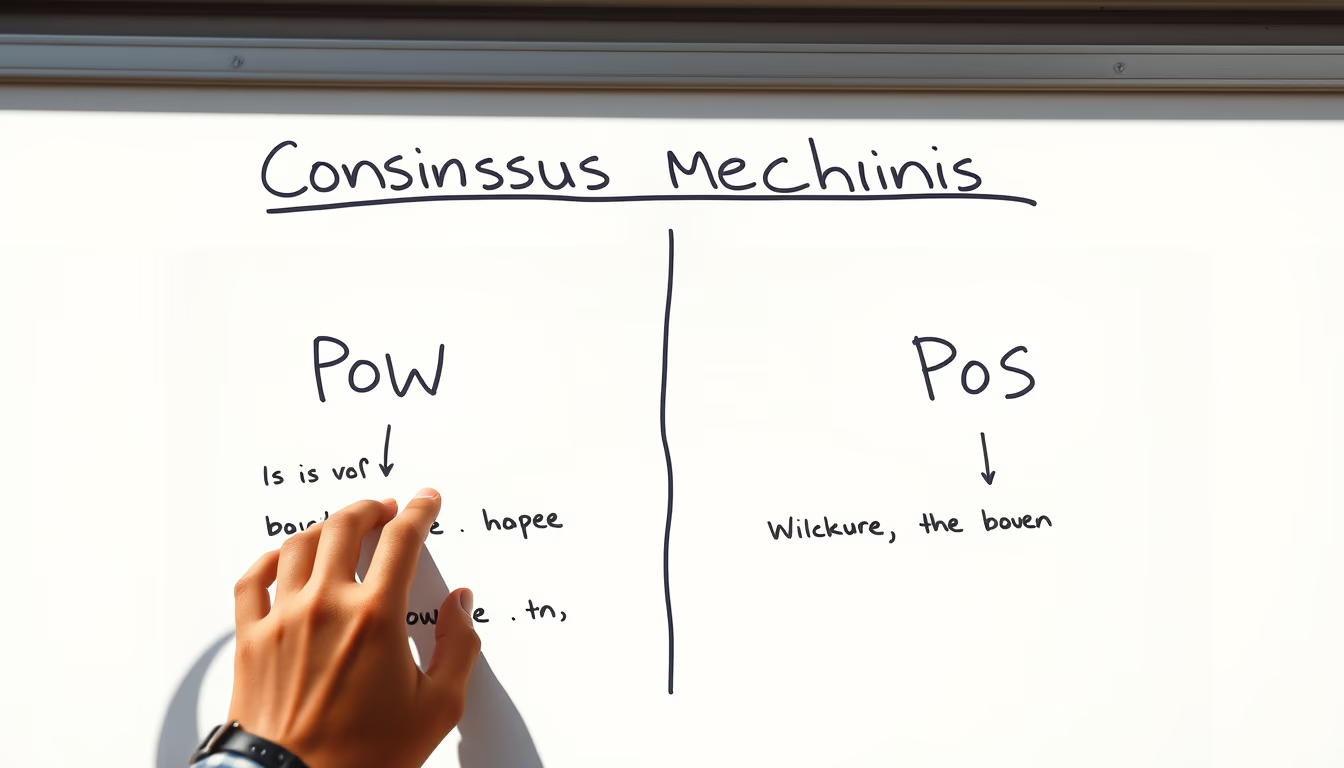
In the context of blockchains like Bitcoin and Ethereum, the distributed ledger is the backbone that records all transactions immutably. Each server, or node, validates and stores a copy of the ledger, using consensus algorithms such as Proof of Work or Proof of Stake to ensure all nodes agree on the current state. This redundancy makes it extremely difficult for an attacker to alter historical data, as they would need to compromise more than half of the network.
Implementing distributed ledgers in modern data centers follows strict physical and logical security standards. Servers are protected by biometric access controls, 24/7 surveillance, and fire suppression systems. Additionally, communication between nodes is encrypted, and backups are maintained in distinct locations to ensure continuity in case of natural disasters.
A notable curiosity is that distributed ledger technology is not limited to cryptocurrencies. Companies like IBM and Microsoft offer solutions based on Hyperledger Fabric for supply chain tracking, identity management, and smart contracts. In these cases, data centers can be private or cloud-based, with access permissions controlled by a central authority, differing from the permissionless model of traditional blockchains.
Frequently Asked Questions
What is the difference between a distributed ledger and a traditional database?
A distributed ledger is decentralized, with multiple copies synchronized among participants, while a traditional database typically has a single point of control (centralized). The distributed ledger offers greater security and transparency but may be slower due to consensus mechanisms.
How does distributed ledger technology ensure data immutability?
Immutability is ensured by cryptographic chaining of blocks and consensus among nodes. Each block contains a hash of the previous block, forming a chain. Altering a block would require modifying all subsequent blocks in more than half of the nodes, which is computationally infeasible.
What are the main use cases of distributed ledgers outside cryptocurrencies?
Beyond cryptocurrencies, distributed ledgers are used in supply chain tracking, electronic voting systems, intellectual property registration, digital identity management, and smart contracts in sectors such as finance, healthcare, and logistics.
Direct URL
https://pub-c7d6a6ea828543ac903a74a341ccb2e1.r2.dev/imagens/distributed-ledger-multiple-servers-in-data-center-editorial-portrait-bright-midday-sun.avifHow to credit
Include a visible link back to UtilizAí. Copy one of the snippets below:
<a href="https://xn--utiliza-eza.com/en/midia/imagens/distributed-ledger-multiple-servers-in-data-center-editorial-portrait-bright-midday-sun">Distributed ledger multiple servers in data center</a> by <a href="https://xn--utiliza-eza.com">UtilizAí</a>, licensed under <a href="https://creativecommons.org/licenses/by/4.0/">CC BY 4.0</a>.
[Distributed ledger multiple servers in data center](https://xn--utiliza-eza.com/en/midia/imagens/distributed-ledger-multiple-servers-in-data-center-editorial-portrait-bright-midday-sun) by [UtilizAí](https://xn--utiliza-eza.com), CC BY 4.0
License: CC-BY-4.0
Tags
Related images
 Smart contract code on monitor with solidity syntax highlighted
 Consensus mechanism diagram on whiteboard showing PoW vs PoS
 Distributed ledger multiple servers in data center
 Hash function visualization cryptographic equations on glass screen
 Hash function visualization cryptographic equations on glass screen
 Hash function visualization cryptographic equations on glass screen