Distributed ledger multiple servers in data center
1344×768 · AVIF · CC BY 4.0

Blockchain relies on distributed ledgers across redundant servers to ensure consensus and data immutability.
About this subject
A distributed ledger is the backbone of any blockchain, maintaining a synchronized and immutable record of transactions across multiple servers, called nodes. In a data center, these servers work together to validate and store each block, eliminating the need for a central authority. This architecture ensures that even if some servers fail or are compromised, the integrity of the network remains intact.
Redundancy is a key principle: the more servers participate, the greater the security and resistance to attacks. In public blockchains like Bitcoin or Ethereum, nodes are operated by independent entities worldwide. In private or permissioned blockchains, servers may be concentrated in one or more corporate data centers, but they still operate under a consensus protocol (such as Proof of Authority or Raft) requiring a majority of nodes to validate transactions.
Distributed ledger technology is not limited to cryptocurrencies; it is used in supply chains, digital identity, voting systems, and smart contracts. Latency between servers in a data center is low, allowing high transaction throughput, but true decentralization depends on the geographic distribution of nodes. Modern data centers include power, network, and cooling redundancy to ensure continuous availability.
Interestingly, the term “distributed ledger” is broader than blockchain, encompassing DAGs (Directed Acyclic Graphs) and other structures. The choice between storing the ledger in a centralized data center or across thousands of home computers directly impacts the network’s scalability, security, and governance.
Frequently Asked Questions
What is a distributed ledger?
It is a shared and synchronized database across multiple servers or nodes, where each transaction is recorded immutably and verified by consensus. Unlike traditional databases, there is no central controller.
How many servers are needed for a distributed ledger to work?
It depends on the protocol. Public blockchains often have thousands of nodes. Permissioned networks typically require 3 to 7 servers to ensure fault tolerance.
What is the difference between blockchain and distributed ledger?
Blockchain is a specific type of distributed ledger that organizes data into cryptographically chained blocks. Other types include DAGs (like IOTA) and private blockchains with different structures.
Direct URL
https://pub-c7d6a6ea828543ac903a74a341ccb2e1.r2.dev/imagens/distributed-ledger-multiple-servers-in-data-center-documentary-photography-studio-professional-lighting.avifHow to credit
Include a visible link back to UtilizAí. Copy one of the snippets below:
<a href="https://xn--utiliza-eza.com/en/midia/imagens/distributed-ledger-multiple-servers-in-data-center-documentary-photography-studio-professional-lighting">Distributed ledger multiple servers in data center</a> by <a href="https://xn--utiliza-eza.com">UtilizAí</a>, licensed under <a href="https://creativecommons.org/licenses/by/4.0/">CC BY 4.0</a>.
[Distributed ledger multiple servers in data center](https://xn--utiliza-eza.com/en/midia/imagens/distributed-ledger-multiple-servers-in-data-center-documentary-photography-studio-professional-lighting) by [UtilizAí](https://xn--utiliza-eza.com), CC BY 4.0
License: CC-BY-4.0
Tags
Related images
 Smart contract code on monitor with solidity syntax highlighted
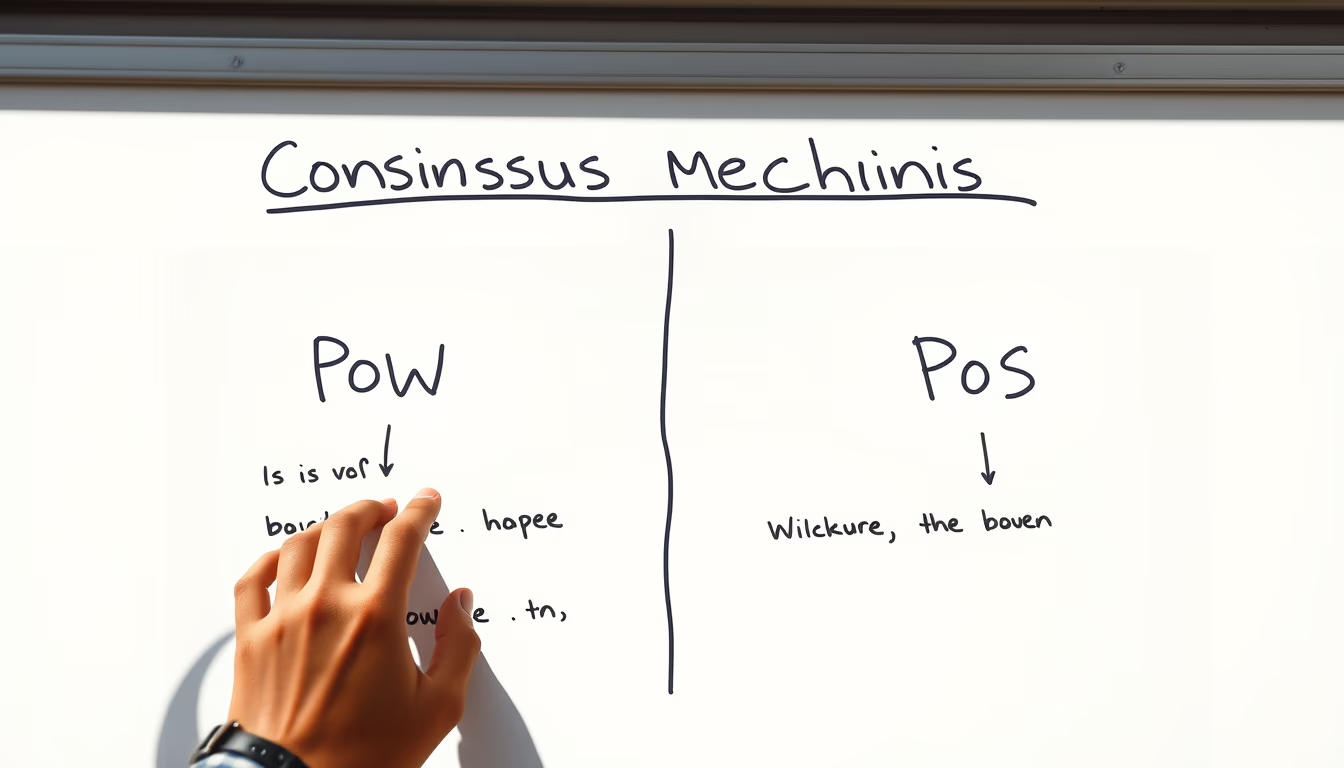 Consensus mechanism diagram on whiteboard showing PoW vs PoS
 Distributed ledger multiple servers in data center
 Hash function visualization cryptographic equations on glass screen
 Hash function visualization cryptographic equations on glass screen
 Hash function visualization cryptographic equations on glass screen