Distributed ledger multiple servers in data center
1344×768 · AVIF · CC BY 4.0

Distributed ledgers are digital records replicated across multiple data center servers, ensuring transparency and security without a central authority.
About this subject
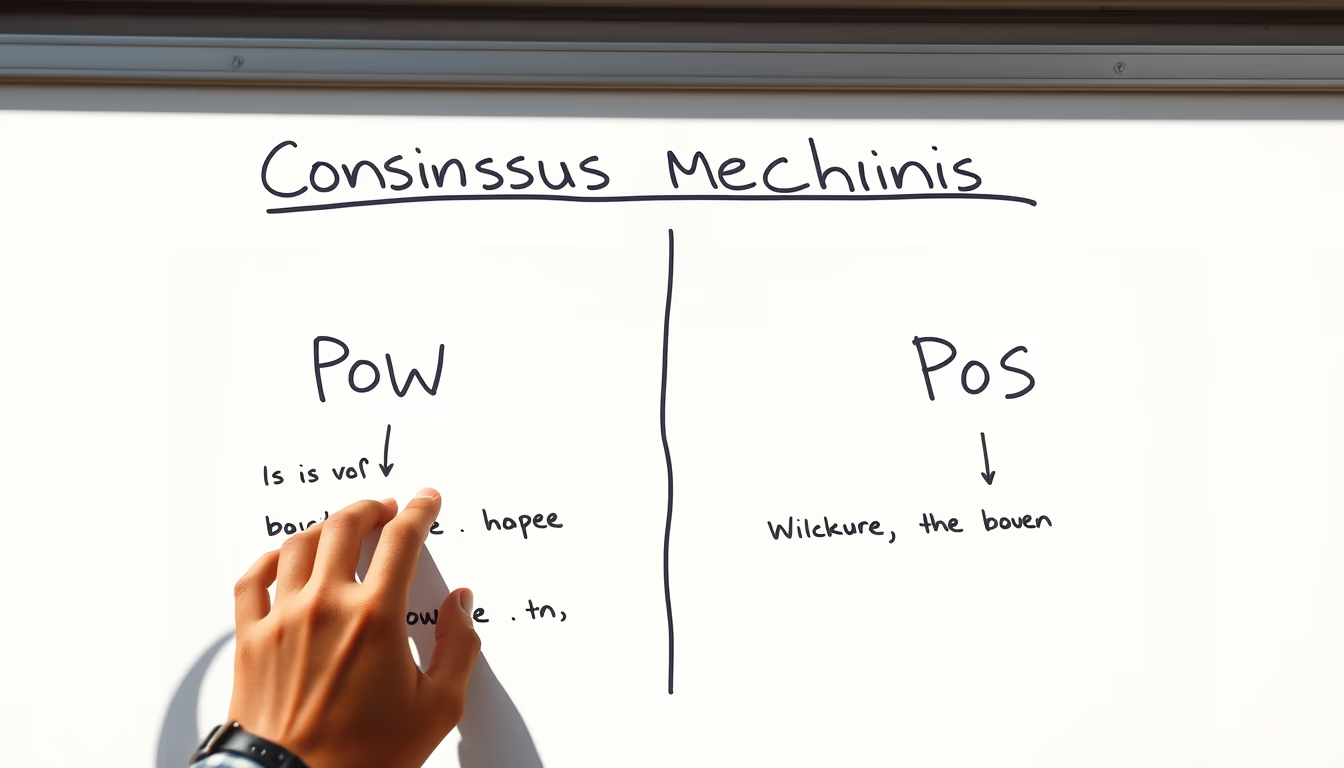
A distributed ledger is a consensual and shared database that operates across a network of computers, such as servers in data centers. Unlike traditional centralized databases, it does not rely on a single entity for validation. Each node in the network maintains an identical copy of the ledger, and updates are propagated and verified through consensus mechanisms like Proof of Work (PoW) or Proof of Stake (PoS). This architecture reduces risks of fraud and censorship, as unilateral changes are virtually impossible.
Distributed ledger technology gained prominence with Bitcoin in 2009, but its applications extend far beyond cryptocurrencies. Sectors like logistics, healthcare, and governance use ledgers to track supply chains, store medical records, and conduct electronic voting. Replication across multiple servers ensures high availability: even if some nodes fail, the system remains operational. Modern data centers host these servers with power and network redundancy, ensuring resilience.
A notable example is Hyperledger Fabric, from the Linux Foundation, used in enterprise consortia. It allows only authorized participants to access the ledger, combining privacy with immutability. Public blockchains like Ethereum use thousands of nodes spread globally. The choice between permissioned or public ledger depends on the use case: the former prioritizes control and speed; the latter, decentralization and full transparency.
Fun fact: the term "distributed ledger" was popularized by the Bank of England in 2014 while studying digital currencies. Today, projects like Corda (R3) and Quorum (JP Morgan) show how banks and companies integrate this technology into critical infrastructure, reducing reconciliation and auditing costs.
Frequently Asked Questions
What is the difference between a distributed ledger and a blockchain?
Every blockchain is a type of distributed ledger, but not every distributed ledger is a blockchain. Blockchains organize data in cryptographically chained blocks, while distributed ledgers may use other structures like DAG (Directed Acyclic Graph).
How many servers are needed for a distributed ledger?
There is no fixed minimum, but for security and consensus, permissioned networks typically have 4 to 20 nodes. Public blockchains like Bitcoin have thousands of nodes. More nodes increase decentralization but reduce speed.
Are distributed ledgers immune to attacks?
They are not immune but are more resilient. 51% attacks (controlling over half the computing power) are possible on public blockchains. In permissioned ledgers, the risk is lower due to access control, but internal attacks remain a concern.
Direct URL
https://pub-c7d6a6ea828543ac903a74a341ccb2e1.r2.dev/imagens/distributed-ledger-multiple-servers-in-data-center-cinematic-wide-shot-studio-professional-lighting.avifHow to credit
Include a visible link back to UtilizAí. Copy one of the snippets below:
<a href="https://xn--utiliza-eza.com/en/midia/imagens/distributed-ledger-multiple-servers-in-data-center-cinematic-wide-shot-studio-professional-lighting">Distributed ledger multiple servers in data center</a> by <a href="https://xn--utiliza-eza.com">UtilizAí</a>, licensed under <a href="https://creativecommons.org/licenses/by/4.0/">CC BY 4.0</a>.
[Distributed ledger multiple servers in data center](https://xn--utiliza-eza.com/en/midia/imagens/distributed-ledger-multiple-servers-in-data-center-cinematic-wide-shot-studio-professional-lighting) by [UtilizAí](https://xn--utiliza-eza.com), CC BY 4.0
License: CC-BY-4.0
Tags
Related images
 Smart contract code on monitor with solidity syntax highlighted
 Consensus mechanism diagram on whiteboard showing PoW vs PoS
 Distributed ledger multiple servers in data center
 Hash function visualization cryptographic equations on glass screen
 Hash function visualization cryptographic equations on glass screen
 Hash function visualization cryptographic equations on glass screen