Cuneiform sumerian tablet
1344×768 · AVIF · CC BY 4.0
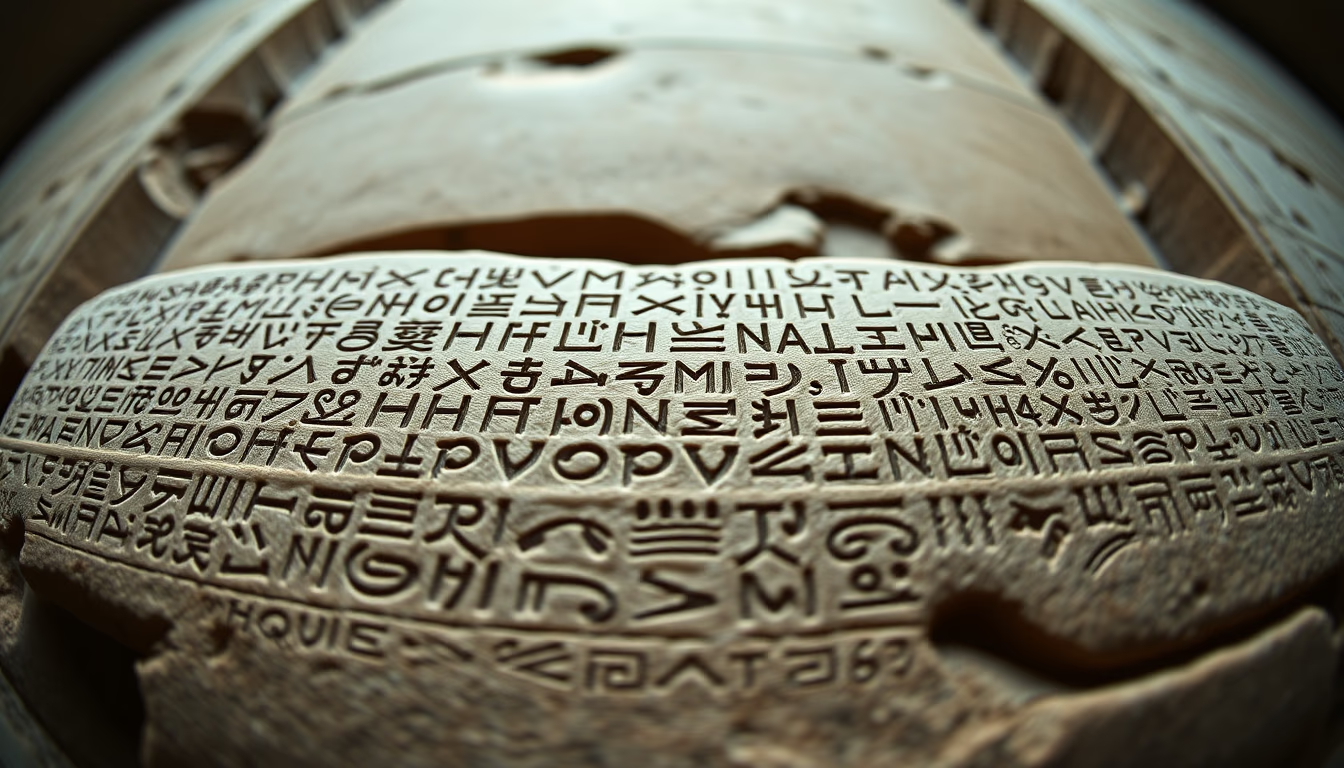
Clay tablet with Sumerian cuneiform script, one of the earliest writing systems in human history, dating back over 5,000 years.
About this subject
Cuneiform script was developed by the Sumerians in Mesopotamia around 3400 BCE, in what is now Iraq. Initially used for recording commercial and administrative transactions on fresh clay tablets, it was inscribed with a reed stylus shaped like a wedge, giving the script its name. Early examples are pictographic but quickly evolved into phonetic symbols, allowing representation of syllables and abstract ideas. This system was adopted by various ancient cultures, Akkadians, Babylonians, Assyrians, and lasted for over three millennia until replaced by simpler alphabets.
Clay tablets were remarkably durable: after being inscribed, they were dried in the sun or baked in kilns, preserving information for millennia. The city of Uruk in Sumer produced thousands of these tablets, revealing details about economy, religion, law, and literature, including the Epic of Gilgamesh. Deciphering cuneiform began in the 19th century, with scholars like Henry Rawlinson working on the Behistun inscription. Today, about 500,000 tablets are scattered in museums worldwide, many still untranslated.
Culturally, cuneiform represents a fundamental cognitive leap: the ability to record and transmit knowledge beyond oral memory. The Sumerians also invented the wheel, irrigated agriculture, and the first code of laws, but writing was perhaps their most impactful legacy. It allowed systematization of taxes, contracts, and narratives, forming the basis of later civilizations. Interestingly, the term "clay" in the Bible (Genesis 2:7) echoes the creation of man from clay, a symbolic parallel with the tablets that gave voice to history.
Frequently Asked Questions
What is cuneiform script?
Cuneiform is a writing system developed by the Sumerians in Mesopotamia over 5,000 years ago. It was inscribed with a wedge-shaped stylus on moist clay and used by various ancient cultures for about 3,000 years.
What were Sumerian clay tablets used for?
Clay tablets were mainly used to record commercial transactions, inventories, laws, and literary texts. They were extremely durable and provide valuable insights into life in ancient Mesopotamia.
How was cuneiform deciphered?
Cuneiform was deciphered in the 19th century, largely by Henry Rawlinson, who used the trilingual Behistun inscription as a key. This monument contained the same text in Old Persian, Elamite, and Akkadian (cuneiform), enabling comparison.
Direct URL
https://pub-c7d6a6ea828543ac903a74a341ccb2e1.r2.dev/imagens/cuneiform-sumerian-tablet-fish-eye-wide-angle-fresh1.avifHow to credit
Include a visible link back to UtilizAí. Copy one of the snippets below:
<a href="https://xn--utiliza-eza.com/en/midia/imagens/cuneiform-sumerian-tablet-fish-eye-wide-angle-fresh1">Cuneiform sumerian tablet</a> by <a href="https://xn--utiliza-eza.com">UtilizAí</a>, licensed under <a href="https://creativecommons.org/licenses/by/4.0/">CC BY 4.0</a>.
[Cuneiform sumerian tablet](https://xn--utiliza-eza.com/en/midia/imagens/cuneiform-sumerian-tablet-fish-eye-wide-angle-fresh1) by [UtilizAí](https://xn--utiliza-eza.com), CC BY 4.0
License: CC-BY-4.0