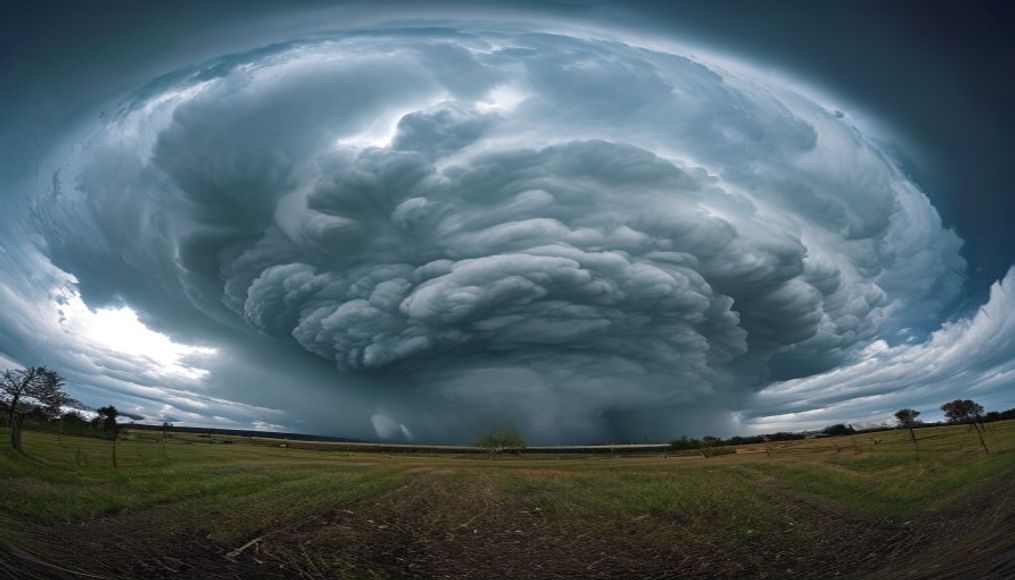
Cumulonimbus thunderhead
1344×768 · AVIF · CC BY 4.0

Cumulonimbus are towering clouds responsible for severe thunderstorms, lightning, and hail.
About this subject
Cumulonimbus clouds are the most towering in Earth's atmosphere, extending from a base about 200 to 2000 meters above ground to a top that often surpasses 12 kilometers, reaching up to 20 kilometers in tropical regions. They form under strong vertical instability when warm, moist air rises rapidly, cools, and condenses, releasing latent heat that accelerates ascent. This process creates a vigorous updraft that sustains the cloud, while precipitation (rain, hail) and droplet drag generate downdrafts.
The characteristic anvil-shaped top emerges when the cloud hits the tropopause, the boundary between troposphere and stratosphere. Rising air spreads horizontally, creating a flat expanse of ice crystals. These clouds are responsible for extreme weather: torrential rain, lightning, strong winds, and in severe cases, tornadoes. Internal electrification results from collisions between ice and water particles, building positive and negative charges that produce lightning.
Globally, cumulonimbus occur everywhere but are most frequent in the tropics, where solar energy is intense and humidity abundant. They play a key role in the hydrological cycle, transporting large volumes of water to the upper atmosphere and redistributing heat. Despite their beauty, they pose hazards to aviation and outdoor activities, monitored by weather radars and satellites.
Frequently Asked Questions
What is the maximum height of a cumulonimbus?
Cumulonimbus can reach up to 20 kilometers in altitude in the tropics, with the top often exceeding 12 kilometers.
How to differentiate cumulonimbus from other clouds?
The anvil-shaped top is the most distinctive feature. Also, they are dense, dark at the base, and associated with storms.
Why does the top have an anvil shape?
The top flattens upon reaching the tropopause because air can no longer rise and spreads horizontally, forming ice crystals.
Direct URL
https://pub-c7d6a6ea828543ac903a74a341ccb2e1.r2.dev/imagens/cumulonimbus-thunderhead-isometric-flat-lay-p3.avifHow to credit
Include a visible link back to UtilizAí. Copy one of the snippets below:
<a href="https://xn--utiliza-eza.com/en/midia/imagens/cumulonimbus-thunderhead-isometric-flat-lay-p3">Cumulonimbus thunderhead</a> by <a href="https://xn--utiliza-eza.com">UtilizAí</a>, licensed under <a href="https://creativecommons.org/licenses/by/4.0/">CC BY 4.0</a>.
[Cumulonimbus thunderhead](https://xn--utiliza-eza.com/en/midia/imagens/cumulonimbus-thunderhead-isometric-flat-lay-p3) by [UtilizAí](https://xn--utiliza-eza.com), CC BY 4.0
License: CC-BY-4.0