Chess board mid game
1344×768 · AVIF · CC BY 4.0
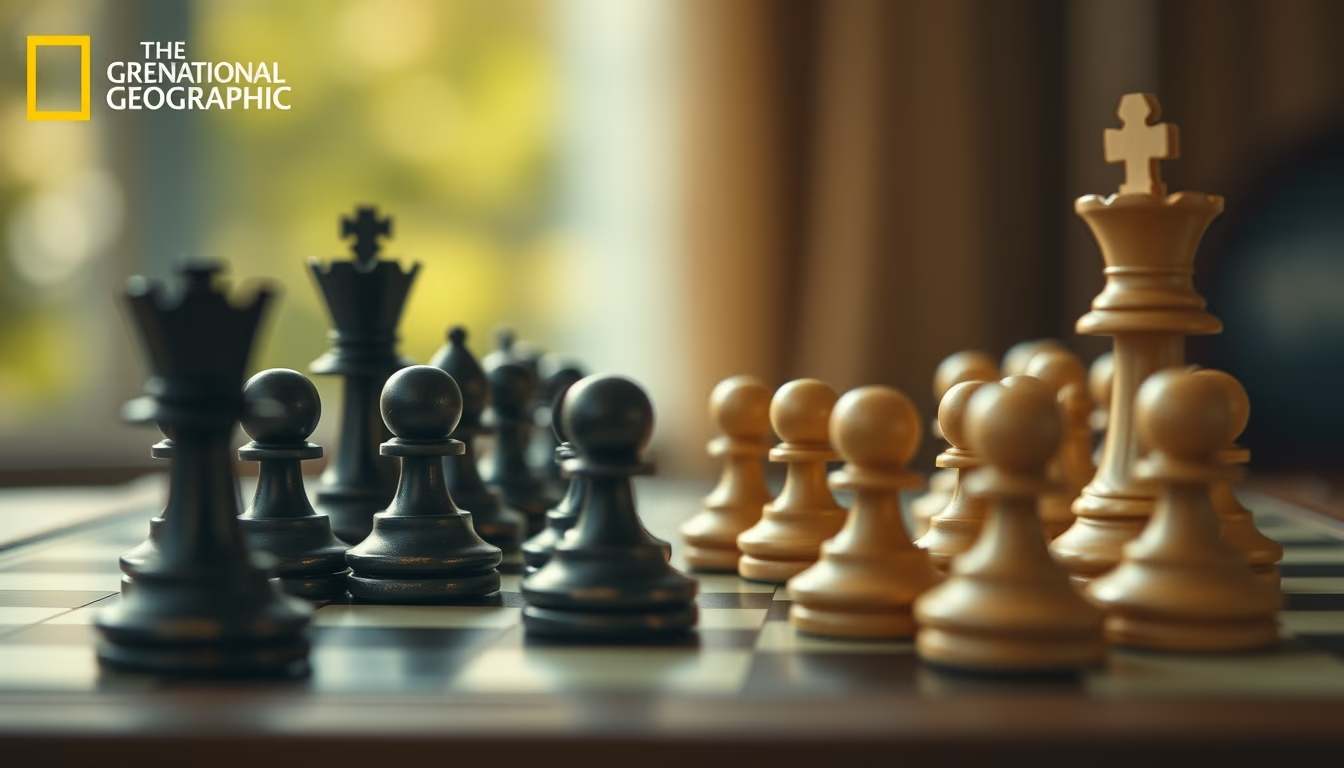
The middlegame in chess is the most complex and creative phase, where opening strategies give way to tactical combinations and long-term plans.
About this subject
The chess middlegame begins after the development of pieces and the conclusion of the opening, typically around the tenth move. In this phase, players seek positional advantages such as control of the center, better pawn structure, and more active pieces. Middlegame theory is vast and includes concepts like king attacks, pawn blockades, tactical sacrifices, and exploitation of weak squares. Grandmasters like Garry Kasparov and Anatoly Karpov are renowned for their mastery in this stage, with historical games like the 1990 World Championship match exemplifying the struggle between initiative and defense.
A crucial feature of the middlegame is the evaluation of exchanges: deciding whether a trade of pieces benefits one's own plan or the opponent's. Studying classic games, such as those of Mikhail Tal, famous for his visionary sacrifices, helps develop tactical intuition. Today, chess engines like Stockfish and Leela Chess Zero have revolutionized analysis, revealing subtleties that were previously overlooked, but human play still values psychological and creative aspects.
In the Brazilian context, chess has grown especially among youth and in schools, with competitions like the Brazilian Chess Championship and the Brazilian School Chess Olympiad. The middlegame is often the focus of study in clubs and courses, as it is where most games are decided. Interestingly, the term 'middlegame' can be subdivided into phases like 'positional play' and 'tactical play', depending on the pawn structure and piece activity.
Furthermore, the middlegame is the scene of some of the most famous moves in history, such as the 'Immortal Game' by Adolf Anderssen (1851) and the 'Game of the Century' between Donald Byrne and Bobby Fischer (1956). These games show how creativity and precision can turn a modest advantage into a spectacular victory. For amateur players, the recommendation is to practice tactical exercises and study endgames, as the transition from middlegame to endgame is a critical moment.
Frequently Asked Questions
What characterizes the middlegame in chess?
The middlegame is the phase after the opening, when pieces are developed and players begin executing strategic and tactical plans, aiming for material or positional advantage.
What are the main concepts of the middlegame?
They include king attacks, center control, pawn structure, piece activity, weak squares, open lines, and exchange evaluation. This phase is rich in combinations and sacrifices.
How to study the middlegame efficiently?
It is recommended to analyze grandmaster games, solve tactical puzzles daily, and practice with chess software that highlights plans and typical mistakes.
Direct URL
https://pub-c7d6a6ea828543ac903a74a341ccb2e1.r2.dev/imagens/chess-board-mid-game-national-geographic-style-p5.avifHow to credit
Include a visible link back to UtilizAí. Copy one of the snippets below:
<a href="https://xn--utiliza-eza.com/en/midia/imagens/chess-board-mid-game-national-geographic-style-p5">Chess board mid game</a> by <a href="https://xn--utiliza-eza.com">UtilizAí</a>, licensed under <a href="https://creativecommons.org/licenses/by/4.0/">CC BY 4.0</a>.
[Chess board mid game](https://xn--utiliza-eza.com/en/midia/imagens/chess-board-mid-game-national-geographic-style-p5) by [UtilizAí](https://xn--utiliza-eza.com), CC BY 4.0
License: CC-BY-4.0