Blockchain network visualization glowing nodes connected by lines on dark background
1344×768 · AVIF · CC BY 4.0

Blockchain is a decentralized digital ledger that records transactions in interconnected blocks, ensuring transparency and security without intermediaries.
About this subject
Blockchain is the underlying technology behind cryptocurrencies like Bitcoin and Ethereum, but its applications extend far beyond finance. It is a distributed database where each block contains a set of transactions, a timestamp, and a cryptographic hash of the previous block, forming an immutable chain. This structure ensures that once information is recorded, it cannot be altered without network consensus.
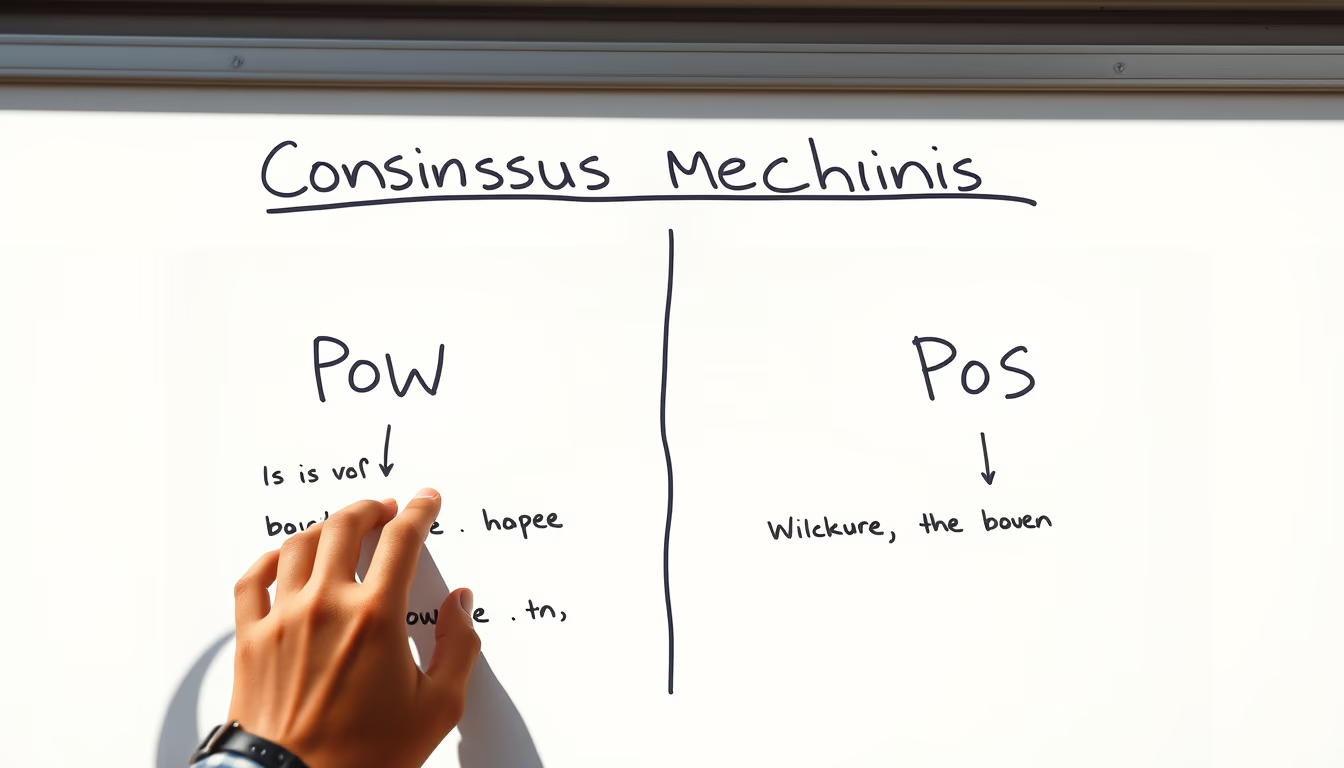
Decentralization is the core pillar of blockchain. Unlike traditional systems relying on a central authority (e.g., banks or governments), blockchain operates on a peer-to-peer network of computers (nodes). Each node maintains a full copy of the ledger, and transactions are validated by consensus mechanisms such as Proof of Work or Proof of Stake. This eliminates intermediaries and reduces fraud risk.
Beyond cryptocurrencies, blockchain is used in supply chains to track products from origin to consumer, ensuring authenticity and combating counterfeits. In the public sector, governments experiment with blockchain for secure electronic voting and land registry. In healthcare, it enables secure sharing of medical records across institutions.
A current challenge is scalability: blockchains like Bitcoin process few transactions per second compared to centralized systems. Solutions such as sharding, sidechains, and layer 2 protocols (e.g., Lightning Network) aim to increase capacity without compromising security. The technology continues to evolve, with green blockchains adopting Proof of Stake to reduce energy consumption.
Frequently Asked Questions
What is a node in a blockchain network?
A node is any computer connected to the blockchain network that maintains a copy of the ledger and participates in transaction validation. Nodes can be full (storing the entire history) or light (only block headers).
How does blockchain ensure data security?
Security comes from cryptographic hashing, decentralization, and consensus. Each block is linked to the previous one by a hash, and altering a block would require recalculating all subsequent blocks, which is computationally infeasible in a large network.
What are the main differences between public and private blockchain?
Public blockchain (e.g., Bitcoin) is open to anyone, permissionless, and fully decentralized. Private blockchain is restricted to authorized participants, offering greater speed and control but less decentralization.
Direct URL
https://pub-c7d6a6ea828543ac903a74a341ccb2e1.r2.dev/imagens/blockchain-network-visualization-glowing-nodes-connected-by-lines-on-dark-backgr-aerial-drone-shot-morning-natural-light.avifHow to credit
Include a visible link back to UtilizAí. Copy one of the snippets below:
<a href="https://xn--utiliza-eza.com/en/midia/imagens/blockchain-network-visualization-glowing-nodes-connected-by-lines-on-dark-backgr-aerial-drone-shot-morning-natural-light">Blockchain network visualization glowing nodes connected by lines on dark background</a> by <a href="https://xn--utiliza-eza.com">UtilizAí</a>, licensed under <a href="https://creativecommons.org/licenses/by/4.0/">CC BY 4.0</a>.
[Blockchain network visualization glowing nodes connected by lines on dark background](https://xn--utiliza-eza.com/en/midia/imagens/blockchain-network-visualization-glowing-nodes-connected-by-lines-on-dark-backgr-aerial-drone-shot-morning-natural-light) by [UtilizAí](https://xn--utiliza-eza.com), CC BY 4.0
License: CC-BY-4.0
Tags
Related images
 Smart contract code on monitor with solidity syntax highlighted
 Consensus mechanism diagram on whiteboard showing PoW vs PoS
 Distributed ledger multiple servers in data center
 Hash function visualization cryptographic equations on glass screen
 Hash function visualization cryptographic equations on glass screen
 Hash function visualization cryptographic equations on glass screen