Aircraft carrier deck
1344×768 · AVIF · CC BY 4.0
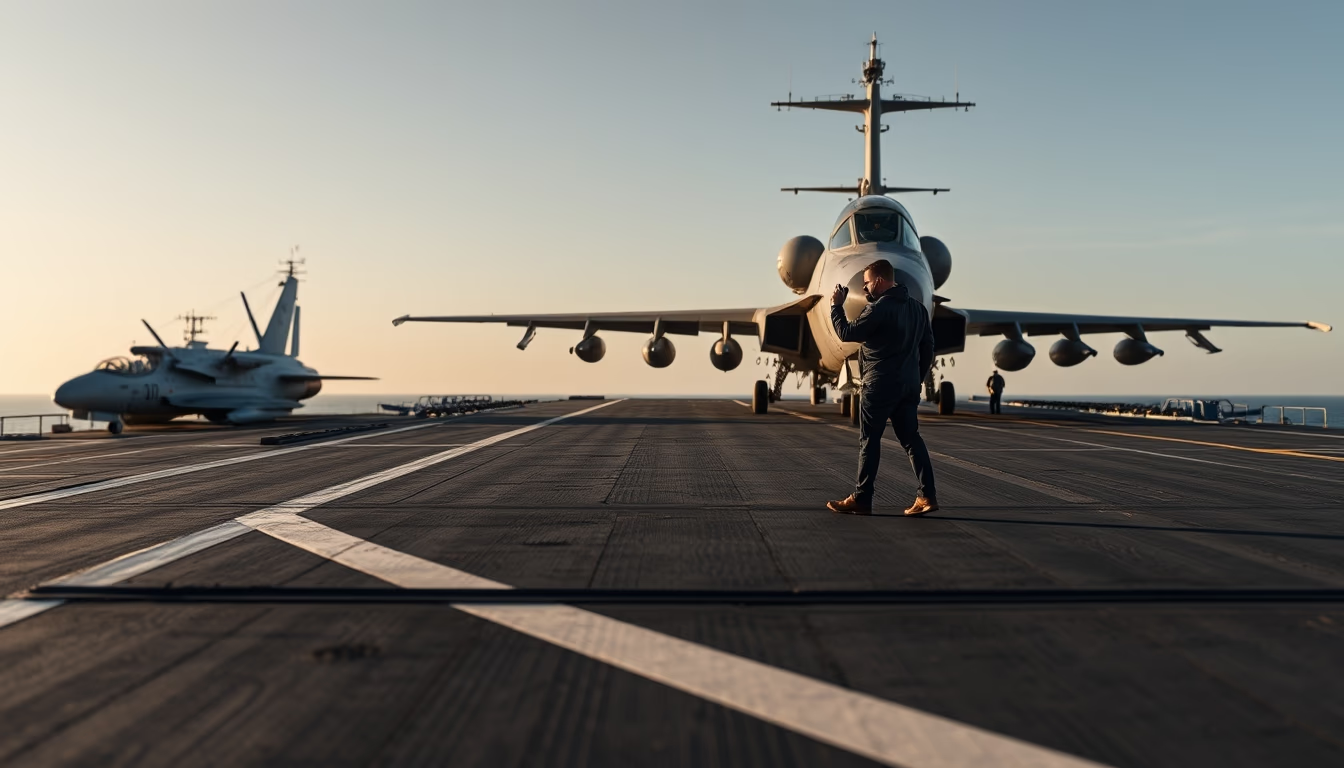
An aircraft carrier deck is a floating runway that enables launch and recovery of military aircraft at sea, the nerve center of naval aviation.
About this subject
The flight deck, also known as the aircraft carrier deck, is the primary area for air operations on an aircraft carrier. It is a flat, reinforced steel surface that spans the entire length of the ship, designed to allow fixed-wing and rotary-wing aircraft to take off, land, and be maneuvered safely. On modern carriers like the U.S. Nimitz class, the deck measures about 333 meters in length and 78 meters in width, an area larger than four football fields. This massive platform is covered with a non-slip coating and features color-coded markings that guide aircraft and support vehicle movement.
A key innovation on these decks is the angled design. Introduced in the 1950s, the angled deck offsets the landing strip by about 8 to 10 degrees from the ship's longitudinal axis. This allows aircraft to land and stop safely while others take off from the bow, greatly improving operational efficiency. The deck also houses catapult systems and arresting wires. Catapults, which can be steam-powered or electromagnetic (EMALS), accelerate fighters from 0 to 270 km/h in just two seconds. Arresting wires are steel cables stretched across the deck that catch the aircraft's tailhook during landing, rapidly reducing its speed.
Operations on the flight deck are among the most intense and dangerous in the military. Hundreds of sailors work simultaneously, each with specific roles identified by colored vests: blue for aircraft movement, yellow for launch officers, green for catapult operators, red for ordnance and safety, among others. The noise is deafening, and communication is done through hand signals. A Nimitz-class carrier can conduct up to 120 sorties per day in combat operations, each involving precise choreography of refueling, rearming, and launching.
Interestingly, the flight deck also serves as a parking area and temporary hangar. Aircraft are positioned in designated spots, and movement is planned by flight deck officers. The world's largest aircraft carrier, USS Gerald R. Ford (CVN-78), can accommodate over 75 aircraft and features an optimized deck that increases launch rate by 25% compared to the Nimitz class. Deck maintenance is constant, with special coatings applied to withstand jet exhaust heat and saltwater corrosion.
Frequently Asked Questions
How many aircraft can fit on an aircraft carrier deck?
It depends on the carrier size. Nimitz-class carriers can carry up to 90 aircraft, while the USS Gerald R. Ford holds over 75. On the deck, parking space is limited, and simultaneous storage varies by aircraft dimensions.
How does an aircraft carrier catapult work?
The catapult uses steam or electromagnetic energy to propel the aircraft. Steam catapults rely on high-pressure pistons in cylinders along the deck. The EMALS system uses a linear motor to accelerate the plane more smoothly, allowing launches of both lighter and heavier aircraft.
What is an angled deck and what are its advantages?
An angled deck is a landing strip offset at an angle (about 8-10 degrees) from the ship's axis. Its main advantage is allowing aircraft to land and stop while others take off from the bow, eliminating waiting time and increasing simultaneous operations.
Direct URL
https://pub-c7d6a6ea828543ac903a74a341ccb2e1.r2.dev/imagens/aircraft-carrier-deck-magazine-editorial-p0.avifHow to credit
Include a visible link back to UtilizAí. Copy one of the snippets below:
<a href="https://xn--utiliza-eza.com/en/midia/imagens/aircraft-carrier-deck-magazine-editorial-p0">Aircraft carrier deck</a> by <a href="https://xn--utiliza-eza.com">UtilizAí</a>, licensed under <a href="https://creativecommons.org/licenses/by/4.0/">CC BY 4.0</a>.
[Aircraft carrier deck](https://xn--utiliza-eza.com/en/midia/imagens/aircraft-carrier-deck-magazine-editorial-p0) by [UtilizAí](https://xn--utiliza-eza.com), CC BY 4.0
License: CC-BY-4.0