Wormhole portal blue
1344×768 · AVIF · CC BY 4.0
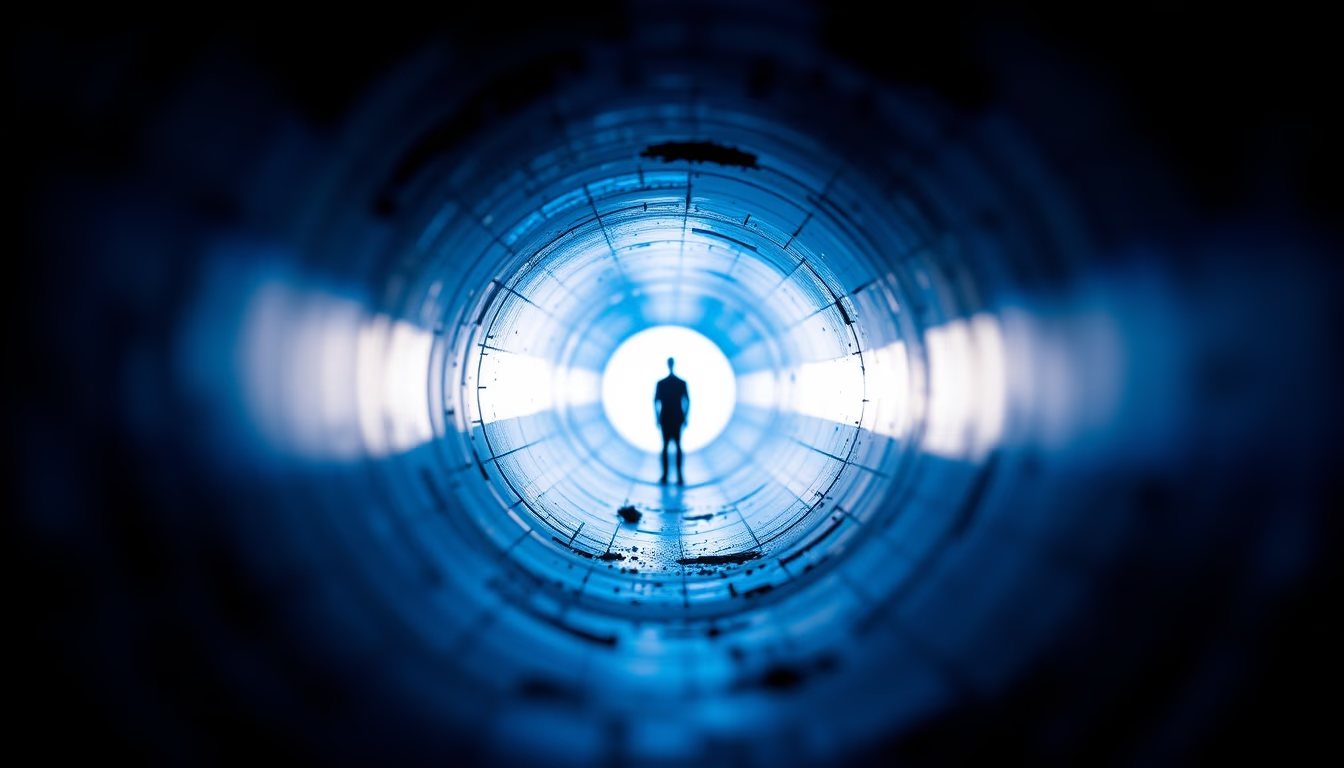
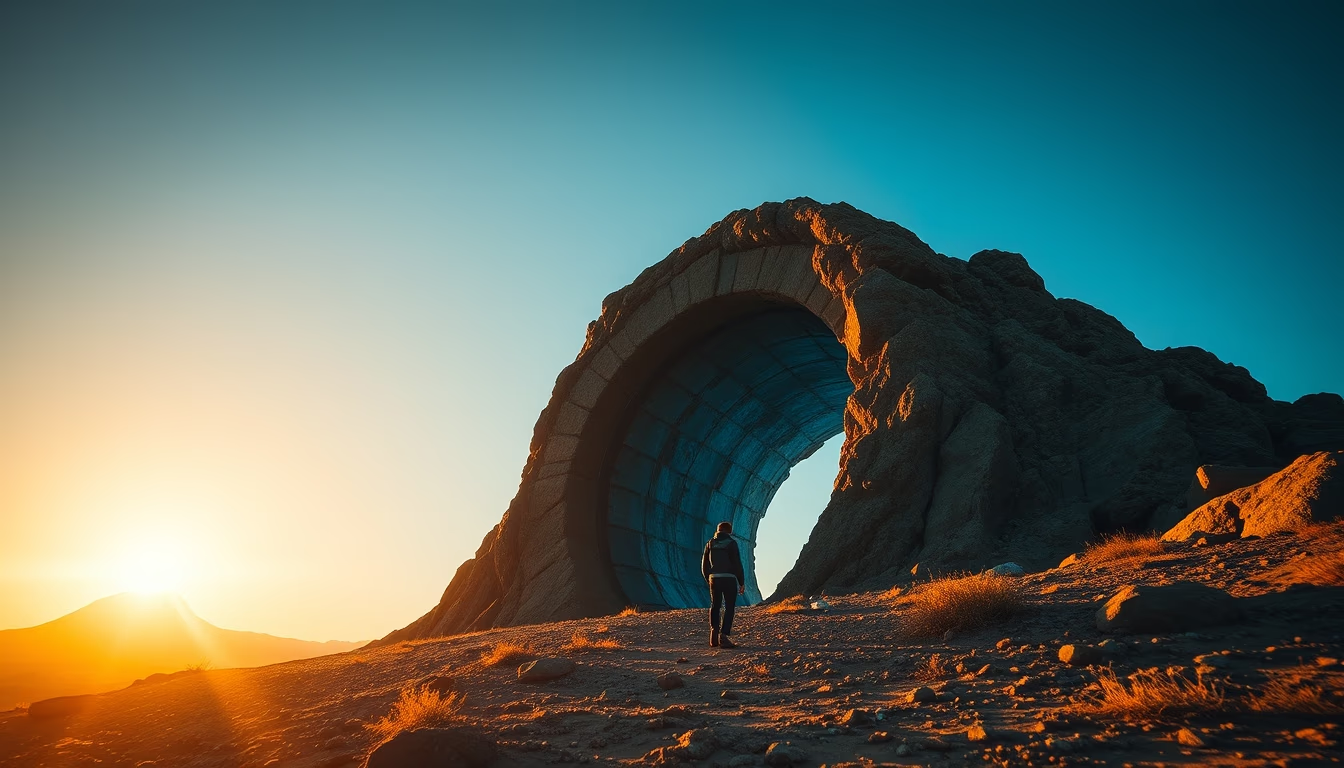
Blue wormhole portal miniature: understand what wormholes are in theoretical physics and science fiction.
About this subject
A wormhole, also known as an Einstein-Rosen bridge, is a hypothetical structure of spacetime that connects two distant points in the universe. Theoretically proposed by Albert Einstein and Nathan Rosen in 1935, this concept arises from the equations of general relativity, which allow shortcuts through the spacetime continuum. In practice, a wormhole would be a tunnel with two mouths connected by a throat, capable of shortening interstellar journeys or even enabling time travel, although its stability requires exotic matter with negative energy, something not yet observed.
In popular culture, wormholes are one of the most recurring themes in science fiction, appearing in films such as "Interstellar" (2014), where Christopher Nolan's team consulted physicist Kip Thorne to portray a wormhole with scientific realism. The classic visual of a bright blue portal with concentric rings, often associated with these objects, was inspired by computer simulations of gravitational lensing and light distortions. This design has become a visual icon, representing the gateway to unknown dimensions or distant galaxies.
Despite no observational evidence of natural wormholes, some physicists speculate they could be artificially created by advanced civilizations, or emerge at quantum scales in the so-called multiverse. The search for indirect signatures, such as anomalies in gravitational lensing or gamma-ray emissions, continues. Meanwhile, the concept fuels not only science but also digital art and 3D modeling, such as the tilt-shift miniature image that transforms a cosmic phenomenon into a playful and tangible object, bringing viewers closer to the fascination with the unknown.
Frequently Asked Questions
What is a wormhole?
A wormhole is a hypothetical solution of general relativity that connects two points in spacetime, acting as a shortcut. Also called an Einstein-Rosen bridge, it would have two mouths linked by a throat.
Do wormholes really exist?
To date, no wormhole has been directly observed. They remain theoretical, and their existence would require exotic matter with negative energy, which hasn't been found in nature.
What's the difference between a wormhole and a black hole?
A black hole is a region of infinite density that traps everything, including light, whereas a wormhole would be a passage connecting two points, without necessarily having an event horizon.
Direct URL
https://pub-c7d6a6ea828543ac903a74a341ccb2e1.r2.dev/imagens/wormhole-portal-blue-tilt-shift-miniature-fresh15.avifHow to credit
Include a visible link back to UtilizAí. Copy one of the snippets below:
<a href="https://xn--utiliza-eza.com/en/midia/imagens/wormhole-portal-blue-tilt-shift-miniature-fresh15">Wormhole portal blue</a> by <a href="https://xn--utiliza-eza.com">UtilizAí</a>, licensed under <a href="https://creativecommons.org/licenses/by/4.0/">CC BY 4.0</a>.
[Wormhole portal blue](https://xn--utiliza-eza.com/en/midia/imagens/wormhole-portal-blue-tilt-shift-miniature-fresh15) by [UtilizAí](https://xn--utiliza-eza.com), CC BY 4.0
License: CC-BY-4.0