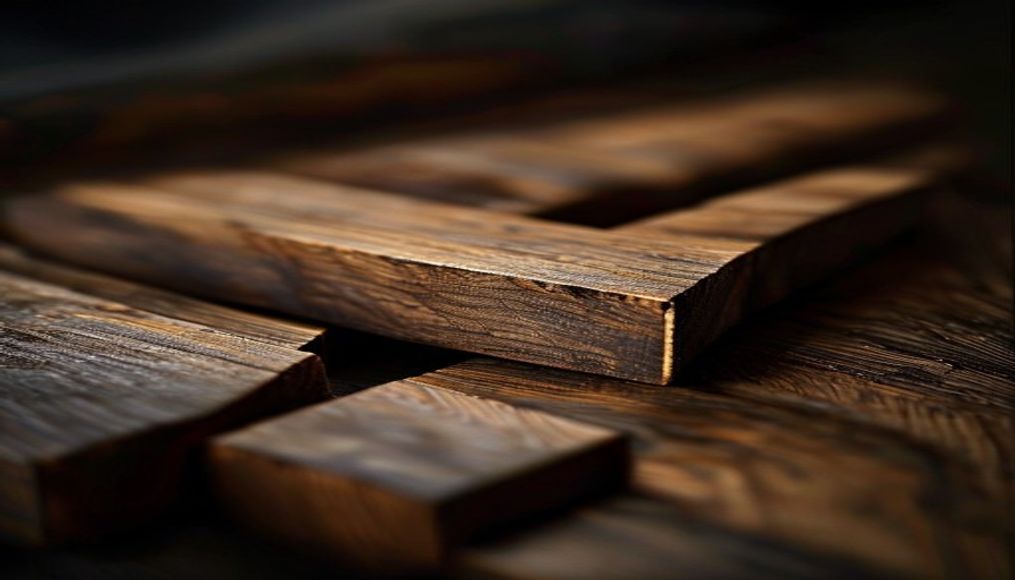
Woodturning chisel detail
1344×768 · AVIF · CC BY 4.0

Detail of a woodturning chisel, an essential tool in handcrafted woodworking that enables precise shaping of cylindrical pieces.
About this subject
The woodturning chisel is a cutting tool used in mechanical or manual lathes to shape rotating wood pieces. Its hardened steel blade, typically with a bevel angle between 25° and 45°, allows controlled chip removal, creating everything from smooth surfaces to ornamental details. Various types exist, such as roughing gouges, skew chisels, and parting tools, each with specific profiles and purposes. The image detail shows the tool tip, possibly with wear marks and wood residues, highlighting the interaction between steel and wood fiber.
Woodturning techniques date back to antiquity, with evidence of primitive lathes in Egypt and China. In Brazil, woodturning spread through colonial joinery, adapting to native woods like ipê, cedar, and peroba. Today, artisans and woodworkers use high-precision chisels, often made from high-speed steel (HSS) or with carbide inserts, for greater durability. Proper sharpening is crucial: a dull chisel can burn the wood or cause accidents. Consequently, many turners maintain a sharpening routine using water stones or grinders.
Beyond its functional role, the woodturning chisel symbolizes manual skill and patience. Every turned piece, from a tool handle to a decorative bowl, begins with precise contact between metal and wood spinning at high speeds. The continuous motion and gradual material removal demand concentration and tactile sensitivity. The choice of attack angle and pressure determines the final result, making each chisel an extension of the craftsman's hand.
Interestingly, the word "chisel" comes from the Latin "caelum" (to engrave). In turning, the tool not only cuts but truly shapes the raw material. The image captures a moment of this process, where the blade detail reveals natural wear and usage history. For antique tool collectors, chisels from brands like Record, Sorby, or Stanley are valued items, often restored and reused in contemporary workshops.
Frequently Asked Questions
What are the main types of woodturning chisels?
The main types are: gouge (roughing chisel), skew chisel, parting tool, scraper, and bowl gouge. Each has a specific profile and angle for different turning stages.
How to properly sharpen a woodturning chisel?
Sharpening can be done with water stones, grinders, or jig systems. The bevel angle must be kept constant, typically between 25° and 45° depending on use. After sharpening, hone the blade with a fine stone or abrasive to remove burrs.
What is the difference between high-speed steel (HSS) and carbon steel chisels?
HSS retains its edge at high temperatures, ideal for continuous turning. Carbon steel is easier to sharpen but loses temper with excessive heat. The choice depends on usage frequency and wood type.
Direct URL
https://pub-c7d6a6ea828543ac903a74a341ccb2e1.r2.dev/imagens/woodturning-chisel-detail-cinematic-wide-shot-p2.avifHow to credit
Include a visible link back to UtilizAí. Copy one of the snippets below:
<a href="https://xn--utiliza-eza.com/en/midia/imagens/woodturning-chisel-detail-cinematic-wide-shot-p2">Woodturning chisel detail</a> by <a href="https://xn--utiliza-eza.com">UtilizAí</a>, licensed under <a href="https://creativecommons.org/licenses/by/4.0/">CC BY 4.0</a>.
[Woodturning chisel detail](https://xn--utiliza-eza.com/en/midia/imagens/woodturning-chisel-detail-cinematic-wide-shot-p2) by [UtilizAí](https://xn--utiliza-eza.com), CC BY 4.0
License: CC-BY-4.0