Tugboat working harbor
1344×768 · AVIF · CC BY 4.0
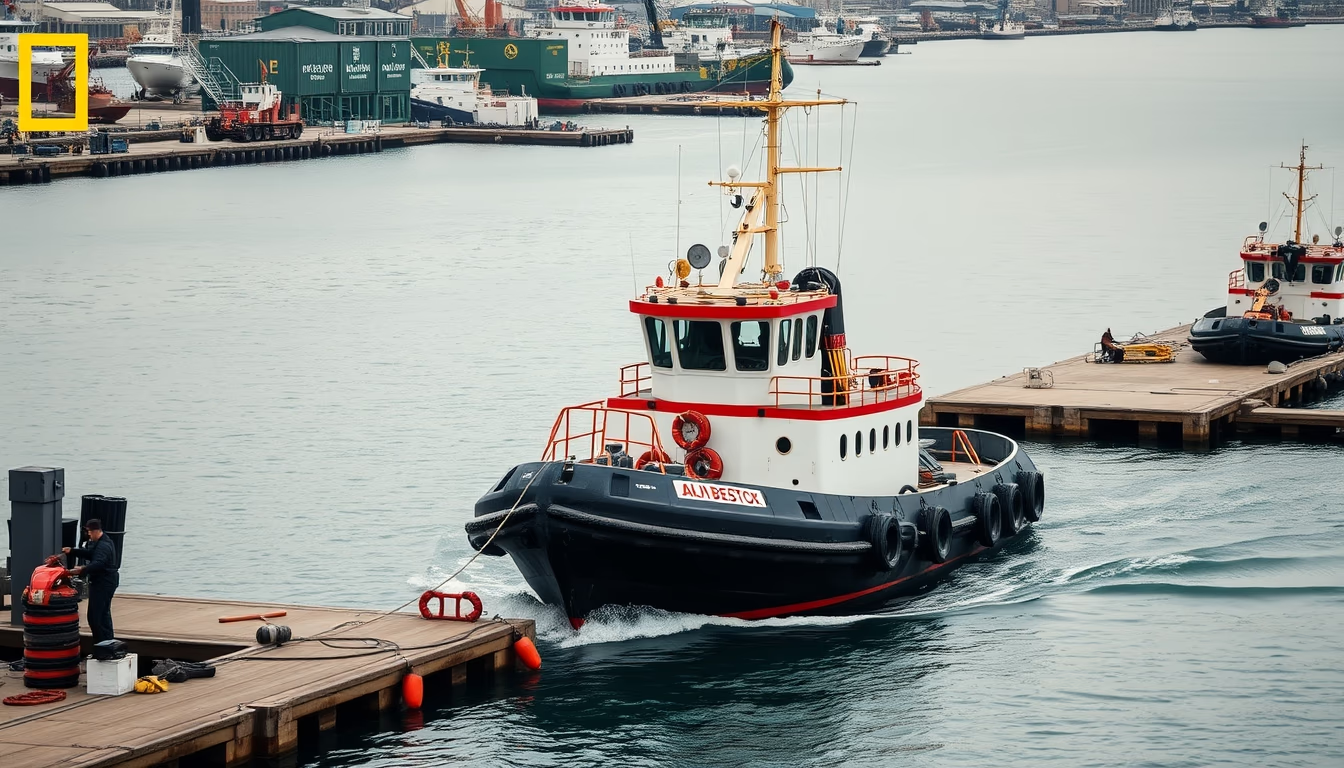
Tugboats are essential vessels for maneuvering ships in harbors, ensuring safety and efficiency in maritime operations.
About this subject
Tugboats are robust and powerful vessels designed to assist larger ships in complex maneuvers within harbors, channels, and confined areas. Their primary role is to push, pull, or tow vessels that cannot move on their own due to size, lack of maneuverability, or adverse conditions. In busy ports such as Santos in Brazil or Rotterdam in the Netherlands, tugboats operate 24/7 to ensure that cargo ships, tankers, and container vessels dock and undock safely, preventing collisions and damage to port infrastructure.
The history of tugboats dates back to the 19th century, when early steam-powered models began replacing manual and animal force in port operations. A landmark vessel is the Eppleton Hall, built in 1914 in England, one of the last surviving steam tugboats. With advancing technology, modern tugboats adopted diesel engines and azimuth thruster systems, such as Voith Schneider or azimuth thrusters, which allow 360-degree rotation and extreme precision. In Brazil, the shipbuilding industry produces tugboats to meet the growing demand of ports like Rio de Janeiro and Paranaguá, as well as to support oil platforms.
Technically, tugboats are rated by their static pulling force, known as bollard pull, which ranges from 20 to 100 tons for harbor models and can exceed 200 tons for ocean-going emergency tugs. Average length is 20 to 40 meters with a shallow draft for operating in shallow waters. Engine power typically falls between 2,000 and 10,000 horsepower. A common curiosity is that the traditional red paint is not mandatory but became iconic for increasing visibility in the smoke and fog of old ports; today, many companies use corporate colors.
Beyond routine work, tugboats are vital in emergencies, such as towing drifting vessels, preventing groundings, fighting onboard fires with their water cannons, and supporting salvage operations. In some regions, they participate in annual competitions of strength and maneuverability, like the Tugboat Race in the United States. For crew members, life aboard combines long shifts with tasks demanding quick reflexes and deep knowledge of local currents and winds.
Frequently Asked Questions
What is the difference between a tugboat and a regular ship?
Tugboats are designed for high maneuverability and power, with special thrusters that allow 360-degree rotation, while regular ships prioritize straight-line navigation and cargo capacity.
Why are tugboats traditionally painted red?
Red was adopted in the past for better visibility in low light and fog, improving safety. Today, many companies use various corporate colors.
How much does a modern tugboat cost?
Prices vary based on size and technology, typically ranging from $5 million to $20 million, and can be higher for ocean-going models with high power.
Direct URL
https://pub-c7d6a6ea828543ac903a74a341ccb2e1.r2.dev/imagens/tugboat-working-harbor-national-geographic-style-p12.avifHow to credit
Include a visible link back to UtilizAí. Copy one of the snippets below:
<a href="https://xn--utiliza-eza.com/en/midia/imagens/tugboat-working-harbor-national-geographic-style-p12">Tugboat working harbor</a> by <a href="https://xn--utiliza-eza.com">UtilizAí</a>, licensed under <a href="https://creativecommons.org/licenses/by/4.0/">CC BY 4.0</a>.
[Tugboat working harbor](https://xn--utiliza-eza.com/en/midia/imagens/tugboat-working-harbor-national-geographic-style-p12) by [UtilizAí](https://xn--utiliza-eza.com), CC BY 4.0
License: CC-BY-4.0