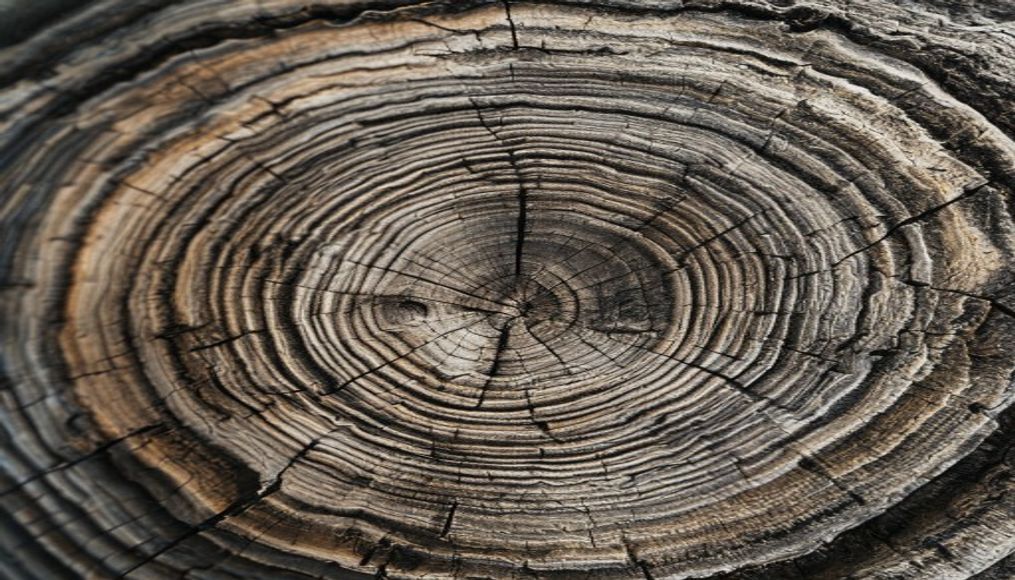
Tree rings cross section
1344×768 · AVIF · CC BY 4.0
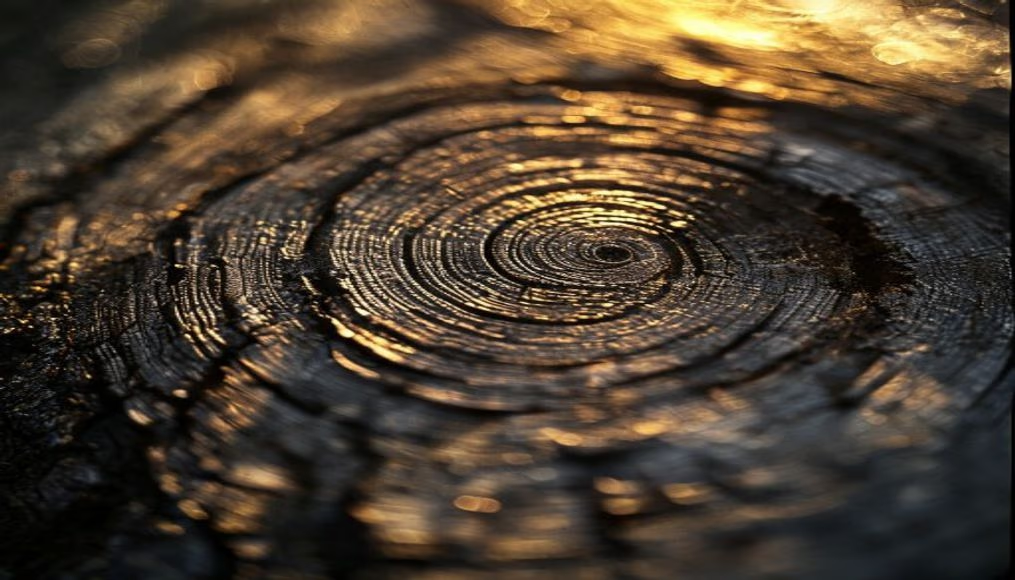
The growth rings of a tree reveal its age and past climatic conditions, being essential for dendrochronology studies.
About this subject
Tree rings, also known as annual rings, are formed by the vascular cambium, which produces xylem cells of varying size and density according to the seasons. In temperate regions, a light ring corresponds to rapid spring and summer growth, while a dark ring represents slow autumn and winter growth. This alternation allows counting the tree's age and identifying events such as droughts, fires, or volcanic eruptions that affected growth.
Dendrochronology, the science of studying these rings, is widely used to date wooden artifacts, reconstruct paleoclimates, and validate carbon-14 dating. The method was pioneered by astronomer A.E. Douglass in the early 20th century, who noticed that tree rings from the southwestern US recorded recurring climatic patterns. Today, samples from long-lived trees like sequoias and bristlecone pines (Pinus aristata) provide continuous chronologies spanning thousands of years.
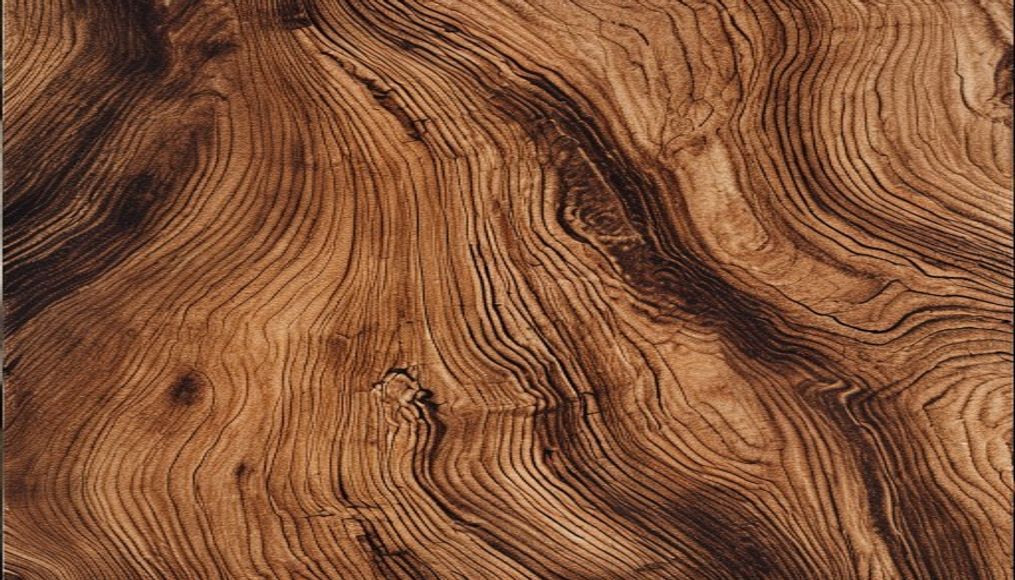
Interestingly, not all trees form visible annual rings. In tropical regions with less distinct seasons, rings may be absent or irregular, requiring techniques like X-ray densitometry to detect patterns. Additionally, trees under water stress or competition may produce false or missing rings, challenging interpretation. Ring width also varies with altitude, latitude, and nutrient availability, offering a detailed record of the local environment over time.
Frequently Asked Questions
How are tree growth rings formed?
The vascular cambium produces xylem cells at different rates throughout the year. In spring and summer, cells are larger with thin walls (light ring). In autumn and winter, cells are smaller with thick walls (dark ring).
What is dendrochronology used for?
It is used to date wooden artifacts, reconstruct past climates, study wildfire frequency, and calibrate radiocarbon dating, providing precise records of environmental events.
Do all trees have visible growth rings?
No. Trees from tropical regions or with continuous growth may lack distinct rings. Species like palms and some dicots also do not form clear annual rings.
Direct URL
https://pub-c7d6a6ea828543ac903a74a341ccb2e1.r2.dev/imagens/tree-rings-cross-section-travel-photography-p3.avifHow to credit
Include a visible link back to UtilizAí. Copy one of the snippets below:
<a href="https://xn--utiliza-eza.com/en/midia/imagens/tree-rings-cross-section-travel-photography-p3">Tree rings cross section</a> by <a href="https://xn--utiliza-eza.com">UtilizAí</a>, licensed under <a href="https://creativecommons.org/licenses/by/4.0/">CC BY 4.0</a>.
[Tree rings cross section](https://xn--utiliza-eza.com/en/midia/imagens/tree-rings-cross-section-travel-photography-p3) by [UtilizAí](https://xn--utiliza-eza.com), CC BY 4.0
License: CC-BY-4.0