Train tracks vanishing point
1344×768 · AVIF · CC BY 4.0

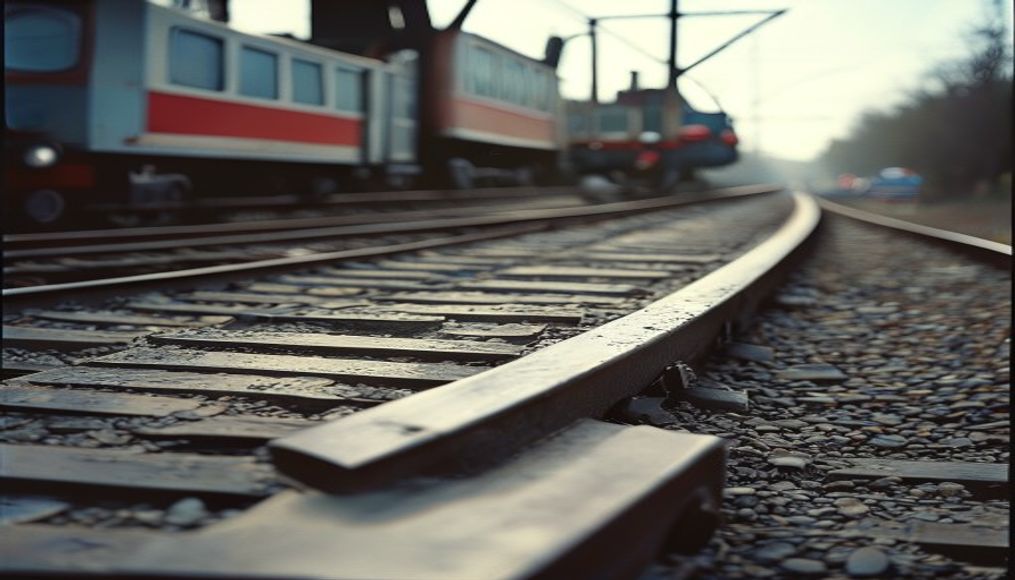
Train tracks converging to a vanishing point, an icon of railway engineering and photographic perspective art.
About this subject
Railway tracks, when observed over a long straight stretch, create a perspective effect known as the vanishing point. This visual phenomenon, widely used in photography and painting, occurs due to the three-dimensional projection of space onto a two-dimensional surface. In the railway context, parallel rails appear to converge in the distance, a classic example of linear perspective that dates back to Renaissance artists such as Brunelleschi and Leonardo da Vinci.
Historically, railways transformed global transportation and economy from the 19th century onward. The standard gauge of 1,435 mm, adopted by George Stephenson for the Liverpool and Manchester Railway in 1830, became the benchmark for most lines worldwide. In Brazil, the first railway, Estrada de Ferro Mauá, inaugurated in 1854, used a 1.676 m gauge. Today, the country has about 30,000 kilometers of tracks, with a predominance of broad and metric gauges.
The vanishing point of tracks is more than an aesthetic resource: it also reflects the precision of permanent way engineering. Straight alignment is essential for safety and operational efficiency, especially on high-speed lines. On curved sections, the vanishing point shifts, requiring calculations of curve radius and superelevation to ensure train stability.
Interestingly, the illusion that rails meet at the horizon has inspired artworks and advertising pieces. The image of a long railway corridor fading into the distance symbolizes journey, progress, and the promise of the unknown, frequently appearing in films, album covers, and tourism campaigns.
Frequently Asked Questions
What is the vanishing point in photography?
The vanishing point is the location on the horizon where parallel lines appear to converge, creating depth and perspective in a two-dimensional image.
Why do train tracks look like they meet if they are parallel?
Tracks are physically parallel, but linear perspective makes them seem to converge in the distance, a common visual effect on roads and railways.
What is the importance of track gauge?
The gauge, the distance between rails, must be uniform across a network to allow trains to run. The international standard gauge is 1,435 mm.
Direct URL
https://pub-c7d6a6ea828543ac903a74a341ccb2e1.r2.dev/imagens/train-tracks-vanishing-point-commercial-product-photography-p3.avifHow to credit
Include a visible link back to UtilizAí. Copy one of the snippets below:
<a href="https://xn--utiliza-eza.com/en/midia/imagens/train-tracks-vanishing-point-commercial-product-photography-p3">Train tracks vanishing point</a> by <a href="https://xn--utiliza-eza.com">UtilizAí</a>, licensed under <a href="https://creativecommons.org/licenses/by/4.0/">CC BY 4.0</a>.
[Train tracks vanishing point](https://xn--utiliza-eza.com/en/midia/imagens/train-tracks-vanishing-point-commercial-product-photography-p3) by [UtilizAí](https://xn--utiliza-eza.com), CC BY 4.0
License: CC-BY-4.0