Steam locomotive vintage
1344×768 · AVIF · CC BY 4.0
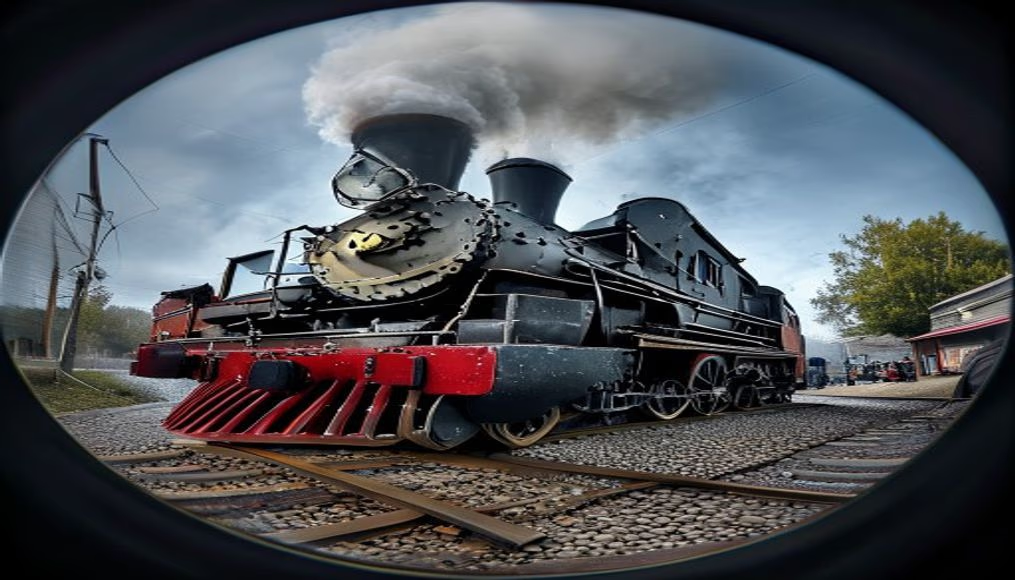
Steam locomotives marked the beginning of the railway era in the 19th century, revolutionizing transportation and commerce with their power and mechanical innovation.
About this subject
The steam locomotive was one of the great symbols of the Industrial Revolution. Initially developed by Richard Trevithick in the United Kingdom in 1804, it transformed land transportation by enabling fast movement of goods and passengers. The most famous model, George Stephenson's Rocket (1829), established technical standards that influenced railways for decades.
These machines operate by burning coal or wood to heat water in a boiler, producing steam that drives pistons connected to the wheels. Efficiency and design varied by manufacturer and purpose: passenger locomotives prioritized speed, while freight ones emphasized torque. Countries like the United States, Germany, and Brazil adopted specific models for their geographies, such as Brazil's famous 'Marias Fumaças' (steam trains).
The era of steam locomotives began to decline in the 1950s with railway electrification and dieselization. Today, they are preserved in museums, tourist railways, and by enthusiasts. Events like the 'Steam Locomotive Festival' in Rio Negrinho (SC, Brazil) keep this history alive. It is estimated that over 200,000 steam locomotives were built worldwide, with operational examples still running in countries such as India, China, and South Africa.
Frequently Asked Questions
How does a steam locomotive work?
A steam locomotive burns fuel (coal or wood) to heat water in a boiler. The steam produced is directed into cylinders, where it pushes pistons that rotate the wheels, converting thermal energy into motion.
What is the most famous steam locomotive in the world?
George Stephenson's Rocket (1829) is considered the most famous steam locomotive. It won the Rainhill Trials and set the standard for modern locomotives with its tubular boiler and inclined cylinders.
Where can I see steam locomotives running in Brazil?
There are several tourist railways, such as the Campos do Jordão Railway (SP), the Maria Fumaça in Ouro Preto (MG), and the Wine Train Railway (RS). Museums like the Train Museum in São Paulo also display them.
Direct URL
https://pub-c7d6a6ea828543ac903a74a341ccb2e1.r2.dev/imagens/steam-locomotive-vintage-fish-eye-wide-angle-p0.avifHow to credit
Include a visible link back to UtilizAí. Copy one of the snippets below:
<a href="https://xn--utiliza-eza.com/en/midia/imagens/steam-locomotive-vintage-fish-eye-wide-angle-p0">Steam locomotive vintage</a> by <a href="https://xn--utiliza-eza.com">UtilizAí</a>, licensed under <a href="https://creativecommons.org/licenses/by/4.0/">CC BY 4.0</a>.
[Steam locomotive vintage](https://xn--utiliza-eza.com/en/midia/imagens/steam-locomotive-vintage-fish-eye-wide-angle-p0) by [UtilizAí](https://xn--utiliza-eza.com), CC BY 4.0
License: CC-BY-4.0