Salar de uyuni reflection
1344×768 · AVIF · CC BY 4.0
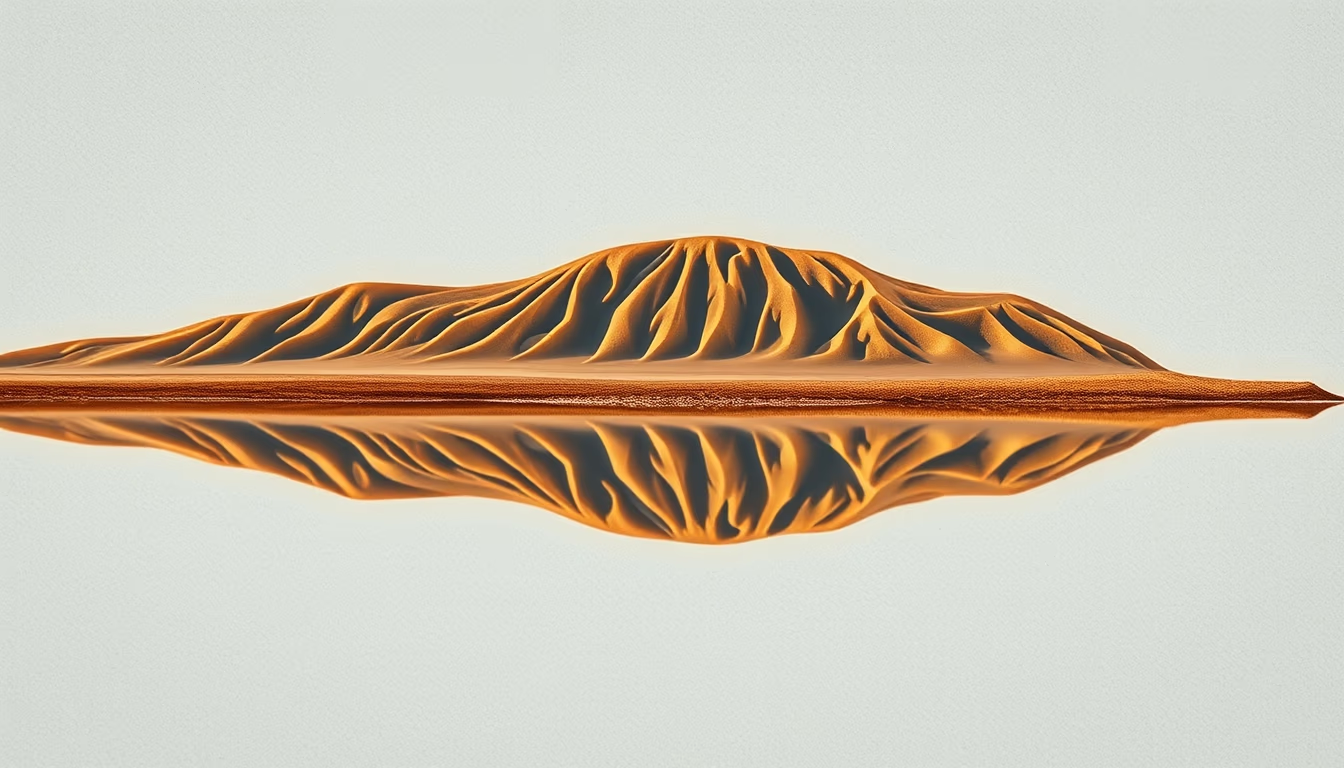
Salar de Uyuni in Bolivia is the world's largest salt flat and one of South America's most stunning tourist destinations.
About this subject
Salar de Uyuni is located in southwestern Bolivia, in the province of Antonio Quijarro, Potosí department. Covering approximately 10,582 square kilometers, it is the largest continuous salt flat on Earth, formed about 40,000 years ago from the evaporation of prehistoric lakes such as Lake Minchin. The salt crust, which can be up to 10 meters thick, lies on a vast plain at an altitude of 3,656 meters in the Andes.
During the rainy season (December to March), a thin layer of water turns the surface into a giant mirror, creating perfect reflections of the sky. This phenomenon attracts photographers and travelers from around the world, especially in February. Besides the visual spectacle, the salt flat holds immense economic value: it contains about 70% of the world's lithium reserves, a mineral crucial for electric vehicle batteries and electronics.
Geological curiosities abound. Islands like Isla Incahuasi are covered by giant cacti that can live for over a thousand years. The salt flat serves as a calibration reference for satellites due to its flatness and high reflectivity. Local fauna includes Andean flamingos that feed on microorganisms in nearby lagoons.
Tourism at Salar de Uyuni is regulated to minimize environmental impact. Visitors can take jeep tours, stay in salt hotels, and watch the sunset. Due to the altitude, acclimatization is recommended. The region is also a gateway to the Eduardo Abaroa Andean Fauna National Reserve, with its colorful lagoons and geysers.
Frequently Asked Questions
What is the best time to visit Salar de Uyuni to see the mirror effect?
The best time is during the rainy season, from December to March, especially in February, when the water layer is thinner and light conditions are ideal for perfect reflections.
Why is Salar de Uyuni important for the lithium industry?
The salt flat contains about 70% of the world's lithium reserves, a metal essential for manufacturing electric vehicle batteries and electronics, making it economically strategic.
Is visiting Salar de Uyuni dangerous due to altitude?
The altitude of 3,656 meters can cause altitude sickness in unacclimatized people. It is recommended to spend a few days in lower cities like Potosí or La Paz before visiting, and stay well hydrated.
Direct URL
https://pub-c7d6a6ea828543ac903a74a341ccb2e1.r2.dev/imagens/salar-de-uyuni-reflection-isometric-flat-lay-p7.avifHow to credit
Include a visible link back to UtilizAí. Copy one of the snippets below:
<a href="https://xn--utiliza-eza.com/en/midia/imagens/salar-de-uyuni-reflection-isometric-flat-lay-p7">Salar de uyuni reflection</a> by <a href="https://xn--utiliza-eza.com">UtilizAí</a>, licensed under <a href="https://creativecommons.org/licenses/by/4.0/">CC BY 4.0</a>.
[Salar de uyuni reflection](https://xn--utiliza-eza.com/en/midia/imagens/salar-de-uyuni-reflection-isometric-flat-lay-p7) by [UtilizAí](https://xn--utiliza-eza.com), CC BY 4.0
License: CC-BY-4.0