Salar de uyuni reflection
1344×768 · AVIF · CC BY 4.0
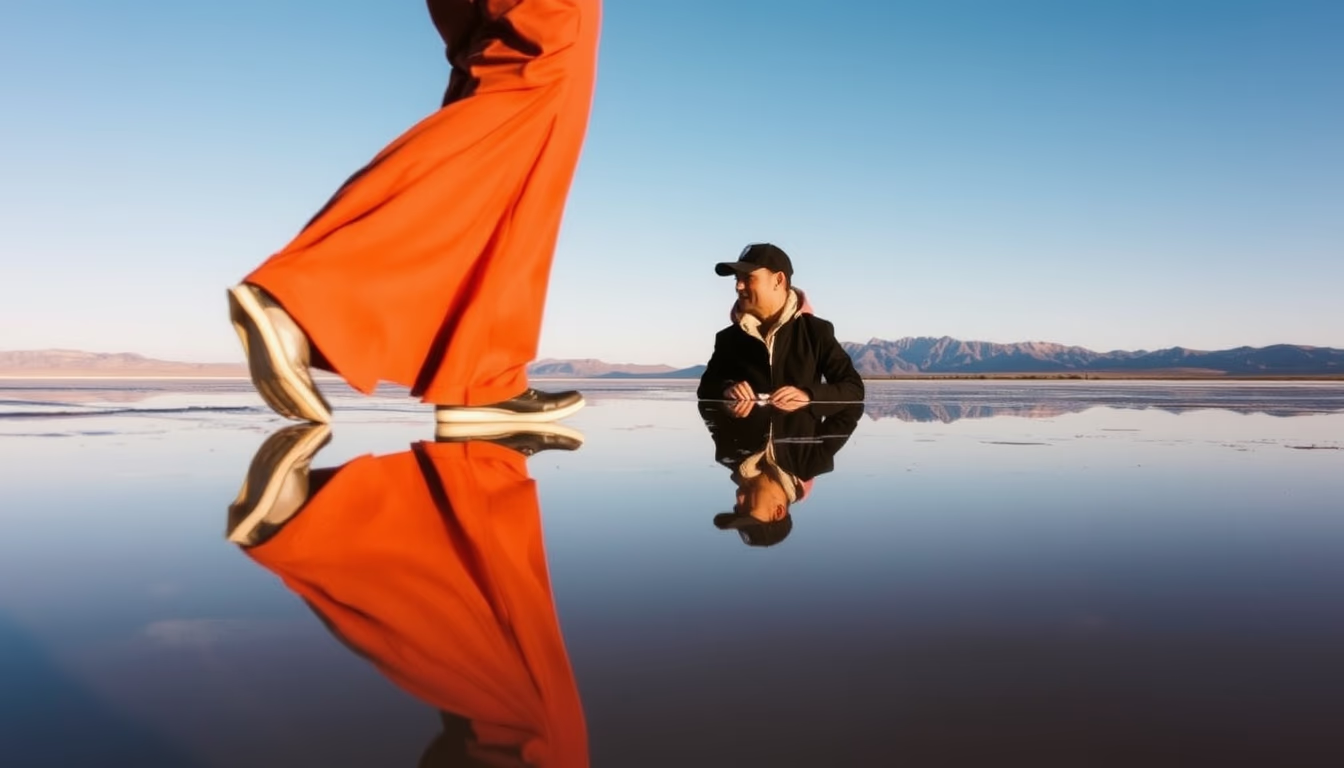
Salar de Uyuni in Bolivia is the world's largest salt flat, famous for its natural mirror effect during the rainy season.
About this subject
Salar de Uyuni is located in southwestern Bolivia, in the Daniel Campos Province of Potosí Department. Spanning over 10,000 km², it is the largest continuous salt flat on Earth, formed by the sequential evaporation of prehistoric lakes, such as Lake Minchin, which existed around 40,000 years ago. The salt crust reaches thicknesses of up to 10 meters, and its flat, highly reflective surface creates the famous mirror effect, particularly from January to March when a thin layer of water covers the salt flat.
Beyond its tourist appeal, Salar de Uyuni holds significant economic and scientific value. It is estimated to contain roughly 70% of the world's lithium reserves, a crucial element for battery manufacturing. Salt extraction is also a traditional livelihood for local communities. Scientists use the salt flat for satellite calibration, exploiting its uniform surface and high reflectivity. Local wildlife includes Andean flamingos that feed on crustaceans in nearby lagoons.
Thousands of tourists visit annually, exploring the Train Cemetery, Incahuasi Island (covered in giant cacti), and hotels built from salt blocks. The local culture, shaped by Aymara and Quechua influences, celebrates festivals like the Day of the Virgin of Socavón, blending indigenous and Catholic traditions. With its surreal beauty and unique characteristics, Salar de Uyuni is considered one of the most stunning destinations in South America.
Frequently Asked Questions
Why does Salar de Uyuni form a natural mirror?
The mirror effect happens when a thin layer of water covers the perfectly flat salt crust, reflecting the sky and clouds like a giant mirror. This occurs mainly during the rainy season from January to March.
What is the economic importance of Salar de Uyuni?
The salt flat holds one of the world's largest lithium reserves, a key metal for batteries. Salt extraction and tourism also provide income for local communities.
How to get to Salar de Uyuni?
The main gateway is the town of Uyuni, reachable by flight or bus from La Paz. From there, organized tours explore the salt flat and its attractions.
Direct URL
https://pub-c7d6a6ea828543ac903a74a341ccb2e1.r2.dev/imagens/salar-de-uyuni-reflection-film-grain-authentic-p3.avifHow to credit
Include a visible link back to UtilizAí. Copy one of the snippets below:
<a href="https://xn--utiliza-eza.com/en/midia/imagens/salar-de-uyuni-reflection-film-grain-authentic-p3">Salar de uyuni reflection</a> by <a href="https://xn--utiliza-eza.com">UtilizAí</a>, licensed under <a href="https://creativecommons.org/licenses/by/4.0/">CC BY 4.0</a>.
[Salar de uyuni reflection](https://xn--utiliza-eza.com/en/midia/imagens/salar-de-uyuni-reflection-film-grain-authentic-p3) by [UtilizAí](https://xn--utiliza-eza.com), CC BY 4.0
License: CC-BY-4.0