Salar de uyuni reflection
1344×768 · AVIF · CC BY 4.0
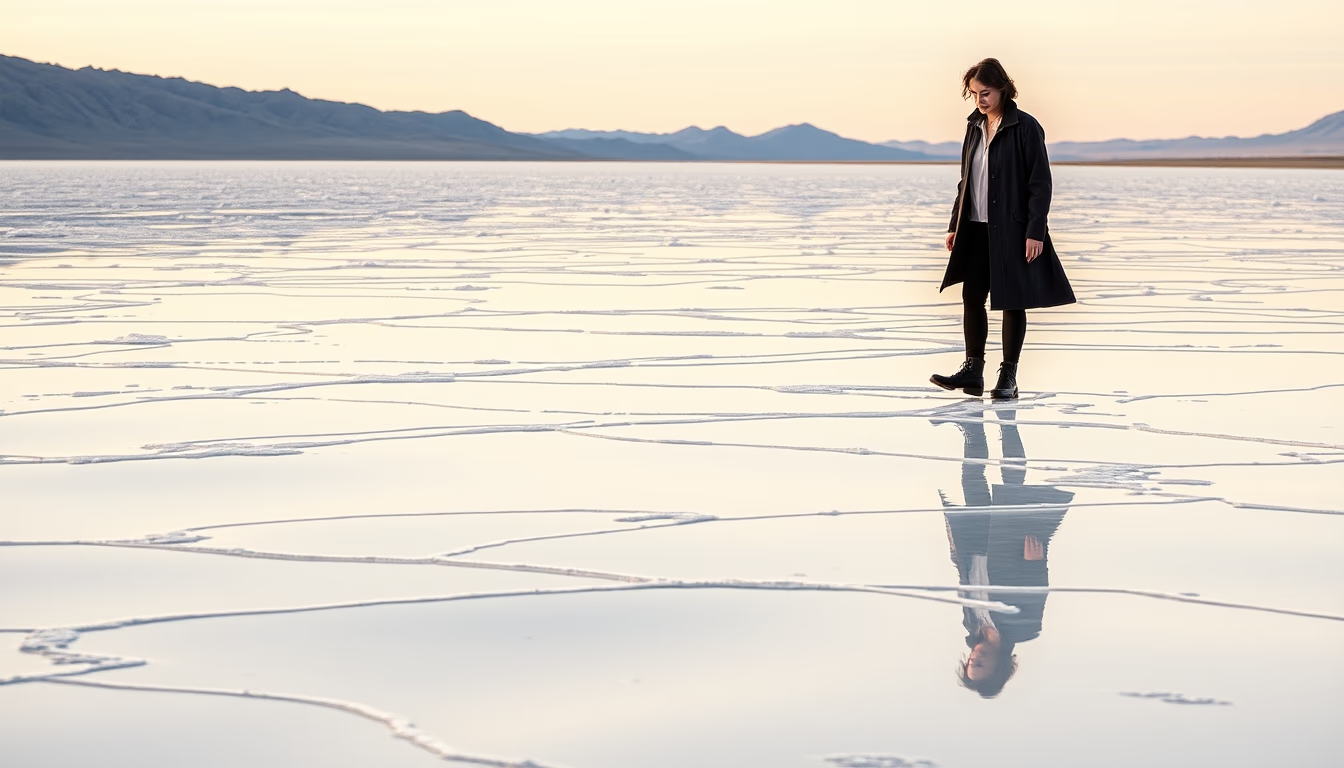
Salar de Uyuni in Bolivia is the world's largest salt flat, renowned for its perfect mirror effect during the rainy season.
About this subject
Salar de Uyuni, located in the Daniel Campos Province of southwestern Bolivia, is the largest salt flat on Earth, covering about 10,582 square kilometers. Formed from the transformation of several prehistoric lakes, such as Lake Minchin, around 30,000 to 40,000 years ago, the flat is covered by a salt crust that ranges from a few meters to tens of meters thick. During the rainy season (December to April), a thin layer of water turns the surface into the world's largest natural mirror, creating a near-perfect reflection of the sky, drawing photographers and tourists from all over the globe.
Beyond its scenic beauty, Salar de Uyuni holds vast lithium reserves, estimated at 21 million tons, about 70% of the world's known resources. This makes the region strategic for the battery and electric vehicle industries. However, lithium extraction is complex and sparks debates on sustainability and environmental impact, as mining consumes large amounts of water and can disrupt the fragile ecological balance of the surrounding salt flats and lagoons.
Culturally, the salt flat is significant to local indigenous communities, such as the Aymara, who traditionally harvest salt for consumption and trade. The area also features the Train Cemetery, a tourist attraction where abandoned 19th-century locomotives rust in the open, witnessing the boom of mining and rail transport in Bolivia. Nearby, colorful lagoons like Laguna Colorada (red due to algae and sediments) and Laguna Verde (green from high arsenic and magnesium content) add to the region's allure.
Geologically, Salar de Uyuni is a remarkable evaporite deposit, formed by successive evaporation of water bodies. Its study helps scientists understand past climates and hydrological cycles. The extremely flat surface is also used for calibrating satellite altimeters, such as NASA's ICESat mission, due to its uniformity and reflectivity.
Frequently Asked Questions
What is the best time to visit Salar de Uyuni to see the reflection?
The best time is during the rainy season from December to April, when a thin layer of water covers the salt flat, creating the mirror effect. January and February are peak months, but travel may be tricky due to muddy roads.
Why is Salar de Uyuni important for the lithium industry?
The salt flat holds about 70% of the world's lithium reserves, crucial for producing batteries for electric vehicles and electronics. Its extraction is strategic but faces environmental and technological challenges.
Is Salar de Uyuni home to any wildlife?
The region hosts species adapted to the extreme environment, such as flamingos (especially James's flamingo), which feed on algae and crustaceans in the brackish lagoons. Foxes, vizcachas, and vicuñas are also found in peripheral areas.
Direct URL
https://pub-c7d6a6ea828543ac903a74a341ccb2e1.r2.dev/imagens/salar-de-uyuni-reflection-documentary-photography-p10.avifHow to credit
Include a visible link back to UtilizAí. Copy one of the snippets below:
<a href="https://xn--utiliza-eza.com/en/midia/imagens/salar-de-uyuni-reflection-documentary-photography-p10">Salar de uyuni reflection</a> by <a href="https://xn--utiliza-eza.com">UtilizAí</a>, licensed under <a href="https://creativecommons.org/licenses/by/4.0/">CC BY 4.0</a>.
[Salar de uyuni reflection](https://xn--utiliza-eza.com/en/midia/imagens/salar-de-uyuni-reflection-documentary-photography-p10) by [UtilizAí](https://xn--utiliza-eza.com), CC BY 4.0
License: CC-BY-4.0