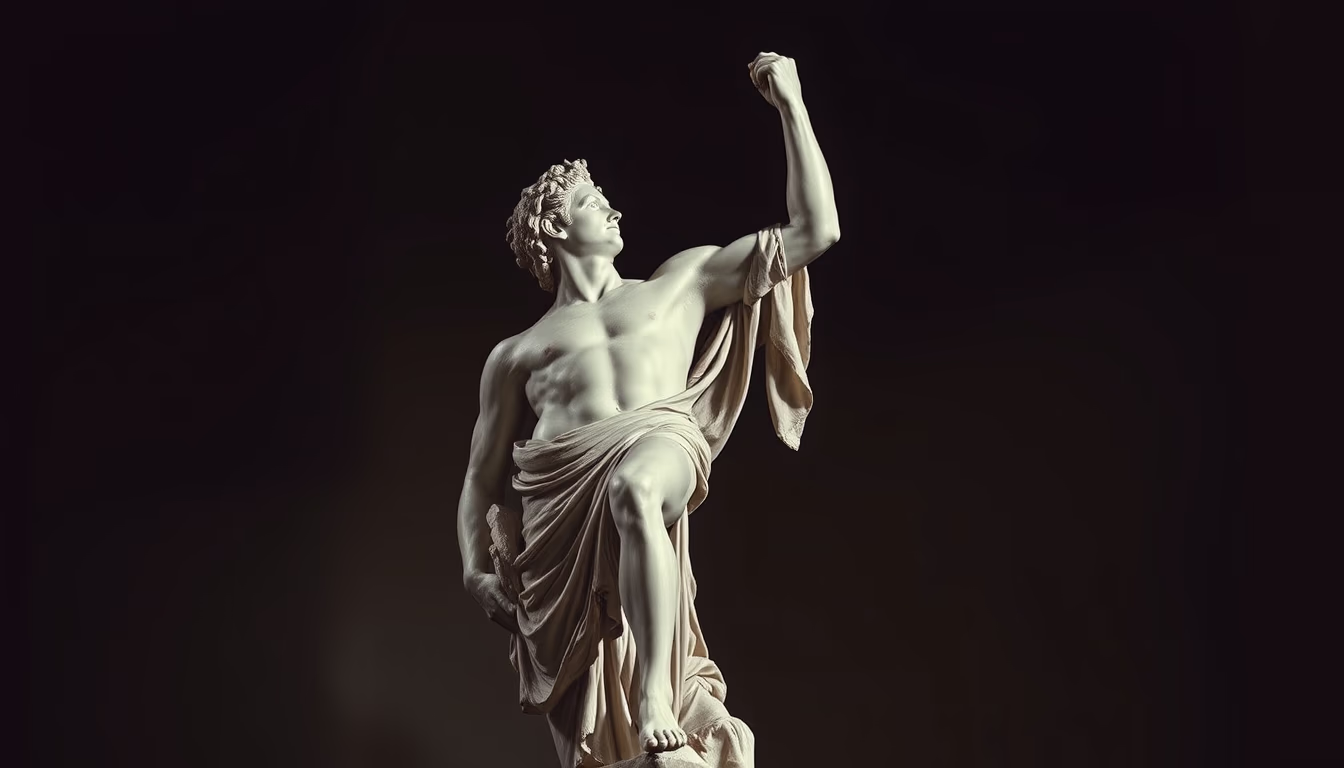
Rodin thinker statue
1344×768 · AVIF · CC BY 4.0

The Thinker statue by Auguste Rodin is one of the most iconic sculptures in Western art, symbolizing philosophical reflection and the human condition.
About this subject
Created by Auguste Rodin between 1880 and 1882, the sculpture 'The Thinker' (Le Penseur) was originally part of a larger ensemble called 'The Gates of Hell', commissioned for the Museum of Decorative Arts in Paris. The figure depicts a nude man seated on a rock, chin resting on his hand, immersed in deep meditation. Rodin drew inspiration from Dante Alighieri's poem 'The Divine Comedy', and it is believed that the sculpture represents Dante himself before the gates of hell, pondering his work. Over time, however, the piece acquired a universal meaning: the act of thinking as creative and existential effort.
The sculpture was first exhibited in 1888 in Copenhagen and quickly became a symbol of intellectuality. More than 20 bronze casts exist worldwide, including versions at the Musée Rodin in Paris and the Museum of Modern Art in New York. The original plaster is housed at the Musée d'Orsay. Each cast may have slight variations in size and finish, but all maintain the characteristic reflective pose. The sculpture stands approximately 186 cm tall in the larger version.
'The Thinker' has influenced not only sculpture but also popular culture, appearing in films, advertisements, and cartoons. The pose has become a visual archetype for representing a moment of reflection or dilemma. Rodin described the figure as 'not only a dreamer, but a creator'. Despite its apparent simplicity, the work is rich in anatomical and expressive details, demonstrating Rodin's mastery of the human form and his ability to convey emotion through muscular tension and posture.
Frequently Asked Questions
Where is the original version of 'The Thinker' located?
The original plaster is at the Musée d'Orsay in Paris, France. The most famous bronze casts are at the Musée Rodin (Paris) and the Museum of Modern Art (New York).
What does 'The Thinker' represent?
The sculpture depicts a man in deep contemplation, originally inspired by Dante Alighieri before the gates of Hell. Today it is a universal symbol of thought and philosophical reflection.
How many replicas of 'The Thinker' exist?
There are over 20 authorized bronze casts, plus versions in plaster and other materials, located in museums and private collections worldwide.
Direct URL
https://pub-c7d6a6ea828543ac903a74a341ccb2e1.r2.dev/imagens/rodin-thinker-statue-tilt-shift-miniature-p1.avifHow to credit
Include a visible link back to UtilizAí. Copy one of the snippets below:
<a href="https://xn--utiliza-eza.com/en/midia/imagens/rodin-thinker-statue-tilt-shift-miniature-p1">Rodin thinker statue</a> by <a href="https://xn--utiliza-eza.com">UtilizAí</a>, licensed under <a href="https://creativecommons.org/licenses/by/4.0/">CC BY 4.0</a>.
[Rodin thinker statue](https://xn--utiliza-eza.com/en/midia/imagens/rodin-thinker-statue-tilt-shift-miniature-p1) by [UtilizAí](https://xn--utiliza-eza.com), CC BY 4.0
License: CC-BY-4.0