Research vessel ocean
1344×768 · AVIF · CC BY 4.0
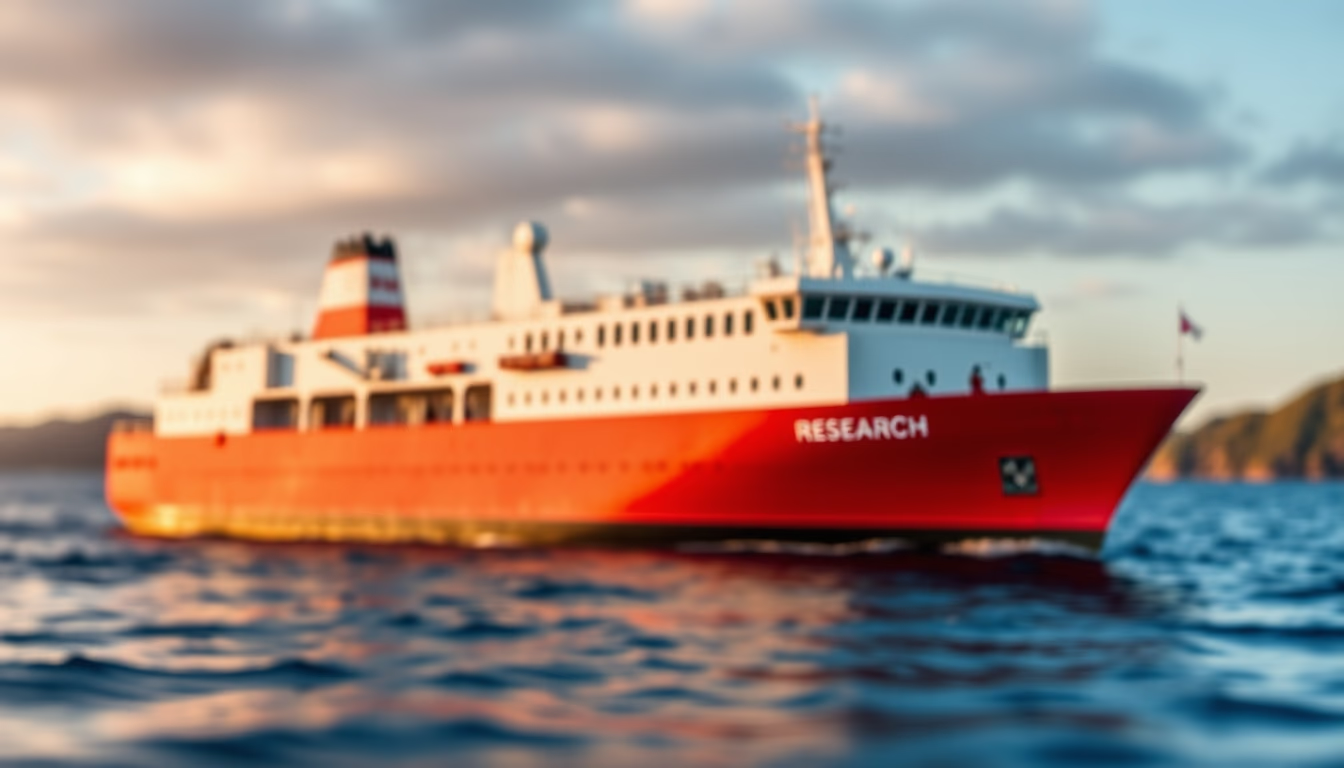
Oceanographic research vessel sailing on the open sea, with tilt-shift effect miniaturizing the scene.
About this subject
Oceanographic research vessels, also known as scientific ships, are specially designed platforms for studying oceans, the water column, the seafloor, and the atmosphere. They function as floating laboratories, equipped with winches, sonars, sediment samplers, CTDs (conductivity, temperature, depth profilers), and dry and wet labs. In Brazil, notable examples include the N/Oc. "Prof. W. Besnard" operated by USP and the N/Oc. "Antares" of the Brazilian Navy, used in programs like REVIZEE to assess living resources in the Exclusive Economic Zone.
These vessels conduct campaigns lasting weeks or months, collecting data on currents, plankton, water chemistry, and benthic biodiversity. Many are multidisciplinary, serving biology, geology, and marine physics projects. The research ship "Atlantis" (USA) is famous for discovering hydrothermal vent fields in the Atlantic. The "Falkor" (Germany) is a reference in deep-sea ecosystem exploration.
The importance of these ships grows with climate change. They monitor parameters like ocean acidification, sea level rise, and water warming. International programs such as GO-SHIP and Argo rely on vessels to calibrate sensors and recover buoys. In Brazil, the 2020s saw the launch of the new N/Oc. "Alpha Crucis", expanding research capacity along the Brazilian coast.
Fact: the tilt-shift effect in the image does not alter the reality of research vessels. They remain one of the pillars of modern oceanography, combining cutting-edge technology with the tradition of scientific navigation.
Frequently Asked Questions
What is the main purpose of an oceanographic research vessel?
To conduct scientific studies of the ocean, including collecting water, sediment, and organism samples, measuring physical and chemical parameters, and mapping the seafloor. They serve as bases for marine biology, geology, chemistry, and physics research.
How are these vessels equipped?
They have hydraulic winches, side-scan sonars, acoustic Doppler current profilers (ADCP), Niskin and Van Veen samplers, dry and wet labs, and precision navigation systems. Some carry ROVs or AUVs for remote exploration.
Which research vessels operate in Brazil?
Key examples include N/Oc. 'Prof. W. Besnard' (USP), N/Oc. 'Antares' (Navy), N/Oc. 'Alpha Crucis' (USP), and N/Oc. 'Atlântico Sul' (FURG). They support programs like PIRATA and REVIZEE.
Direct URL
https://pub-c7d6a6ea828543ac903a74a341ccb2e1.r2.dev/imagens/research-vessel-ocean-tilt-shift-miniature-p2.avifHow to credit
Include a visible link back to UtilizAí. Copy one of the snippets below:
<a href="https://xn--utiliza-eza.com/en/midia/imagens/research-vessel-ocean-tilt-shift-miniature-p2">Research vessel ocean</a> by <a href="https://xn--utiliza-eza.com">UtilizAí</a>, licensed under <a href="https://creativecommons.org/licenses/by/4.0/">CC BY 4.0</a>.
[Research vessel ocean](https://xn--utiliza-eza.com/en/midia/imagens/research-vessel-ocean-tilt-shift-miniature-p2) by [UtilizAí](https://xn--utiliza-eza.com), CC BY 4.0
License: CC-BY-4.0