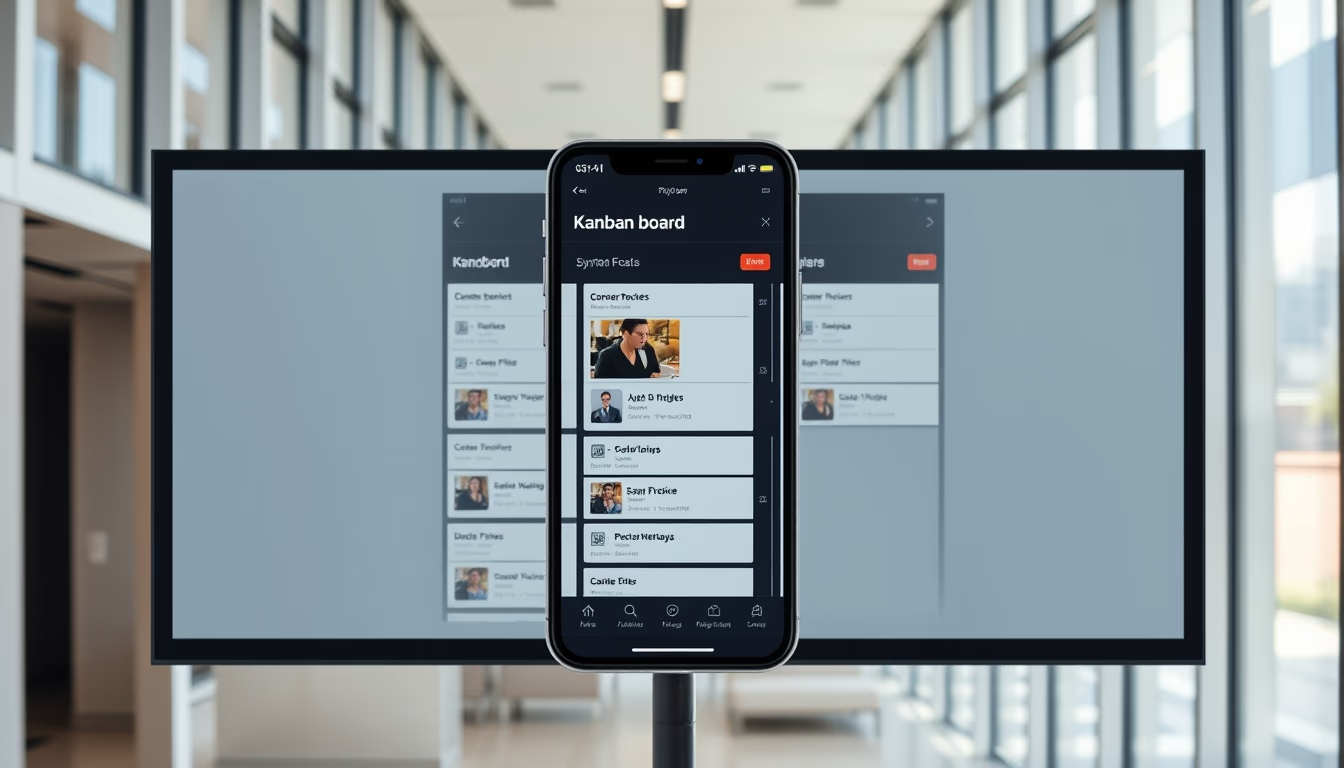
Kanban board app screen
1344×768 · AVIF · CC BY 4.0
The Kanban board is a visual workflow management tool originating from the Toyota Production System, widely adopted in software development.
About this subject
Kanban is a workflow management method that has become essential in agile software development teams. Its origins date back to 1940s Japan, when Toyota engineer Taiichi Ohno developed the Just-in-Time system to optimize industrial production. The word "Kanban" means "card" or "signal" in Japanese, referring to the visual cards indicating task progress on the assembly line. Decades later, the concept was adapted to the digital world, giving rise to tools like Trello, Jira, and Asana.
The core principle of Kanban is to limit Work in Progress (WIP) to avoid bottlenecks and improve efficiency. In a typical Kanban board, tasks are represented by cards moving through columns such as "To Do", "In Progress", and "Done". This visualization allows the team to quickly identify blockers and prioritize deliveries. Unlike Scrum, Kanban does not require fixed sprints; the flow is continuous, making it ideal for support and operations teams.
In the context of SaaS (Software as a Service), Kanban is crucial for managing features, bug fixes, and customer requests. The "pull" approach of Kanban ensures new tasks are started only when the team has capacity, reducing rework and increasing predictability. Companies like Spotify and Microsoft use custom Kanban variations to accelerate delivery cycles.
A notable curiosity: Kanban aligns with continuous improvement (Kaizen) principles. Teams adopting Kanban often hold daily stand-up meetings to review the board and adjust priorities. The most common metric is lead time: the time from request to delivery, which can be drastically reduced with proper practice.
Frequently Asked Questions
What is the difference between Kanban and Scrum?
Kanban is a continuous flow method without fixed sprints, focusing on limiting work in progress. Scrum uses time-boxed iterations (sprints) with defined roles like Scrum Master and Product Owner.
Does Kanban only work for software development?
No. Kanban is applicable to any repetitive process, such as marketing, manufacturing, HR, and operations. Its visual and WIP-limiting logic is universal.
What are the main benefits of using a Kanban board?
It improves workflow visibility, reduces bottlenecks, increases efficiency by limiting WIP, and enables more predictable deliveries. It also helps identify dependencies.
Direct URL
https://pub-c7d6a6ea828543ac903a74a341ccb2e1.r2.dev/imagens/kanban-board-app-screen-magazine-editorial-p0.avifHow to credit
Include a visible link back to UtilizAí. Copy one of the snippets below:
<a href="https://xn--utiliza-eza.com/en/midia/imagens/kanban-board-app-screen-magazine-editorial-p0">Kanban board app screen</a> by <a href="https://xn--utiliza-eza.com">UtilizAí</a>, licensed under <a href="https://creativecommons.org/licenses/by/4.0/">CC BY 4.0</a>.
[Kanban board app screen](https://xn--utiliza-eza.com/en/midia/imagens/kanban-board-app-screen-magazine-editorial-p0) by [UtilizAí](https://xn--utiliza-eza.com), CC BY 4.0
License: CC-BY-4.0