Indian devanagari sanskrit
1344×768 · AVIF · CC BY 4.0

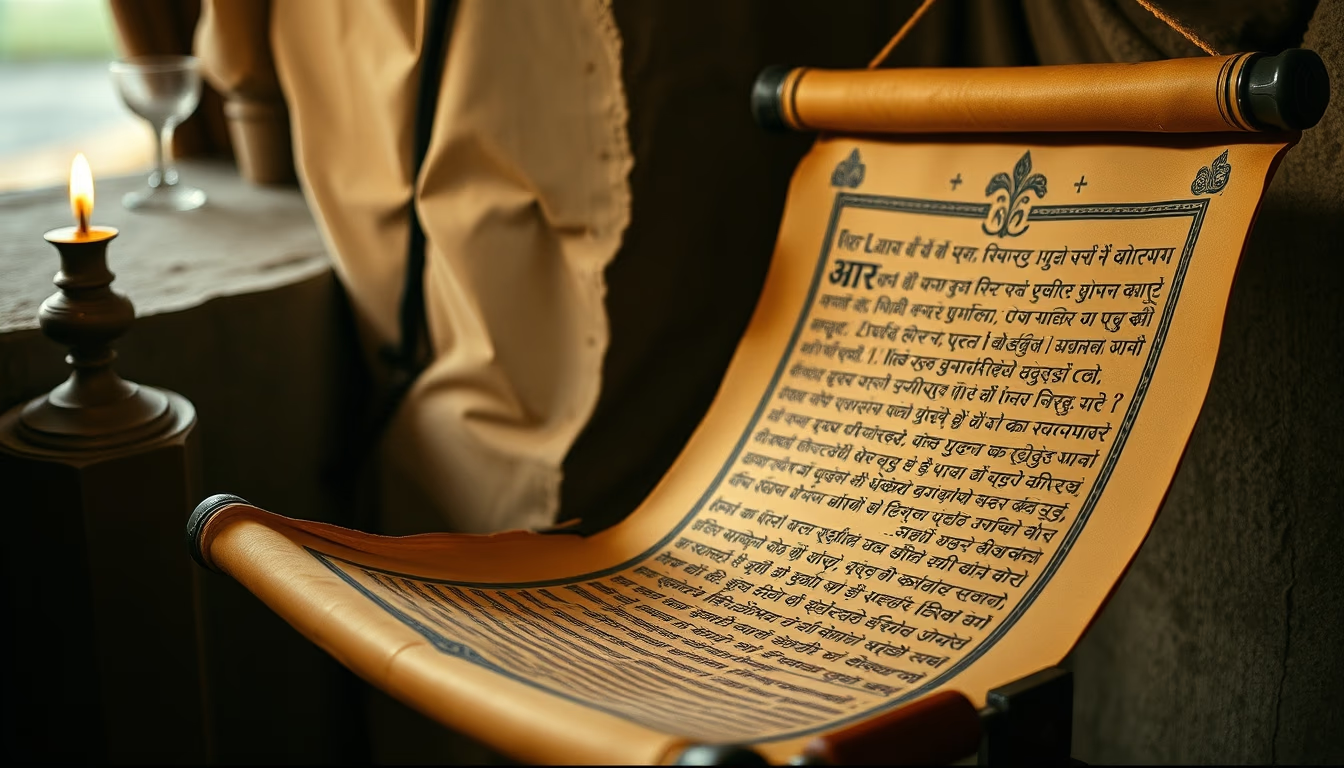
Devanagari is the writing system used for Sanskrit, Hindi, and other Indian languages, originating in the 7th century BCE.
About this subject
Devanagari (देवनागरी) is an abugida writing system where each character represents a consonant with an inherent vowel (usually 'a'). It originated from the Brahmi script, which flourished in the Indian subcontinent around the 7th century BCE. The term 'devanagari' means 'divine city script', referencing its use in sacred Hindu texts such as the Vedas and Upanishads. Today, it is the official script for Hindi, Marathi, Nepali, Konkani, and modern Sanskrit in India, and is also used for Kashmiri and Sindhi.
The structure of Devanagari is notable for its continuous horizontal line (शिरोरेखा, shirorekha) that connects letters at the top of words. Each letter is written from left to right, and independent vowels or vowel modifications are represented through diacritics. For instance, the vowel 'i' is added as a stroke to the left of the consonant. The alphabet comprises 33 consonants and 13 vowels, plus punctuation marks and other symbols. Classical Sanskrit, which maintains a distinct pronunciation, is often written in Devanagari even though it was originally transmitted orally.
An interesting fact: Devanagari is one of the few scripts that preserve etymological pronunciation consistently. Due to its phonetic precision, Indo-European linguists often learn the system to study language evolution. Additionally, UNESCO recognized Devanagari as part of the Intangible Cultural Heritage of Humanity in 2016, highlighting its role in transmitting ancient knowledge. The calligraphic design of Devanagari ranges from stone inscriptions to elegant manuscript forms, and its adaptation to digital media has been a technical challenge leading to specific Unicode standards.
Frequently Asked Questions
What is the difference between Devanagari and other Indian scripts?
Devanagari is an abugida with a continuous horizontal top line, while scripts like Bengali or Tamil have distinct shapes and lack this feature. Devanagari is used for multiple languages, whereas others are region-specific.
Why is Devanagari important for Sanskrit?
Classical Sanskrit is often written in Devanagari because the script accurately represents etymological pronunciation, facilitating precise recitation of ritual and literary texts.
How can I learn to read Devanagari?
Learning Devanagari involves memorizing the alphabet (varnamala), practicing consonant-vowel combinations, and understanding diacritics. Online resources and apps like Duolingo offer introductory courses.
Direct URL
https://pub-c7d6a6ea828543ac903a74a341ccb2e1.r2.dev/imagens/indian-devanagari-sanskrit-lo-fi-disposable-camera-fresh13.avifHow to credit
Include a visible link back to UtilizAí. Copy one of the snippets below:
<a href="https://xn--utiliza-eza.com/en/midia/imagens/indian-devanagari-sanskrit-lo-fi-disposable-camera-fresh13">Indian devanagari sanskrit</a> by <a href="https://xn--utiliza-eza.com">UtilizAí</a>, licensed under <a href="https://creativecommons.org/licenses/by/4.0/">CC BY 4.0</a>.
[Indian devanagari sanskrit](https://xn--utiliza-eza.com/en/midia/imagens/indian-devanagari-sanskrit-lo-fi-disposable-camera-fresh13) by [UtilizAí](https://xn--utiliza-eza.com), CC BY 4.0
License: CC-BY-4.0