Icebreaker arctic ship
1344×768 · AVIF · CC BY 4.0
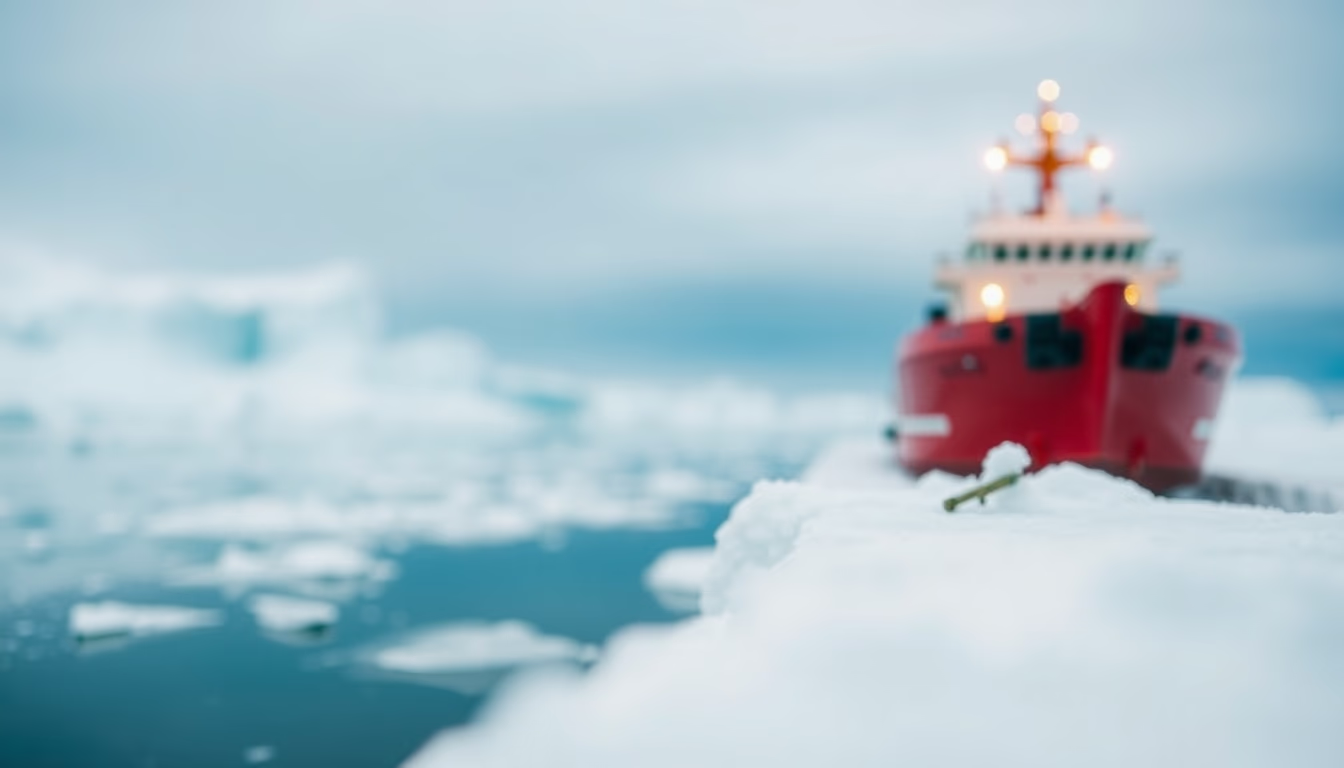
Icebreakers are specialized ships designed to navigate frozen waters, crucial for Arctic exploration and commerce.
About this subject
Icebreakers are vessels built to navigate through ice-covered waters, enabling shipping and scientific research in polar regions. They feature reinforced hulls and powerful engines, capable of breaking ice several meters thick. Types include nuclear-powered icebreakers, such as Russia's Arktika class, which can operate for long periods without refueling, and diesel-powered ones like the US Coast Guard's Polar Star. The first true icebreaker was the Yermak, built in 1899 for Russia, paving the way for Arctic expeditions.
The importance of icebreakers extends beyond science. They are crucial for the Northern Sea Route, a shipping lane connecting Europe to Asia through the Arctic, shortening distances compared to the Suez Canal route. With melting ice due to climate change, navigation on this route is becoming more feasible but still requires icebreaker support. Countries like Russia, Canada, the US, Norway, and Finland invest in these vessels to ensure sovereignty and access to natural resources.
Icebreakers not only break ice but also operate in open water. Their design features an inclined bow that rides over ice, using the vessel's weight to crack it. Many have dynamic positioning systems for station-keeping during drilling or research. The world's most powerful icebreaker class, Russia's LK-60Ya, uses nuclear reactors and can break ice up to 2.8 meters thick.
Frequently Asked Questions
What is the difference between an icebreaker and a regular ship?
An icebreaker has a reinforced hull, more powerful engines, and a special bow shape that allows it to ride over and break ice. Regular ships are not designed to withstand ice impact.
How many nuclear-powered icebreakers are there in the world?
Currently, Russia operates the largest fleet of nuclear icebreakers, with about 5 in service, including the Arktika and LK-60Ya classes. No other country has civilian or military nuclear icebreakers.
How do climate change affect the need for icebreakers?
Arctic ice melt is extending the ice-free navigation season, but icebreakers remain essential for safety on routes like the Northern Sea Route, especially during winter.
Direct URL
https://pub-c7d6a6ea828543ac903a74a341ccb2e1.r2.dev/imagens/icebreaker-arctic-ship-tilt-shift-miniature-p3.avifHow to credit
Include a visible link back to UtilizAí. Copy one of the snippets below:
<a href="https://xn--utiliza-eza.com/en/midia/imagens/icebreaker-arctic-ship-tilt-shift-miniature-p3">Icebreaker arctic ship</a> by <a href="https://xn--utiliza-eza.com">UtilizAí</a>, licensed under <a href="https://creativecommons.org/licenses/by/4.0/">CC BY 4.0</a>.
[Icebreaker arctic ship](https://xn--utiliza-eza.com/en/midia/imagens/icebreaker-arctic-ship-tilt-shift-miniature-p3) by [UtilizAí](https://xn--utiliza-eza.com), CC BY 4.0
License: CC-BY-4.0