Icebreaker arctic ship
1344×768 · AVIF · CC BY 4.0
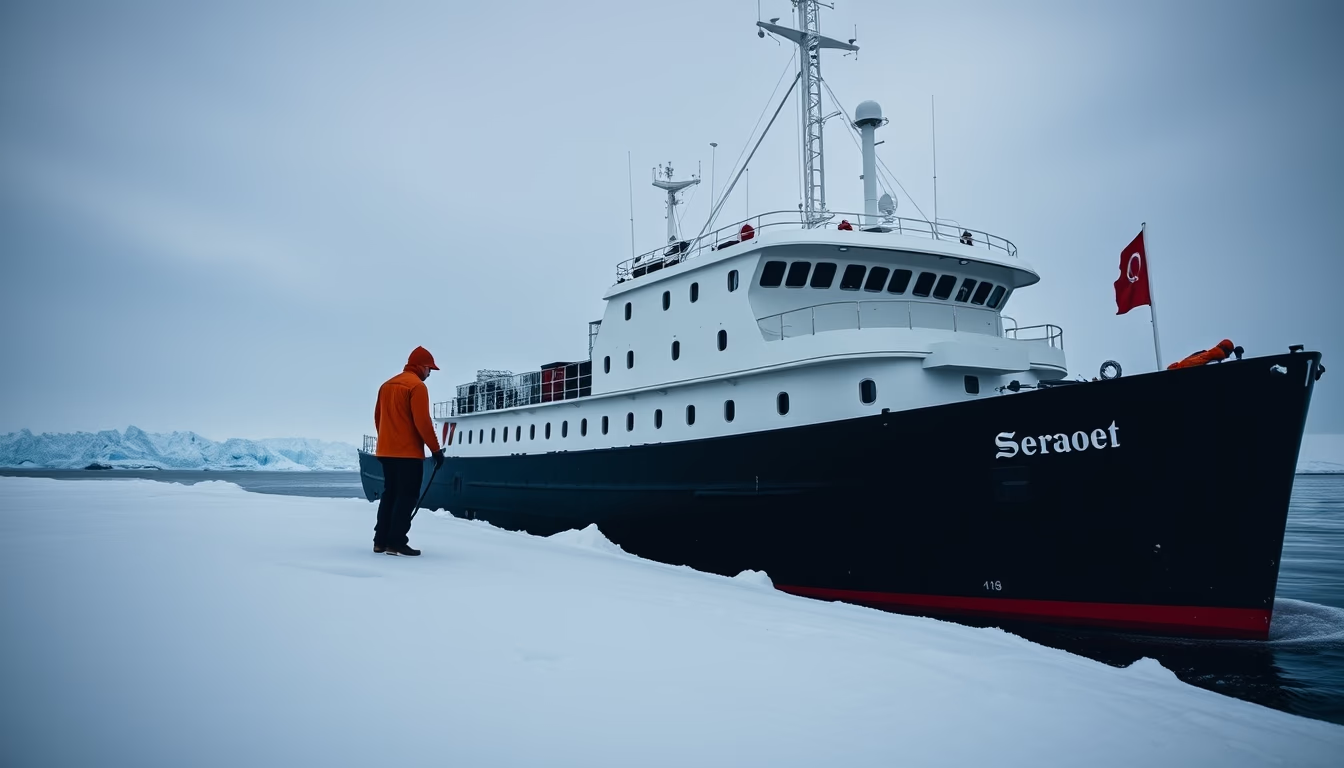
Icebreakers are specialized ships designed to navigate ice-covered waters, crucial for Arctic logistics and research.
About this subject
Icebreakers are vessels engineered to break sea ice, clearing paths for other ships or conducting scientific missions. They feature reinforced hulls, rounded bows, and powerful engines, allowing them to ride over ice and crush it under weight. Some models, like Russia's Arktika-class, are nuclear-powered, providing extended endurance in polar regions.
These ships are vital for supplying remote communities, research stations, and resource extraction in the Arctic. In winter, many Canadian and Russian ports rely on icebreakers to maintain shipping routes. They are also essential for climate research, as the Arctic warms four times faster than the global average.
The world's largest icebreaker, Arktika, launched in 2020, measures 173 meters and can break ice up to 2.8 meters thick. Russia operates a fleet of seven nuclear icebreakers, while countries like Canada, the U.S., and Finland deploy smaller diesel-powered ones. Performance is measured by continuous icebreaking capability and maneuverability in extreme conditions.
As sea ice melts, Arctic shipping routes (e.g., Northwest Passage) become more navigable, increasing demand for icebreaker escorts for commercial vessels. However, infrastructure gaps and environmental risks limit growth. New projects, such as the U.S. Polar Security Cutter, aim to modernize aging fleets to meet geopolitical and environmental challenges of the 21st century.
Frequently Asked Questions
How does an icebreaker break ice?
The ship uses its rounded bow shape and weight to ride up onto the ice, cracking it under pressure. The reinforced hull withstands impacts, and powerful engines provide continuous thrust.
What is the largest icebreaker in the world?
The largest icebreaker is Russia's Arktika, measuring 173 meters in length and nuclear-powered. It can break ice up to 2.8 meters thick.
Why are icebreakers important for climate research?
They enable access to remote polar regions for deploying sensors, collecting samples, and monitoring ice melt, providing crucial data for global climate models.
Direct URL
https://pub-c7d6a6ea828543ac903a74a341ccb2e1.r2.dev/imagens/icebreaker-arctic-ship-documentary-photography-p4.avifHow to credit
Include a visible link back to UtilizAí. Copy one of the snippets below:
<a href="https://xn--utiliza-eza.com/en/midia/imagens/icebreaker-arctic-ship-documentary-photography-p4">Icebreaker arctic ship</a> by <a href="https://xn--utiliza-eza.com">UtilizAí</a>, licensed under <a href="https://creativecommons.org/licenses/by/4.0/">CC BY 4.0</a>.
[Icebreaker arctic ship](https://xn--utiliza-eza.com/en/midia/imagens/icebreaker-arctic-ship-documentary-photography-p4) by [UtilizAí](https://xn--utiliza-eza.com), CC BY 4.0
License: CC-BY-4.0