Hieroglyphs egyptian wall
1344×768 · AVIF · CC BY 4.0
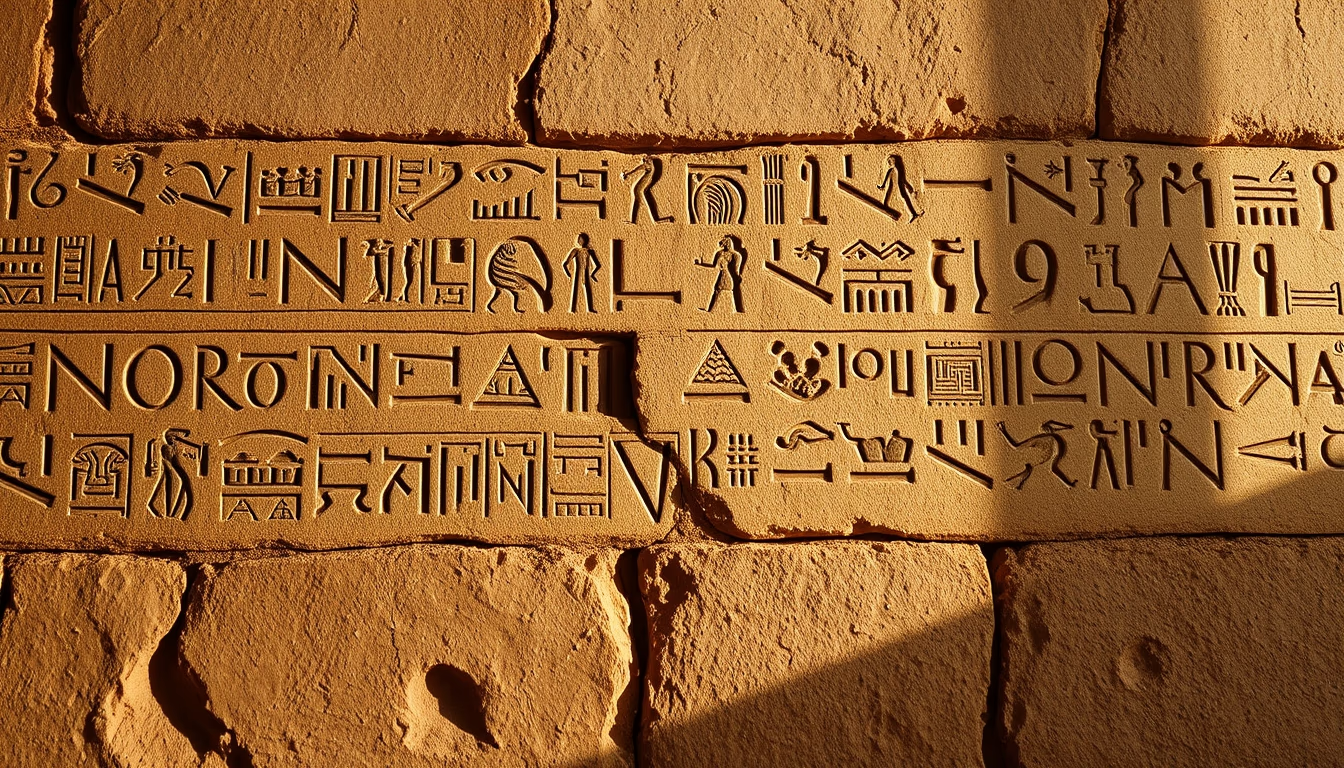
Egyptian hieroglyphs on temple and tomb walls narrate the history and religion of Ancient Egypt, with over 700 pictographic signs.
About this subject
Egyptian hieroglyphs are one of the world's oldest and longest-lasting writing systems, used for about 3,500 years from the Predynastic period (c. 3200 BCE) until the 4th century CE. They were carved or painted on the walls of temples, tombs, and monuments, primarily for religious, funerary, or commemorative purposes. Unlike cursive hieratic and demotic scripts, hieroglyphs retained their pictorial nature, combining logograms (signs representing words or ideas) and phonograms (signs representing sounds).
The decipherment of hieroglyphs became possible thanks to the Rosetta Stone, discovered in 1799, which contained the same text in Greek, Demotic, and hieroglyphs. French scholar Jean-François Champollion succeeded in decoding the system in 1822, realizing that hieroglyphs could represent both sounds and concepts. He also discovered that the reading direction is indicated by the orientation of the signs: when human or animal figures face right, the text reads from right to left; otherwise, from left to right.
Temple walls at Karnak, Luxor, and the Valley of the Kings are rich in hieroglyphic inscriptions describing offerings, battles, rituals, and the afterlife. Egyptian scribes, belonging to a privileged class, mastered the art of writing and used metal chisels and hammers to carve signs into stone. Colors also held meaning: black symbolized fertility and rebirth, while red represented chaos or the desert.
Today, over 700 hieroglyphs are catalogued, but the total number of variations over the centuries is estimated to have exceeded 5,000. Hieroglyphic writing continued even after the introduction of the Coptic alphabet derived from Greek; the last known inscription was carved at the Temple of Philae in 394 CE. The study of hieroglyphs is fundamental to Egyptology and reveals details about the society, economy, and beliefs of ancient Egypt.
Frequently Asked Questions
How were Egyptian hieroglyphs deciphered?
Decipherment became possible thanks to the Rosetta Stone, discovered in 1799, which contained the same text in Greek, Demotic, and hieroglyphs. Jean-François Champollion, in 1822, realized that hieroglyphs could represent both sounds and concepts, using knowledge of Greek and Coptic to translate the names of pharaohs like Ptolemy and Cleopatra.
How many hieroglyphs exist and how are they read?
There are over 700 known hieroglyphs, but the total number of variations exceeds 5,000. Reading direction can be from left to right or right to left, indicated by the direction human or animal figures face. Inscriptions are read from top to bottom in columns or from right to left in horizontal lines.
What is the difference between hieroglyphs, hieratic, and demotic?
Hieroglyphs are the formal, pictorial script used on monuments and tombs. Hieratic is a simplified cursive form used on papyrus for religious and administrative texts. Demotic is an even more abbreviated and popular version, emerging around 650 BCE, used for everyday documents. All three systems were used simultaneously in different contexts.
Direct URL
https://pub-c7d6a6ea828543ac903a74a341ccb2e1.r2.dev/imagens/hieroglyphs-egyptian-wall-magazine-editorial-fresh12.avifHow to credit
Include a visible link back to UtilizAí. Copy one of the snippets below:
<a href="https://xn--utiliza-eza.com/en/midia/imagens/hieroglyphs-egyptian-wall-magazine-editorial-fresh12">Hieroglyphs egyptian wall</a> by <a href="https://xn--utiliza-eza.com">UtilizAí</a>, licensed under <a href="https://creativecommons.org/licenses/by/4.0/">CC BY 4.0</a>.
[Hieroglyphs egyptian wall](https://xn--utiliza-eza.com/en/midia/imagens/hieroglyphs-egyptian-wall-magazine-editorial-fresh12) by [UtilizAí](https://xn--utiliza-eza.com), CC BY 4.0
License: CC-BY-4.0