Hieroglyphs egyptian wall
1344×768 · AVIF · CC BY 4.0
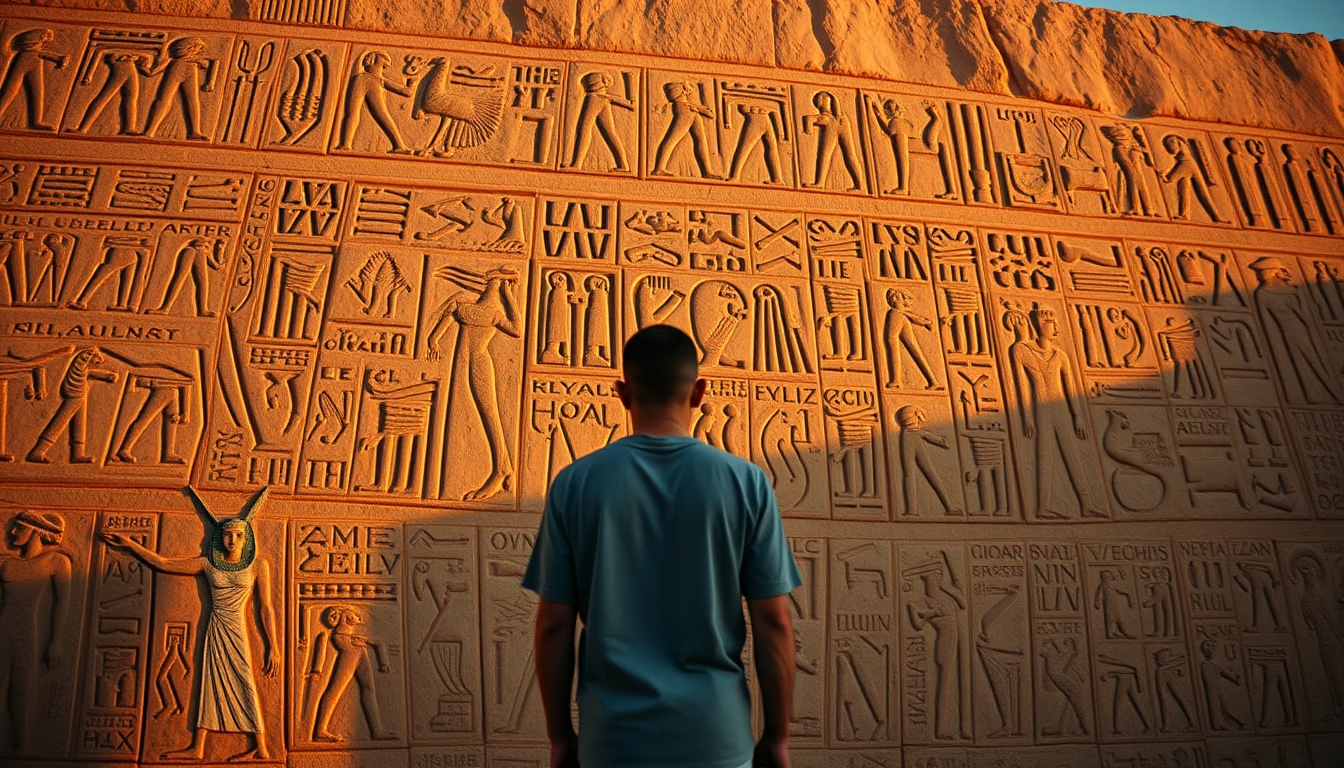
Egyptian hieroglyphs: the sacred writing that deciphered the history of one of the most fascinating ancient civilizations.
About this subject
Egyptian hieroglyphs are a writing system comprising hundreds of symbols that combine logographic and alphabetic elements. They emerged around 3200 BCE during the predynastic period and were used for over 3,500 years, until the end of the Roman era in Egypt. The word "hieroglyph" comes from the Greek "hieros" (sacred) and "glyphein" (to carve), reflecting their initial use on religious monuments and royal tombs.
Contrary to popular belief, hieroglyphs were not just picture writing. Each sign could represent an object, an idea, or a consonantal sound. There were about 1,000 different characters, but only about 100 were commonly used. The script could be read from right to left or left to right depending on the orientation of the symbols. Egyptians also developed two cursive variants: hieratic and demotic, used for everyday and administrative texts.
The decipherment of hieroglyphs was a milestone in Egyptology. The breakthrough came with the Rosetta Stone, discovered in 1799, which bore the same text in Greek, demotic, and hieroglyphs. Jean-François Champollion deciphered the system in 1822 by recognizing that hieroglyphs could have phonetic value, based on Coptic, the descendant language of ancient Egyptian. This achievement opened the door to understanding the history, religion, and culture of pharaonic Egypt.
Today, hieroglyphs continue to fascinate scholars and the public. Inscriptions on temples like Karnak and Luxor, as well as tombs in the Valley of the Kings, preserve accounts of pharaohs, rituals, and daily life. Studying hieroglyphs requires knowledge of Egyptian grammar, which includes determinatives (signs that aid interpretation) and a complex combination of uniliteral, biliteral, and triliteral signs. UNESCO recognizes hieroglyphic writing as an intangible cultural heritage of humanity.
Frequently Asked Questions
What was the importance of hieroglyphs for Egyptian civilization?
Hieroglyphs were the official script for religious, funerary, and monumental purposes. They recorded the history of pharaohs, myths, rituals, and administrative knowledge, essential for cultural cohesion and the power of the Egyptian state.
How did archaeologists decipher hieroglyphs?
The key was the Rosetta Stone, which contained a decree in three scripts: Greek, demotic, and hieroglyphic. Jean-François Champollion compared the texts and realized that hieroglyphs could represent sounds, using Coptic as a reference.
Are hieroglyphs still used today?
Not as a daily writing system. However, they are studied academically and reappear in cultural contexts such as decoration and symbolism. Coptic, derived from ancient Egyptian, is still used liturgically by the Coptic Orthodox Church.
Direct URL
https://pub-c7d6a6ea828543ac903a74a341ccb2e1.r2.dev/imagens/hieroglyphs-egyptian-wall-cinematic-wide-shot-fresh6.avifHow to credit
Include a visible link back to UtilizAí. Copy one of the snippets below:
<a href="https://xn--utiliza-eza.com/en/midia/imagens/hieroglyphs-egyptian-wall-cinematic-wide-shot-fresh6">Hieroglyphs egyptian wall</a> by <a href="https://xn--utiliza-eza.com">UtilizAí</a>, licensed under <a href="https://creativecommons.org/licenses/by/4.0/">CC BY 4.0</a>.
[Hieroglyphs egyptian wall](https://xn--utiliza-eza.com/en/midia/imagens/hieroglyphs-egyptian-wall-cinematic-wide-shot-fresh6) by [UtilizAí](https://xn--utiliza-eza.com), CC BY 4.0
License: CC-BY-4.0