Hangul korean ancient
1344×768 · AVIF · CC BY 4.0
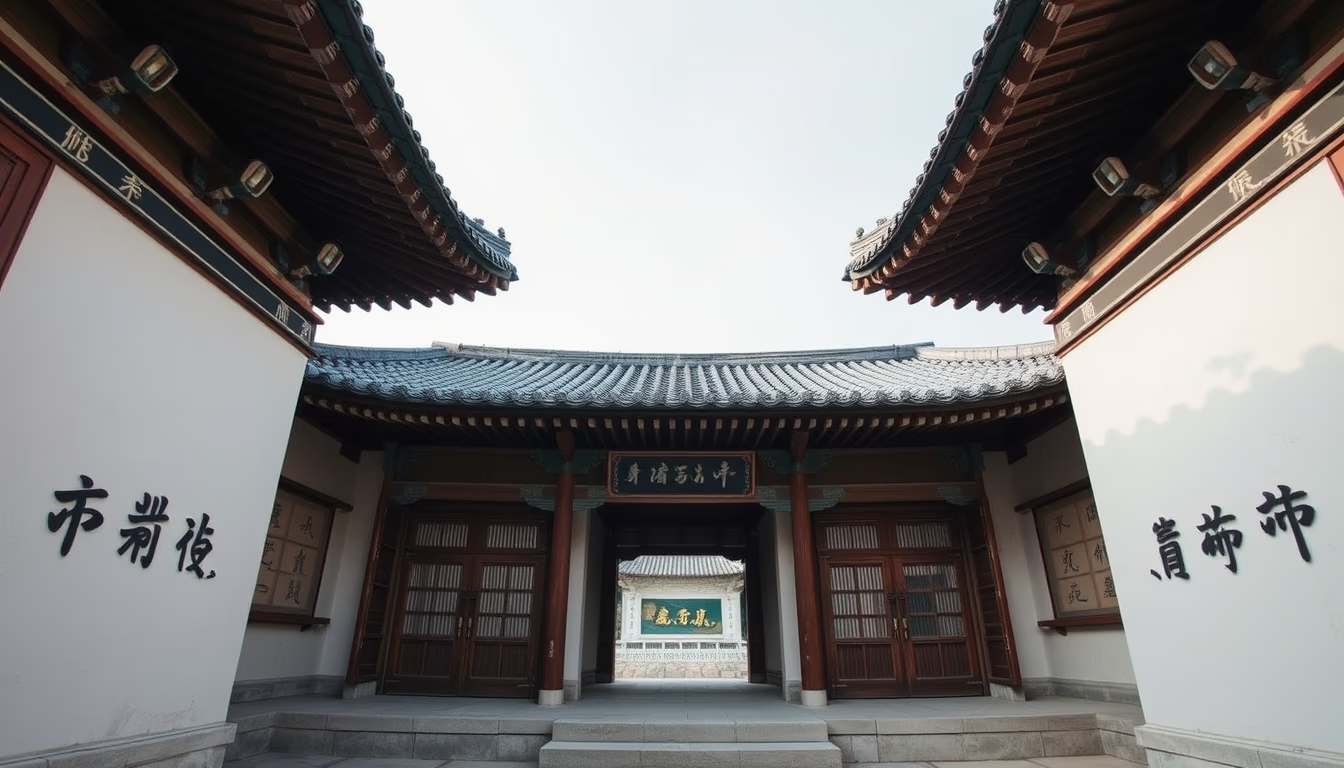
Hangul, the Korean alphabet created in the 15th century by King Sejong, is one of the world's most scientific writing systems, designed to promote popular literacy.
About this subject
Hangul was promulgated in 1446 by King Sejong the Great of the Joseon dynasty, aimed at providing a writing system accessible to all Koreans, unlike the complex Chinese characters (hanja) used by the elite. The alphabet originally consisted of 28 letters, now reduced to 24, and is famous for its phonetic basis: consonants mimic the shape of the vocal organs (tongue, lips, throat) during sound production, while vowels are composed of strokes representing heaven, earth, and humans, following Neo-Confucian principles.
The creation of Hangul is considered a landmark in linguistics for its rational and systematic approach. Unlike other alphabets that evolved organically, Hangul was deliberately invented by scholars under royal guidance. Its syllable structure groups letters into visual syllable blocks, making reading and writing easier. Modern studies show Hangul is extremely efficient for learning, contributing to the high literacy rates in both South and North Korea.
In ancient Korea, Hangul was often used in official documents, literature, and inscriptions on public buildings, temples, and tombs. Many of these historical inscriptions can still be seen in palaces like Gyeongbokgung and UNESCO World Heritage sites. Hangul calligraphy, appreciated as art, ranges from formal to cursive styles and is practiced today. The image accompanying this text likely captures one such inscription or an artistic representation of Hangul in an architectural context, highlighting its enduring presence in Korean culture.
Frequently Asked Questions
Why was Hangul created?
Hangul was created by King Sejong in 1443 to allow common Koreans to read and write easily, as the Chinese system (hanja) was complex and restricted to the elite.
What is the structure of Hangul?
Hangul is a phonetic alphabet with 14 basic consonants and 10 vowels. Letters are grouped into syllable blocks, each forming a visual syllable that typically combines a consonant, vowel, and optionally a final consonant.
Where can we see ancient inscriptions in Hangul?
Ancient Hangul inscriptions can be found in Korean palaces like Gyeongbokgung, Buddhist temples, and tombs from the Joseon dynasty, as well as in historical documents preserved in museums such as the National Museum of Korea.
Direct URL
https://pub-c7d6a6ea828543ac903a74a341ccb2e1.r2.dev/imagens/hangul-korean-ancient-architectural-photography-fresh11.avifHow to credit
Include a visible link back to UtilizAí. Copy one of the snippets below:
<a href="https://xn--utiliza-eza.com/en/midia/imagens/hangul-korean-ancient-architectural-photography-fresh11">Hangul korean ancient</a> by <a href="https://xn--utiliza-eza.com">UtilizAí</a>, licensed under <a href="https://creativecommons.org/licenses/by/4.0/">CC BY 4.0</a>.
[Hangul korean ancient](https://xn--utiliza-eza.com/en/midia/imagens/hangul-korean-ancient-architectural-photography-fresh11) by [UtilizAí](https://xn--utiliza-eza.com), CC BY 4.0
License: CC-BY-4.0