Fume hood chemistry
1344×768 · AVIF · CC BY 4.0
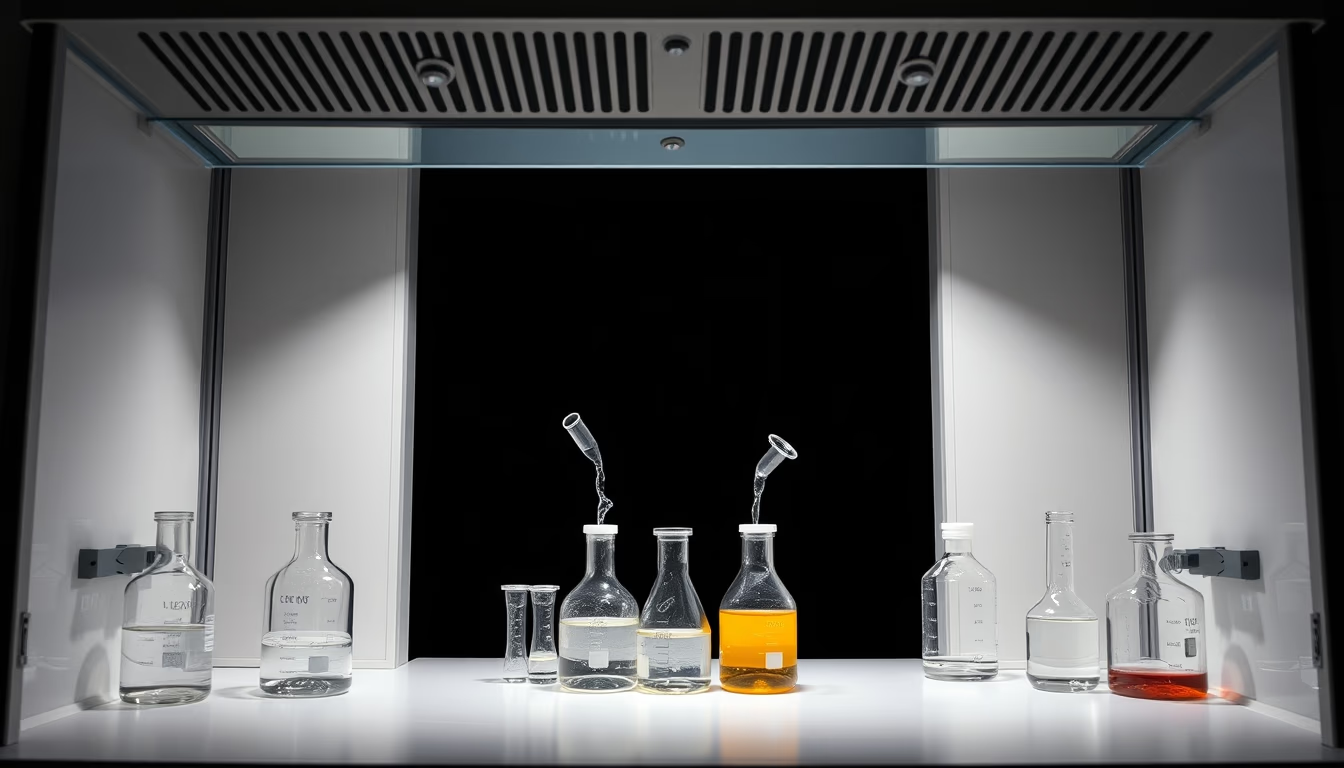
Fume hood for chemistry, essential laboratory equipment that protects users from toxic vapors and hazardous reactions.
About this subject
The chemical fume hood, also known as a laminar flow hood or safety cabinet, is one of the most important pieces of equipment in any laboratory handling volatile substances. Its operating principle relies on forced ventilation: a fan draws air from inside the cabinet, filtering it or exhausting it outside the building, preventing harmful gases, vapors, or particles from reaching the operator. Modern fume hoods feature airflow sensors, alarms, and tempered glass sashes that slide vertically for access. The history of this equipment dates back to the early 20th century, when chemists like Thomas Midgley Jr. began developing rudimentary ventilation systems to deal with substances such as tetraethyl lead. Today, fume hoods follow rigorous standards such as ANSI/ASHRAE 110 and Brazil's NBR 14570, which establish minimum face velocities (typically 0.5 m/s at the opening). In organic synthesis labs, the hood is used for reactions that release toxic gases, like thionyl chloride or concentrated sulfuric acid. Beyond personal protection, fume hoods prevent environmental contamination, maintaining air quality and preventing fires or explosions. Interestingly, not all hoods are the same: there are recirculating models (with HEPA and activated carbon filters) and ducted models that exhaust directly outside. Periodic maintenance, including filter replacement and airflow verification, is crucial for effectiveness.
Frequently Asked Questions
What is the difference between a fume hood and a biological safety cabinet?
A chemical fume hood protects the user from toxic vapors but does not protect the sample from external contamination. A biological safety cabinet (BSC) protects both user and sample using HEPA filtration and laminar flow. Fume hoods exhaust air outside; BSCs typically recirculate filtered air.
How often should I test the airflow of a fume hood?
Airflow should be verified annually by a qualified professional, per standards such as ANSI/ASHRAE 110. Additionally, a simple daily test with an anemometer or smoke tube is recommended before use to ensure the exhaust is working properly.
Can I use any fume hood for experiments with radioisotopes?
No. Experiments with radioactive materials require specific fume hoods with lead or stainless steel lining, HEPA absolute filters, and radiation monitoring. Common chemical fume hoods do not provide adequate shielding against ionizing radiation.
Direct URL
https://pub-c7d6a6ea828543ac903a74a341ccb2e1.r2.dev/imagens/fume-hood-chemistry-studio-still-life-fresh6.avifHow to credit
Include a visible link back to UtilizAí. Copy one of the snippets below:
<a href="https://xn--utiliza-eza.com/en/midia/imagens/fume-hood-chemistry-studio-still-life-fresh6">Fume hood chemistry</a> by <a href="https://xn--utiliza-eza.com">UtilizAí</a>, licensed under <a href="https://creativecommons.org/licenses/by/4.0/">CC BY 4.0</a>.
[Fume hood chemistry](https://xn--utiliza-eza.com/en/midia/imagens/fume-hood-chemistry-studio-still-life-fresh6) by [UtilizAí](https://xn--utiliza-eza.com), CC BY 4.0
License: CC-BY-4.0