Fume hood chemistry
1344×768 · AVIF · CC BY 4.0

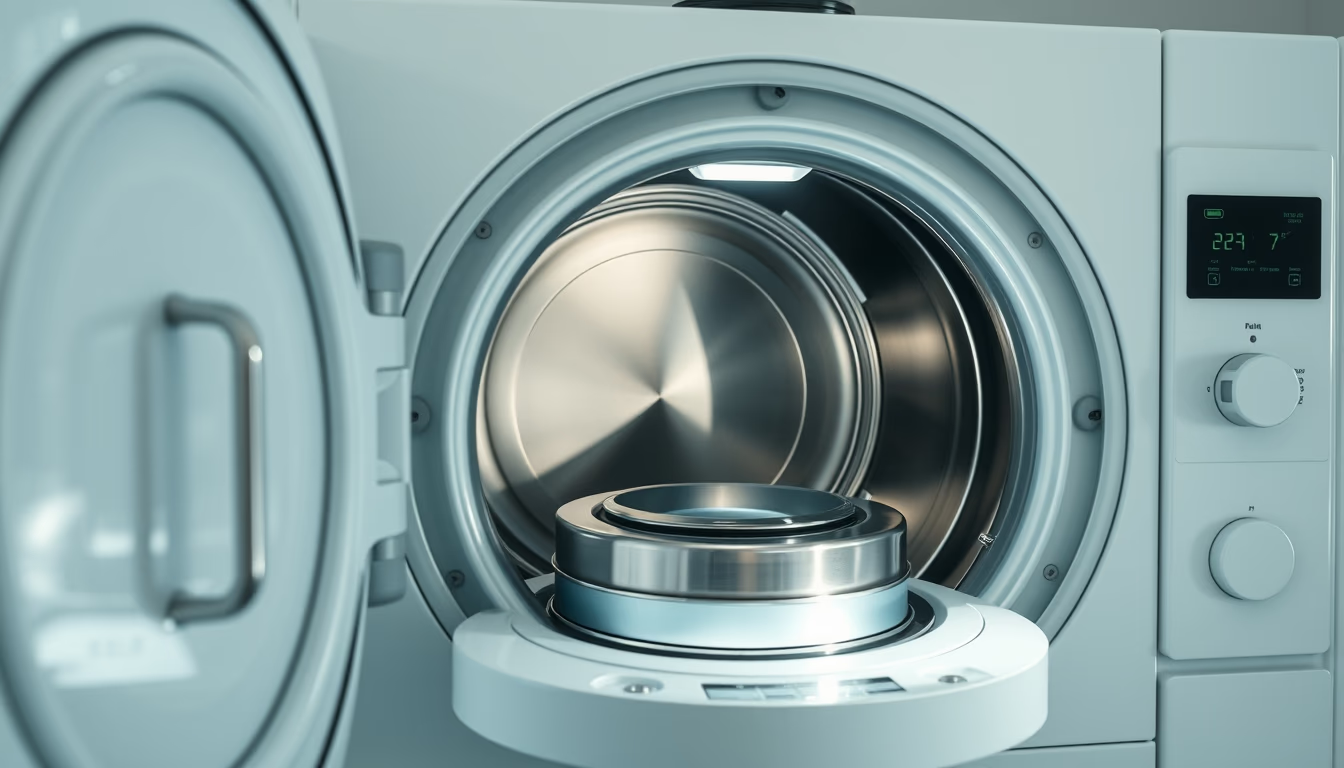
Chemical fume hood: essential safety equipment in laboratories, removing toxic vapors and protecting researchers.
About this subject
The chemical fume hood, also known as a laminar flow hood or simply fume hood, is one of the most critical safety devices in chemistry, biology, and pharmacy laboratories. Its primary purpose is to protect the user and the environment from inhaling hazardous gases, vapors, dusts, and aerosols generated during experiments. The working principle relies on forced exhaust of contaminated air to the outside of the building, passing through appropriate filters or being safely diluted. There are two main types: ducted (external exhaust) and ductless (recirculating, with activated carbon and HEPA filters). The former is more common in research and teaching labs. Standards like ASHRAE 110 and EN 14175 define performance tests for face velocity (typically 0.4, 0.6 m/s) and containment. Historically, the first fume hoods appeared in the 19th century as simple wooden boxes with glass fronts. Modern fume hoods feature digital controls, airflow sensors, explosion-proof lighting, and corrosion-resistant materials such as stainless steel and polypropylene. Regular maintenance is crucial: filters must be replaced per schedule, and airflow should be verified annually. In many countries, fume hoods are mandated by occupational safety regulations (e.g., OSHA, NR-9 in Brazil). A common misconception is that fume hoods are the same as biological safety cabinets (BSC); however, fume hoods only protect the user, while BSCs also protect the sample by using HEPA filtration to prevent cross-contamination.
Frequently Asked Questions
What is the difference between a chemical fume hood and a biological safety cabinet?
A fume hood only protects the user from toxic vapors, while a biological safety cabinet (BSC) protects both the user and the sample, using HEPA filters to retain microorganisms. BSCs are used in microbiology; fume hoods in chemistry.
What is the ideal air velocity at the fume hood opening?
The face velocity should be between 0.4 and 0.6 m/s, according to standards like ASHRAE 110. Too low compromises containment; too high can cause turbulence and spillage.
Should I use a fume hood even for experiments with non-toxic substances?
Yes, whenever there is a risk of releasing gases, vapors, or dusts. Many common solvents and reagents are harmful when inhaled. The fume hood is a safety barrier.
Direct URL
https://pub-c7d6a6ea828543ac903a74a341ccb2e1.r2.dev/imagens/fume-hood-chemistry-minimalist-composition-fresh17.avifHow to credit
Include a visible link back to UtilizAí. Copy one of the snippets below:
<a href="https://xn--utiliza-eza.com/en/midia/imagens/fume-hood-chemistry-minimalist-composition-fresh17">Fume hood chemistry</a> by <a href="https://xn--utiliza-eza.com">UtilizAí</a>, licensed under <a href="https://creativecommons.org/licenses/by/4.0/">CC BY 4.0</a>.
[Fume hood chemistry](https://xn--utiliza-eza.com/en/midia/imagens/fume-hood-chemistry-minimalist-composition-fresh17) by [UtilizAí](https://xn--utiliza-eza.com), CC BY 4.0
License: CC-BY-4.0