Ferry crossing strait
1344×768 · AVIF · CC BY 4.0
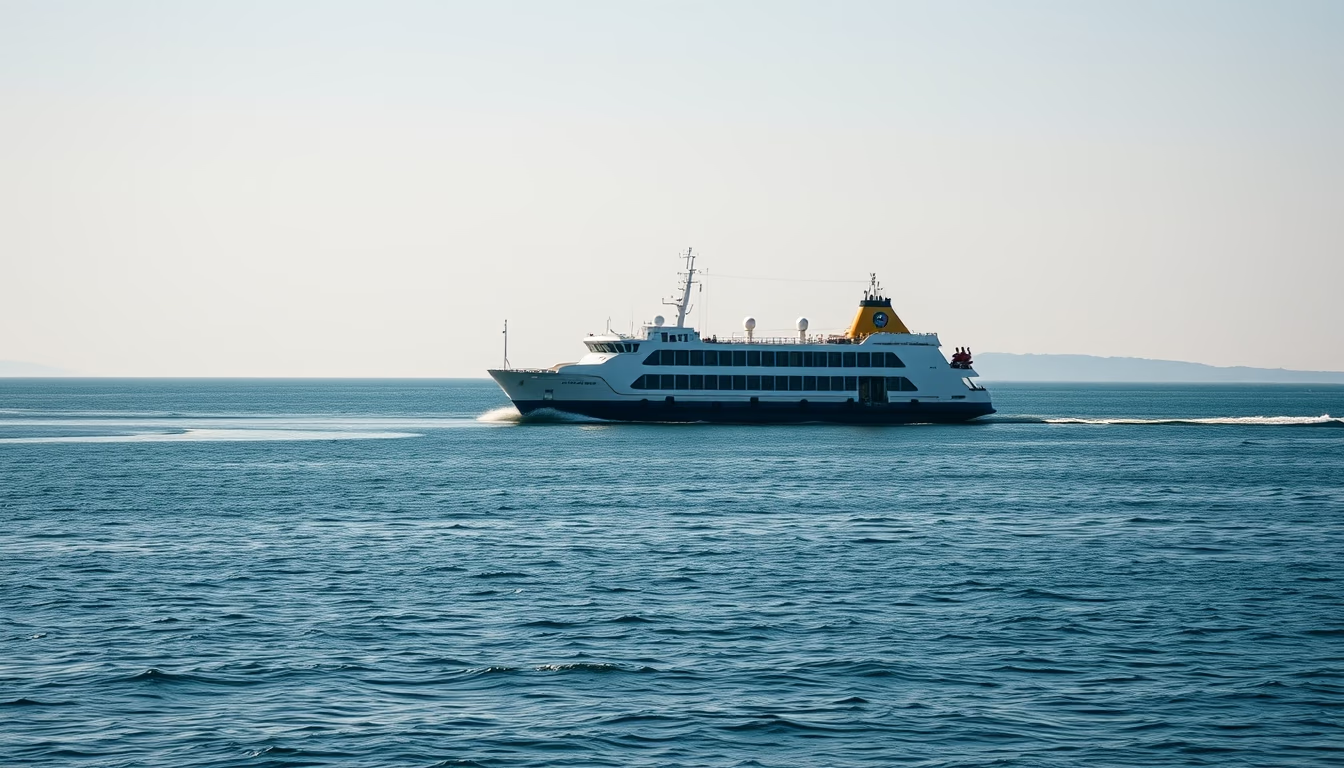
Ferry crossing strait connects shores, essential for maritime transport in coastal regions.
About this subject
Ferries crossing straits play a vital role in transporting passengers and vehicles between two landmasses separated by a narrow channel. These crossings are common in coastal regions where bridges or tunnels are economically or geographically unfeasible. A classic example is the Bosphorus Strait in Istanbul, where ferries carry thousands of people daily between the European and Asian continents. Similarly, the Strait of Dover, between England and France, is one of the busiest in the world, with ferry services connecting the UK to mainland Europe.
Operating ferries in straits requires robust vessels capable of handling strong currents, tides, and heavy maritime traffic. Many of these routes are served by roll-on/roll-off (ro-ro) ships, enabling quick loading and unloading of vehicles. Beyond passenger transport, these ferries are crucial for commerce, moving cargo that cannot be transported by air or road due to cost or logistical constraints. Crossing frequencies vary; some operate 24/7, especially in urban straits.
Historically, strait crossings by ferries date back centuries, evolving from rowboats to modern motorized vessels. They also hold tourist appeal, offering panoramic views and a unique crossing experience. However, they face challenges like adverse weather and collision risks, requiring strict safety and navigation protocols.
Interestingly, some ferry routes in straits are being replaced by bridges or tunnels, such as the Channel Tunnel under the English Channel, but many remain indispensable, particularly in densely populated or geographically complex areas.
Frequently Asked Questions
What is the difference between a ferry and a barge?
A ferry is a vessel designed to carry passengers and vehicles on scheduled services, while a barge is typically a flat-bottomed boat for transporting freight, often without its own propulsion.
How do ferries navigate strong currents in straits?
Ferries have powerful engines and advanced propulsion systems like controllable-pitch propellers and bow thrusters for precise maneuvering. Captains are trained to handle adverse conditions safely.
Which are the busiest straits for ferries?
The Strait of Dover (between France and England) and the Bosphorus Strait (Istanbul) are among the busiest, with hundreds of daily crossings. Others include the Strait of Messina (Italy) and the Strait of Gibraltar.
Direct URL
https://pub-c7d6a6ea828543ac903a74a341ccb2e1.r2.dev/imagens/ferry-crossing-strait-minimalist-composition-p6.avifHow to credit
Include a visible link back to UtilizAí. Copy one of the snippets below:
<a href="https://xn--utiliza-eza.com/en/midia/imagens/ferry-crossing-strait-minimalist-composition-p6">Ferry crossing strait</a> by <a href="https://xn--utiliza-eza.com">UtilizAí</a>, licensed under <a href="https://creativecommons.org/licenses/by/4.0/">CC BY 4.0</a>.
[Ferry crossing strait](https://xn--utiliza-eza.com/en/midia/imagens/ferry-crossing-strait-minimalist-composition-p6) by [UtilizAí](https://xn--utiliza-eza.com), CC BY 4.0
License: CC-BY-4.0